
Bio-organic Fertilizer Production: How to Configure a Complete Equipment System
In today’s global agricultural landscape, moving towards green and sustainable development, the market demand for bio-organic fertilizer continues to rise. However, transforming raw waste such as livestock manure and crop straw into standardized, high-efficiency commercial organic fertilizer is not a simple matter of piling and fermentation, but a systematic project relying on a scientific equipment system. From raw material intake to finished product output, each step requires specialized equipment support, and the rational configuration of the equipment directly determines production efficiency, cost, and the quality of the final product.
A complete bio-organic fertilizer production line typically follows five core process stages: “raw material pretreatment—fermentation and turning—granulation and molding—drying and screening—finished product packaging.” The equipment selection for each stage must be closely aligned with the characteristics of the raw materials and production capacity planning.
The first stage: Raw material pretreatment. This is the foundation for ensuring fermentation efficiency. Raw materials entering the plant often vary in form and require crushing equipment. For high-moisture livestock manure, a semi-wet material crusher is needed; for raw materials with high fiber content such as straw, a cage crusher is more suitable; and dried auxiliary materials can be processed using a chain crusher. The core objective is to crush the material to a uniform fineness, creating favorable contact conditions for the subsequent growth and reproduction of microorganisms.
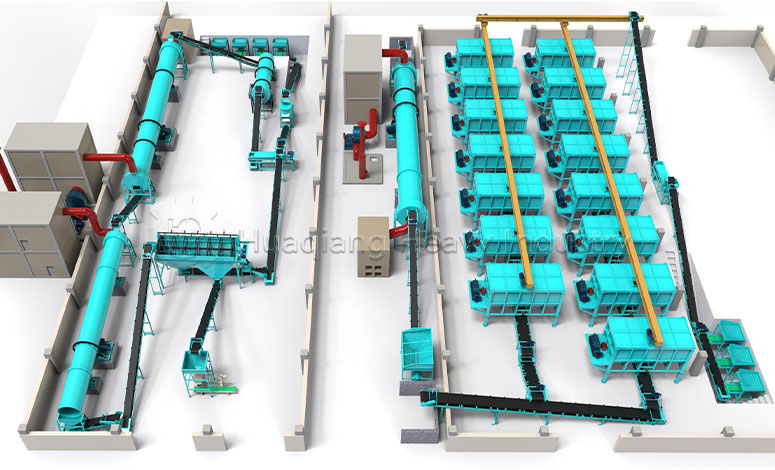
The second stage: Core fermentation. This is the “heart” of bio-organic fertilizer production and the key to determining fertilizer efficiency. The role of the fermentation turning equipment is to forcefully ventilate and oxygenate the pile through mechanical force, providing an optimal living environment for aerobic microorganisms. In large-scale production, large wheel-type turning machines are suitable for windrow fermentation in spacious areas, with a single unit capable of processing thousands of tons per day; while trough-type turning machines are more suitable for continuous operation within fermentation tanks, saving space. Regardless of the type of equipment, its core value lies in shortening the fermentation cycle from the traditional 60 days to 20-30 days, while thoroughly killing harmful bacteria and improving the maturity of the material.
The third stage: Granulation and post-processing. The fermented powdered material needs to be granulated to become a commercially viable product that is easy to store and apply. Disc granulators, due to their high granulation rate and intuitive operation, have become the mainstream choice in the market. The wet granules after granulation have a high moisture content and need to be dried in a rotary dryer, then graded and screened by a vibrating screen. Qualified granules enter the packaging stage, while unqualified granules are returned for regranulation to ensure that each fertilizer particle has a uniform size.
Auxiliary and Connecting Equipment. In addition to the core equipment mentioned above, an efficient production line also relies on the coordination of conveying equipment (such as belt conveyors), mixing equipment (such as horizontal mixers), and environmental dust removal equipment. Together, they form a closed-loop production line from raw materials to finished products.
The logic of equipment configuration is not static but follows the principle of “tailored to specific needs.” For small production lines with an annual output of 10,000-30,000 tons, the configuration should focus on practicality, with key processes requiring mechanization. For large-scale bases with an annual output of over 100,000 tons, an intelligent control system is needed to achieve fully automated and precise control from batching to packaging.
In conclusion, the production of bio-organic fertilizer is a concerto of microorganisms and machinery. A scientific equipment configuration system can not only transform waste into resources, but also win the market with standardized quality, providing a solid material guarantee for the healthy improvement of soils worldwide.
The comprehensive overview highlights the critical role of a tailored equipment system. The initial raw material preparation relies on a range of fertilizer raw material processing machinery and equipment. A half-wet material crusher machine is essential for tackling high-moisture manure, while a chain crusher efficiently handles drier, harder lumps. For achieving a finer, more uniform grind, a cage crusher is the optimal choice. After successful fermentation, the material progresses to the granulation stage, which is central to any bio organic fertilizer production line. The organic fertilizer granulator series offers various technologies, with a complete organic fertilizer disc granulation production line being a popular and effective method for creating premium spherical granules. This integrated approach—from the specialized crushing of diverse feedstocks using equipment like the half-wet material crusher machine to the final shaping in an organic fertilizer disc granulation production line—transforms raw waste into a consistent, high-value, and market-ready bio-organic fertilizer product.