
Chain Crusher: The “Heavy Metal Drummer” for Sticky, Wet Fertilizer Raw Materials?
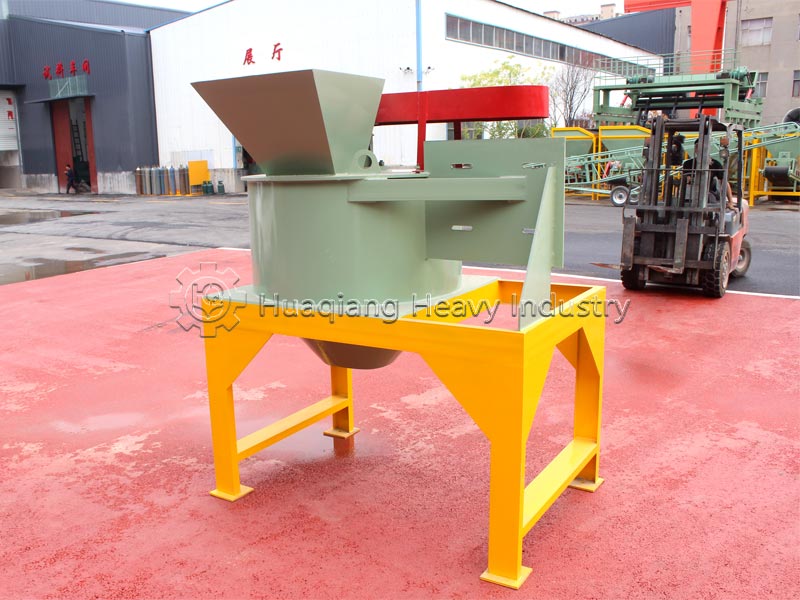
On the pre-processing stage of fertilizer production, when raw materials are damp, sticky, and prone to tangling, traditional cage crushers often struggle with clogging and inefficiency. It is here that a unique crushing device stands out with its robust yet agile operation—the chain crusher. Like a powerful heavy metal drummer, it uses high-speed rotating chains as its drumsticks to thoroughly “deconstruct” troublesome materials, clearing obstacles for downstream processes.
Core Advantages: Combining Force with Flexibility, Specializing in Stubborn Materials
The design philosophy of the chain crusher lies in using flexible impact force to tackle rigid crushing challenges, excelling particularly at processing high-moisture, high-fiber organic materials.
Unrivaled Anti-Clogging Capability
Its core working components are multiple high-toughness alloy chains suspended from a rotor. When rotating at high speed, the chains form a dense, flexible curtain of impact. Confronting easily tangled straw, filter cake, manure, or damp lumpy materials, the flailing action of the chains effectively “tears apart” rather than “compresses” the material, preventing fiber wrapping and cavity buildup, enabling continuous, stable operation even under harsh conditions.
Exceptional Adaptability to Wet Materials
For materials with moisture content as high as 30%-50%, many crushing devices see a sharp drop in efficiency. The chain crusher relies on the kinetic energy impact of the chains for crushing, making it far less sensitive to material moisture than devices based on compression and shear. It can effectively break down damp lumps into smaller, loose particles, making it an ideal choice for pre-composting treatment and for handling returned materials or wet substrates in organic fertilizer production lines.
Simple Structure & Easy Maintenance
The main wear parts are the chains themselves, which are simple and quick to replace, requiring no complex recalibration. The crushing chamber often has no screen or uses a large-aperture grid plate, providing ample flow-through space. This further minimizes blockage risks and significantly reduces daily cleaning and maintenance efforts.
Synergistic Production: The “Game-Changer” in Organic Fertilizer Lines
In the field of organic and bio-fertilizer production, the chain crusher often plays the role of a “game-changer” in the pre-processing stage, working in close concert with upstream and downstream equipment.
Synergy with “Feeders”: Receives raw mixed materials (e.g., mixtures of livestock manure and straw) from apron or uniform feeder, performing primary coarse crushing to break up large crusts and cut long fibers.
Pre-processing for “Fermentation”: Crushes materials to an appropriate particle size, dramatically increasing the specific surface area of the material. This allows for full contact with microorganisms and air (or anaerobic conditions) in fermentation trenches or tanks, significantly improving fermentation speed and uniformity.
Linkage with “Horizontal Mixers”: The crushed material is then uniformly mixed with microbial agents and conditioners. The crushed physical state ensures mixing homogeneity.
Handling “Post-Drying Lumps”: After fertilizer drying, some products may cake due to moisture regain. The chain crusher can perform gentle breaking to restore product looseness before conveying to screening and packaging equipment.
Evolution & Outlook: The Art of Impact, More Efficient and Intelligent
With technological advancements, the chain crusher is also evolving, pursuing better performance and user experience:
Rotor Dynamics Optimization: Computer simulation optimizes rotor structure and chain distribution, reducing energy consumption and unbalanced vibration while maintaining crushing power, resulting in smoother operation.
Wear Resistance Upgrade: Chain materials are advancing towards special alloys and composite wear-resistant materials. Replaceable wear liners are added at key points to extend the service life of core components.
Intelligent Monitoring: Installation of vibration sensors and temperature monitoring points allows for real-time tracking of rotor balance and bearing temperature, enabling predictive maintenance to prevent unplanned downtime.
Conclusion
In summary, with its unique flexible-chain crushing principle, exceptional anti-clogging characteristics, and strong adaptability to wet, sticky materials, the chain crusher has secured its special niche in organic waste recycling and fertilizer production. It is more than just a simple crusher; it is key problem-solving equipment that ensures the smooth operation of entire organic fertilizer lines by overcoming challenging raw materials. In today’s growing era of circular agriculture and organic farming, this efficient “drummer” is playing an indispensable and solid overture for the production of high-quality organic fertilizers.