


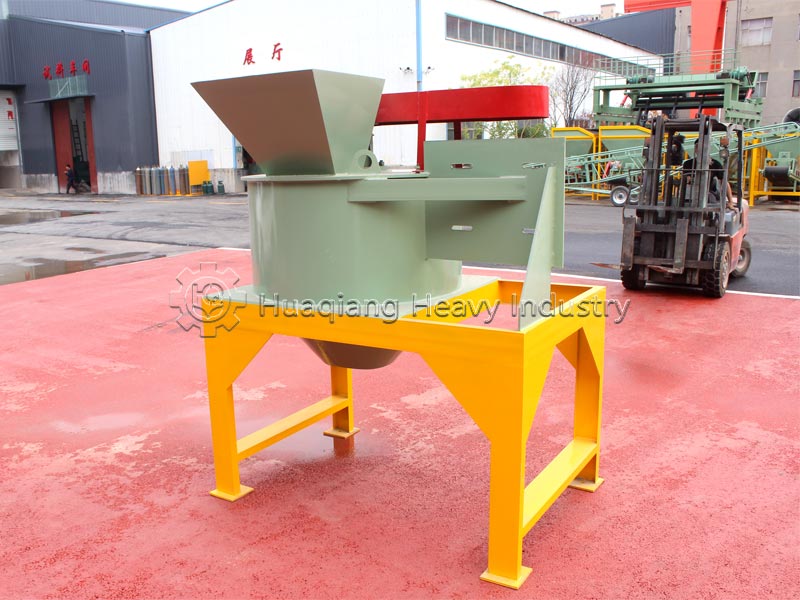

Equipment Introduction
The chain crusher is one of the most commonly used crushing equipment in the compound fertilizer industry, belonging to the impact crusher category. It employs high-strength, wear-resistant hard alloy chains and hammers rotating at synchronous speeds. The high-speed rotating chain repeatedly impacts, squeezes, and grinds the material, crushing lumpy materials into fine powder or small particles.
This equipment is highly adaptable to materials with high moisture content, is not prone to clogging, and ensures smooth feeding. It can crush undried phosphate fertilizers containing water and free acid, as well as various compound fertilizer products, overcoming the shortcomings of traditional crushers that are prone to sticking to the walls and clogging.
Equipment Structure
The chain crusher mainly consists of the following components:
| Component | Function Description |
|---|---|
| Lower Frame | Machine base, mounted on concrete foundation and fixed by anchor bolts. |
| Machine Housing | Enclosed crushing chamber. Lined with rubber plates or protective liners to prevent material sticking and steel‑plate wear. |
| Main Shaft & Upper‑Lower Bearing Housings | Main shaft supported by self‑aligning bearings on upper and lower bearing housings; serves as the core transmission part. |
| Rotor Disk | Installed on main shaft, drives chains for high‑speed rotation. |
| Chains & Hammer Heads / Hammer Blades | One end of each link chain connects to rotor, the other end is fitted with wear‑resistant steel chain heads; hammer blades assist fine crushing. |
| Motor Bracket & Transmission Assembly | Power drives main shaft via coupling sleeve. Horizontal dual‑rotors are independently driven by separate motors. |
| Feeding Hopper | Located on top of housing for uniform material feeding. |
| Access Door / Inspection Hatch | Quick‑open inspection hatches on both housing sides for easy cleaning, observation and maintenance. |
Structural Features: Horizontal double rotor design, with the rotors enclosed within the machine body; easy cleaning can be achieved by opening the side covers; vibration dampers are installed at the bottom of the base to reduce operating vibration and noise.
Working Principle of the Equipment
The chain crusher adopts the “impact-type” crushing principle:
- Material Input: The material enters the high-speed rotating crushing chamber through the upper feed inlet.
- Initial Impact: During its descent, the material first violently impacts the wear-resistant chain rotating at synchronous speed.
- Rebound Crushing: After being impacted, the material gains kinetic energy and rushes at high speed against the inner wall of the machine casing. After rebounding, it bounces back and undergoes secondary or even multiple impacts with the chain or hammers.
- Compression Crushing: During the high-frequency impact and mutual compression between materials, the material is rapidly crushed into powder or fine particles, which are discharged from the bottom.
Raw Material Requirements for the Equipment
The chain crusher can process the following types of raw materials:
| Raw Material Type | Specific Materials |
|---|---|
| Fertilizer Raw Materials | Single superphosphate, heavy calcium, phosphate fertilizer, nitric phosphate, urea, compound fertilizer lumps, over‑size returned materials |
| Organic Raw Materials | Fermented lump organic fertilizer, livestock manure lumps, sludge lumps |
| Chemical Raw Materials | Medium‑hard lumpy chemical materials |
| Mineral Raw Materials | Ore, coal lumps, limestone, shale and other medium‑hard materials |
Feed Requirements:
- Maximum feed particle size: ≤60mm (Huaqiang LP series)
- Particle size after crushing: <0.7mm (can reach below 3mm, adjustable by increasing or decreasing the number of chains; when the chain is full, it can crush to below 1mm)
- Material moisture content: Can adapt to higher moisture content (some models can reach 50%), less prone to clogging.
Equipment operation and maintenance methods
| Operation Phase | Specific Content | Standards & Notes |
|---|---|---|
| Foundation Installation | Install equipment on horizontal concrete foundation, fix with anchor bolts | Foundation shall be horizontal; bolts shall be fastened tightly |
| Foundation Installation | Ensure verticality between main unit and horizontal plane during installation | Verticality of main body shall meet requirements |
| Installation Inspection | Check for loose bolts at all positions and tightness of main unit door | Tighten any loose bolts |
| Electrical Configuration | Arrange power cables and control switches according to equipment power | Cable specification shall match equipment power |
| Commissioning Acceptance | Perform no‑load test run (3‑5 min). Start production after normal test‑run | No‑load test run for 3‑5 minutes |
| Pre‑start Preparation | Fully check chain tightness (avoid excessive slack or tension) | Moderate chain tightness |
| Pre‑start Preparation | Inspect wear condition of hammer blades | Replace heavily worn blades |
| Pre‑start Preparation | Check lubrication status of bearings | Bearings shall be well‑lubricated |
| Pre‑start Preparation | Remove hard foreign objects such as metal blocks and stones from materials | Prevent damage to blades and equipment |
| Pre‑start Preparation | Confirm all protective devices are intact; operators shall wear protective gear | Safety protection shall be in place |
| Pre‑start Preparation | Run no‑load for 3‑5 minutes, confirm no abnormality before loaded operation | No‑load test run for 3‑5 minutes |
| In‑operation | Adopt uniform & continuous feeding; avoid one‑time heavy feeding | Feed uniformly and continuously |
| In‑operation | Keep watch all the time, monitor motor temperature | Motor temperature shall not exceed 75℃ |
| In‑operation | Keep watch all the time, monitor bearing temperature | Bearing temperature shall be lower than 60℃ |
| In‑operation | Adjust rotating speed, sieve aperture and other parameters according to material properties | Parameters shall match material characteristics |
| In‑operation | Prohibit putting hands or tools into feeding inlet while equipment is running | Safe operation; violation is forbidden |
| Post‑shutdown Operation | Stop feeding first; cut off main power after residual material is fully discharged | Stop feeding before shutdown |
| Post‑shutdown Operation | Clean residual material inside equipment after power‑off | Keep interior of equipment clean |
| Post‑shutdown Operation | Check wear of chains and hammer blades; check for loose bearings | Daily inspection for wear and looseness |
| Bearing Lubrication | Apply grease once per shift | Once per shift |
| Bearing Lubrication | Grease model: No.3 lithium‑based grease | Model: No.3 lithium‑based grease |
| Bearing Lubrication | Fill grease to 1/3‑1/2 volume; replace periodically | Fill 1/3‑1/2, replace on schedule |
| Bearing Lubrication | Injected grease must be clean with good sealing performance | Grease clean, sealing in good condition |
| Chain Inspection | Open access door before shift; check severe wear of fixed‑chain bolts and pin shafts | Inspect before each shift |
| Chain Inspection | Replace when wear loss exceeds 1/3 of original diameter | Replacement standard: wear>1/3 diameter |
| Chain Inspection | Sag of chain middle‑lower section shall keep 20‑30 mm | Sag: 20‑30 mm |
| Wear‑part Replacement | Check wear level of vulnerable parts frequently; replace damaged parts timely | Inspect frequently, replace timely |
| Wear‑part Replacement | Single‑plate replacement for worn chain links, low cost | Single‑plate replaceable |
| Long‑term Shutdown Maintenance | Clean all residual materials and apply anti‑rust oil if idle more than 15 days | Maintenance required when idle>15 days |
| Long‑term Shutdown Maintenance | Anti‑rust oil coating parts: chains, liners and other metal components | Coat metal components |
| Long‑term Shutdown Maintenance | Release chain tension to 20 mm to avoid permanent deformation caused by long‑term tension | Release tension to 20 mm |
| Regular Tightening | New‑installed chains tend to get loose; check frequently | Frequent inspection for new chains |
| Regular Tightening | Tighten anchor bolts every month | Frequency: once per month |
Application of the Equipment in the Production Line
- In a fertilizer production line, the chain crusher is typically located in the following process stages:
Raw material storage → Batching and metering → Chain crusher → Mixing and stirring → Granulation → Drying → Cooling → Screening → Packaging
- Core Functions:
1) Raw material pretreatment: Crushing large pieces of fertilizer raw materials (such as superphosphate and heavy calcium carbonate blocks) to the fineness required for granulation;
2) Return material crushing: Re-crushing large particles after screening for recycling;
3) Shortening the process: Directly processing undried, moisture-containing materials, eliminating the pre-drying step;
4) Protecting downstream equipment: Preventing large pieces of material from entering the granulator and causing equipment damage.
Target Users of the Equipment
Chain crushers are primarily intended for the following user groups:
- Compound fertilizer/blended fertilizer manufacturers: processing granular compound fertilizers, superphosphate, heavy calcium carbonate, phosphate fertilizers, and other lumpy raw materials and returned materials;
- Organic fertilizer manufacturers: crushing fermented lumpy organic materials;
- Phosphate fertilizer/chemical fertilizer raw material processing plants: processing phosphate fertilizer raw materials containing water and free acids;
- Chemical enterprises: crushing medium-hardness lumpy chemical raw materials;
- Building materials and mining enterprises: processing ores, coal lumps, and other medium-hardness materials;
- Environmental treatment enterprises: crushing and processing organic waste from waste and sewage treatment plants.
Common problems and solutions
| Inspection Item | Inspection Standard | Handling Method |
|---|---|---|
| Raw Material Moisture | Moisture content shall be ≤15% | Dry materials before crushing; reduce feeding speed if moisture is too high |
| Feeding Size | Feed size shall meet equipment requirements; oversized materials are not allowed | Remove large lumps first; adjust feeding method or install pre‑screening device |
| Feeding Uniformity | Feed continuously and evenly; avoid sudden overload | Use variable‑speed feeder; adjust gate opening and feeding frequency |
| Current & Load | Motor current shall not exceed rated value | Reduce feeding amount immediately; stop machine if overload persists |
| Bearing Temperature | Bearing temperature shall be ≤60℃ | Stop machine to check lubrication; replenish or replace grease |
| Motor Temperature | Motor surface temperature shall be ≤75℃ | Check voltage, cooling fan and operating load; reduce continuous operation time if necessary |
| Vibration Condition | No abnormal vibration or loose foundation | Check anchor bolts, rotor balance and bearing condition; tighten or replace parts |
| Noise Condition | No abnormal impact noise or metal collision sound | Stop machine and check for foreign objects, loose blades or damaged rotors |
| Discharge Particle Size | Finished particle size shall meet process requirements | Check screen mesh, hammer blade wear and chain condition; replace or adjust as needed |
| Lubrication Condition | Lubrication shall be sufficient and grease shall not be deteriorated | Clean bearings; refill with No.3 lithium‑based grease |
| Bolt Tightness | All bolts shall be fastened without looseness | Tighten loose bolts; replace severely corroded or damaged bolts |
| Sealing Condition | Machine door, access hatch and seals shall be tight | Adjust door gap; replace sealing strips if damaged |
| Electrical System | Cables, switches and motors shall operate normally | Check wiring, insulation and control switches; repair or replace faulty components |
| Safety Protection | Protective covers, guards and emergency stop shall be intact | Restore missing guards; test emergency stop function before operation |
Have Any Problem? Please, Contact
Integrity
Adhere to honesty and trustworthiness, be responsible to customers, employees, partners, and society, and establish long-term trust relationships.
Win win
Establish win-win relationships with all stakeholders such as customers, suppliers, and employees to share the fruits of enterprise development.