


Equipment Introduction
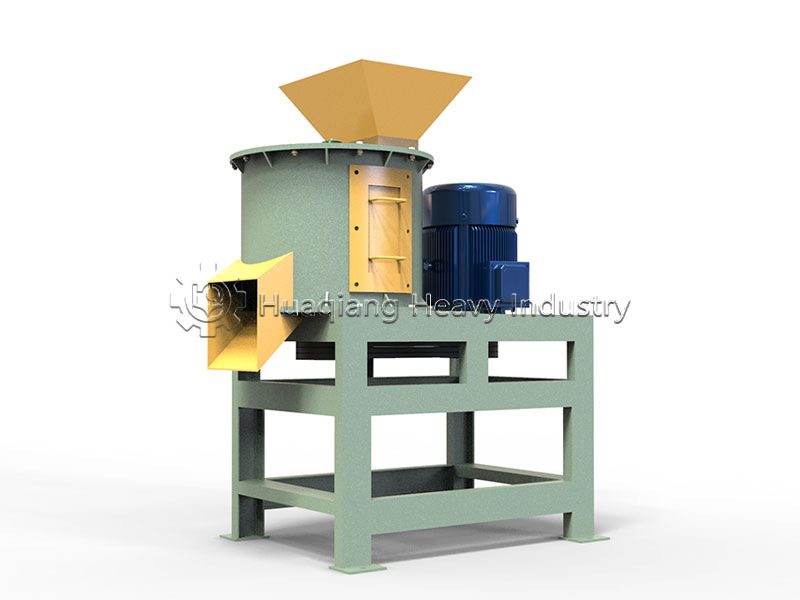
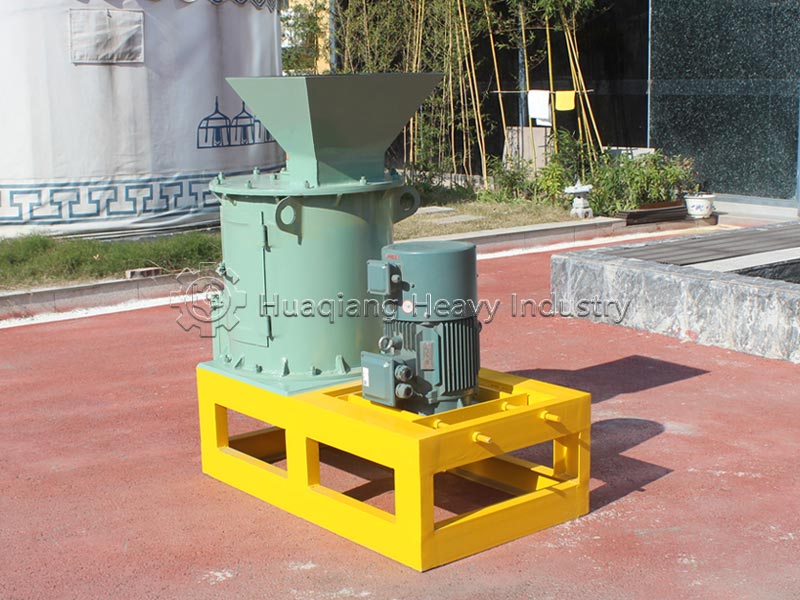
The half-wet material crusher, also known in the industry as a double-stage screenless crusher or a high-moisture organic fertilizer crusher, is a specialized impact-shear fine crushing equipment developed for high-moisture, high-fiber organic materials. It has been patented and fundamentally solves the industry pain points of traditional hammer crushers and cage crushers, such as screen clogging, cavity sticking, and drastic capacity reduction caused by wet materials.
Core Positioning and Classification
- Model Classification
1) Single-stage half-wet crusher: Suitable for small workshops and small-capacity pre-processing, with a single rotor and single-layer blades;
2) Double-stage double-layer half-wet crusher (market mainstream): Features a double-rotor, double-layer crushing structure connected in series, with crushing efficiency twice that of the single-stage model. Suitable for large-scale organic fertilizer production lines. The Huaqiang Heavy Industry BSFS series is the standard representative model;
3) Stainless steel corrosion-resistant model: For processing salty, acidic sludge and fermented kitchen materials.
- Core Key Features: The machine features a screenless, screen-bottom-free design, eliminating the problem of wet materials clogging the screen plates; it is suitable for high-moisture materials with a moisture content of 25%~55%, allowing for continuous crushing without pre-drying; the double-layer rotor composite crushing mechanism combines impact, shearing, and material feeding mechanisms, resulting in outstanding cutting performance for fibrous materials.
- Key Differentiation from Cage Crusher
| Equipment | Applicable Moisture Content | Core Materials | Structure | Limitations |
|---|---|---|---|---|
| Semi-wet Material Crusher | 25%~55% | Livestock & Poultry Manure, Mushroom Residue, Straw, Sludge (high-moisture & high-fiber materials) | Double-layer series-connected rotors, blades / hammer pieces | Not suitable for dry and hard agglomerated chemical fertilizers |
| Cage Crusher | ≤12% | Urea, Ammonium Phosphate, Dry Mineral Slag (brittle materials) | Concentric counter-rotating double-cage steel rods | High-moisture materials are extremely prone to adhesion and blockage |
Core Advantages of the Equipment:
- Screen-bottom-free anti-clogging design ensures continuous operation with high-moisture materials without jamming, preventing engine stalling and motor burnout;
- Double-layer, double-stage crushing provides a large crushing ratio and uniform output particle size (adjustable from 0.5~5mm);
- High-alloy wear-resistant blades with shifting and gap adjustment technology extend the service life of vulnerable parts by 3 times;
- Enclosed casing with a dust collection interface ensures controllable dust;
- No pre-drying treatment is required, shortening the organic fertilizer process and reducing investment in supporting equipment;
- Single-person operation with a hydraulically opened cover structure for convenient internal cleaning and maintenance. III. III.Equipment Limitations
- Not suitable for high-hardness ores or large, hard, agglomerated fertilizers;
- Long-fiber materials are prone to slight entanglement with the rotor, requiring pre-screening and segmentation;
- Blade wear accelerates when processing high-mud and sandy materials.
The structure of the equipment
The half-wet material crusher is mainly composed of the following four parts. Each part works together to ensure the stable operation of the equipment in a high-humidity environment:
- Rack part
The frame is the load-bearing foundation of the entire equipment. It is welded with high-quality carbon steel plates and channel steel. After strict product certification and specific process requirements, it has sufficient rigidity and stability to withstand the impact load and vibration generated during the crushing process. The normal operation of all machinery is inseparable from solid frame support.
- Rotor broken part
This is the core working component of the equipment. It adopts an upper and lower double-layer rotor blade (double-stage rotor) structural design. The rotor has a novel structure and reasonable design. After the material enters the crushing chamber from the feed port, it is initially crushed into fine particles by the upper rotor, and then transported to the lower rotor for further crushing into fine powder, achieving the best crushing effect of “material powder, hammer powder”. The crushing effect is twice that of other similar products. The upper and lower double-layer blade crushing system cooperates with the crushing plate to continuously grind the materials to meet the particle size requirements required for granulation.
- Breaking plate adjustment device
By adjusting the distance between the crushing plate and the rotor blade, the fineness and output of the crushed material can be flexibly controlled. The gap between the hammer head and the tooth tip of the crushing plate is usually 1.5 times the maximum discharge particle size. This adjustable structure allows the equipment to adapt to production scenarios with different raw materials and different particle size requirements.
- Transmission connection part
Using a flexible belt transmission system, the motor drives the pulleys and belts to directly transmit power to the main shaft, causing the main shaft to rotate at high speed to achieve the crushing effect. The flexible transmission design has a certain overload protection capability. When encountering unbreakable hard objects or excessive instantaneous load, the belt slippage can be used to protect the motor and spindle from damage.
In addition, some high-end models are also equipped with a centralized oil injection and lubrication system, which can inject lubricating oil without stopping the equipment during normal operation, further improving maintenance efficiency.
Working Principle of the Equipment
The half-wet material crusher adopts a composite crushing mechanism of “impact + shearing + grinding.” Its core workflow is as follows:
- Material Input and Pre-distribution: High-moisture materials enter the crushing chamber through the feed inlet. Some models are equipped with a spiral feeding device to evenly control the feeding speed and prevent material accumulation. The special design of the feed inlet allows for smooth material entry and reduces wall adhesion.
- Two-Stage Rotor Crushing (Core Process): The equipment adopts a two-stage rotor design connected in series. Both rotors rotate at high speed simultaneously:
Upper Rotor: Performs initial impact crushing on large pieces of material, tearing them into smaller particles;
Lower Rotor: Further crushes the initially crushed material, grinding it into fine powder.
After being crushed by the upper rotor in the machine cavity, the material is immediately further crushed by the hammers of the rapidly rotating lower rotor. The materials in the cavity collide and crush each other, achieving the effect of “hammer-to-material and material-to-material.”
- Screenless Discharge Mechanism
The biggest difference from traditional crushers is that this half-wet material crusher does not have a screen or sieve bottom. The crushed material is discharged directly from the outlet under centrifugal force. Qualified fine powder is discharged promptly, while unqualified coarse material continues to circulate and be crushed within the chamber. Because there is no screen, wet material will not adhere to the screen holes and cause blockages; even highly viscous materials can pass through smoothly.
- Particle Size Control Mechanism
The discharge particle size is controlled by adjusting the gap between the hammers and the liner (crushing plate) using bidirectional gap adjustment technology. When the hammers wear down, no repair is needed; simply moving the hammers allows for continued use. Adjusting the gap between the hammers and the liner controls the material particle size, making operation simple.
Raw Materials for the Equipment
The half-wet material crusher can process over a hundred types of raw materials, mainly including:
| Raw Material Category | Specific Materials |
|---|---|
| Livestock & Poultry Manure | Chicken manure, pig manure, cow manure, sheep manure, duck manure, etc. |
| Agricultural Wastes | Straw, rice husk, sawdust, turf, peat, mushroom residue, bagasse, etc. |
| Food Processing Residues | Mushroom dregs, herbal residues, distiller’s grains, sugar residues, fruit & vegetable residues, soybean dregs, etc. |
| Domestic Waste | Kitchen waste, garden waste, urban organic sludge, etc. |
| Industrial Organic Materials | Sodium humate, humic acid, organic chemical raw materials, etc. |
| Impurity-containing Materials | Organic materials mixed with hard impurities such as glass, ceramics, bricks, gravel, etc. |
- Raw Material Moisture Content Requirements: This equipment allows for a moisture content of 25%–50% (some sources indicate 25%–55%) in bio-fermented organic fertilizer materials. High-efficiency crushing can be achieved within this moisture content range without clogging due to wet material crushing. Even materials freshly retrieved from water can be crushed.
- Feed Particle Size Requirements: Generally, it can process large pieces of material ranging from 200–800mm, depending on the specific machine configuration.
Equipment Applications
- Organic Fertilizer Granule Production Line Pretreatment: Fermented and decomposed organic materials are finely crushed, resulting in uniform particle size for easy mixing with nitrogen, phosphorus, and potassium inorganic fertilizers. This improves the granulation rate of disc/extrusion granulation and reduces residual material loss.
- Composting Secondary Fermentation Section: Large pieces of decomposed material are crushed, increasing the specific surface area, accelerating microbial fermentation, and shortening the decomposition cycle.
- Livestock and Poultry Manure Resource Utilization Project: Manure from livestock farms is directly crushed after fermentation, eliminating the drying process and reducing the energy consumption and equipment investment of the entire production line.
- Urban Organic Solid Waste Treatment Station: Kitchen waste, garden waste, and municipal sludge are crushed after fermentation to produce organic nutrient soil and substrate fertilizer.
- Microbial Fertilizer and Bio-organic Fertilizer Processing Plant: Microbial residue and fermented organic matter are finely crushed to ensure uniform dispersion of microorganisms and improve fertilizer quality.
Equipment operation and maintenance methods
| No. | Specification Module | Core Requirements | Notes |
|---|---|---|---|
| 1 | Installation Requirements | 1. Standard factory configuration: Semi-wet material crusher main body (machine frame, rotor assembly), main motor (pulley), V-belt accessories 2. Installation foundation: Install under guidance of manufacturer technicians or design according to drawings 3. Installation standard: Machine levelness, anchor bolts tightened; motor and main shaft pulley on the same plane with moderate belt tension | Ensure firm installation foundation; avoid abnormal operation caused by improper installation |
| 2 | Pre-start Inspection (Daily Mandatory) | 1. Bolt inspection: Check tightness of all bolts, focus on rotor parts, bearing seats and frame connecting bolts 2. Lubrication inspection: Confirm oil level of bearing seats and reducer; check lubrication system status 3. Transmission inspection: Check tension and wear condition of pulleys and V-belts 4. Cavity inspection: Clear foreign objects and residual materials inside crushing cavity 5. Raw material inspection: Confirm raw material moisture within allowable range of 25%~55% 6. Feed inlet inspection: Ensure smooth inlet without blockage | Complete all inspections before startup; strictly prohibit direct startup without inspection |
| 3 | Operating Procedures | 1. Startup sequence: Start main motor first; feed materials only after stable no-load operation. Startup with materials is forbidden 2. Operation monitoring: Listen to equipment noise, observe ammeter readings, check abnormal vibration and temperature rise during operation 3. Feeding control: Uniform continuous feeding; feeding speed shall match rated output; overload feeding prohibited 4. Rotation direction: Check main shaft rotation after startup; stop immediately for adjustment if reversed 5. Shutdown sequence: Stop feeding first; shut down main motor only after crushing cavity is emptied. Shutdown with materials forbidden | Feeding before startup easily causes motor overload and irreversible equipment damage; operation sequence must be strictly followed |
| 4 | Lubrication & Maintenance | 1. Before operation: Supplement grease and confirm all lubrication points are normal before production 2. Main shaft bearing housing: Replace grease every three months 3. Centralized lubrication system (if equipped): Oil filling can be carried out during machine operation without shutdown 4. Auxiliary components: Add grease regularly to motor bearings, pulley bearings per manufacturer requirements | Inadequate lubrication maintenance will greatly shorten service life; implement maintenance strictly on schedule |
Equipment Application in the Production Line
- Core Position in the Organic Fertilizer Production Line
The half-wet material crusher is the core crushing equipment in the organic fertilizer production line. It plays a crucial role in the complete organic fertilizer production line process, connecting the fermentation and batching/granulation stages.
The complete processing flow is:
Livestock manure mixed with straw → High-temperature composting by a turning machine → Belt conveyor to the half-wet material crusher for crushing and refining → Fine powder conveyed to a mixing device for adding trace elements → Granulation/direct powdering → Drying → Screening → Packaging
- Process Position in the Production Line
The half-wet material crusher is a dedicated pre-treatment stage, located in the core stage “after solid-liquid separation and before mixing and adjustment.” The specific process connection is:
Solid-liquid separation → half-wet material crusher → Mixing and adjustment → Subsequent processing
- Powdered Organic Fertilizer Production Line
The powdered organic fertilizer production line configuration includes:
Organic fertilizer turning machine → Loader → Quantitative feeder → Crusher → Screening machine (drum screen or vibrating screen)
The equipment needs to be connected by belt conveyors.
- Granular Organic Fertilizer Production Line
The granular organic fertilizer production line adds crushing, granulation, drying, and cooling stages to the powder production line:
Forklift → Compost Turner → Quantitative Feeding Vibrating Silo → Crusher → Drum Screen → Belt Conveyor → Mixer → Organic Fertilizer Granulator → Drum Dryer → Drum Cooler → Packaging Machine
Common Equipment Faults and Solutions
| Fault No. | Fault Phenomenon | Root Causes | Solutions | Long-term Preventive Measures |
|---|---|---|---|---|
| 1 | Feed inlet blockage, materials cannot enter crushing cavity; accumulated materials at inlet cause intermittent feeding and overload alarm | 1. Material moisture exceeds 65%; high viscosity leads to adhesion and bridging at feed inlet 2. Hard impurities such as stones and metal blocks mixed in raw materials block feeding channel 3. Excessively fast feeding rate beyond equipment processing capacity | 1. Stop feeding immediately, clean blocked materials at feed inlet, dredge material bridging 2. Adjust feeding speed; install frequency converter to match production capacity 3. Control raw material moisture at 30%~60%; mix 5%~10% dry base materials for sticky materials 4. Install grid and magnetic separator at feed inlet to remove metal impurities | 1. Strictly implement raw material pretreatment standards, control moisture and impurity content 2. Stabilize feeding volume to avoid sudden large feeding quantity 3. Check inlet smoothness before startup every day |
| 2 | Abnormal vibration of crusher; obvious jitter during operation; irregular metal collision noise; frame shaking | 1. Hammers/blades loose or falling off, causing rotor unbalance 2. Bearing wear / excessive clearance resulting in rotor eccentricity 3. Hard foreign materials entering cavity leading to uneven rotor stress | 1. Stop machine for inspection; open inspection door to check fastening bolts of hammers, tighten to 20–40N·m torque, add anti-loosening washers 2. Rotate rotor manually to check jamming; clear foreign hard objects and fragments inside cavity 3. Replace severely worn blades and conduct rotor dynamic balance calibration | 1. Inspect wear status of hammers/blades daily, replace worn parts timely 2. Install magnetic separator at feeding end; prohibit hard foreign materials from entering 3. Check bearing grease monthly and replace in a timely manner |
| 3 | Output drops, crushing efficiency declines obviously; equipment capacity far below rated value, hourly output greatly reduced | 1. Severe wear of hammers/blades; gap between hammer and liner exceeds 5mm, poor crushing effect 2. Belt slipping causes drop of rotor rotating speed 3. Excessive material accumulation inside crushing cavity reduces effective crushing space | 1. Measure gap between hammer and liner; standard gap 1–3mm; adjust gasket to narrow clearance 2. Adjust belt tension; standard sag 10–15mm under pressure 3. Clean accumulated materials inside cavity; thoroughly clean machine weekly 4. After each batch, idle machine for 30s to discharge residual materials by centrifugal force | 1. Check blade wear daily, adjust or replace on time 2. Regularly inspect belt tension and aging status 3. Control raw material moisture to reduce material adhesion |
| 4 | Crushed material particle size fails to meet requirements; finished materials too coarse or over-fine, out of specification | 1. Severe wear of hammers/blades reduces crushing capacity 2. Too large / too small gap between hammer and liner causes uneven particle size 3. Rotating speed too high / too low affects particle size distribution | 1. For coarse particles: Replace worn hammers/blades or reduce rotating speed to narrow crushing clearance 2. For over-fine materials: Appropriately increase rotating speed or widen crushing clearance 3. Keep consistent gap between hammer and liner to ensure uniform crushing | 1. Check hammer blade wear and clearance weekly 2. Match rotating speed according to process requirements; forbid random parameter adjustment |
| 5 | Motor overheating, overload shutdown; motor housing hot, temperature alarm, overload trip | 1. Excessive load, too much accumulated materials inside crushing cavity leading to heavy motor operation 2. Motor fan damaged or blocked resulting in poor heat dissipation 3. Unstable power supply voltage causes abnormal motor current | 1. Stop feeding immediately, clear materials inside cavity, reduce feeding volume to stabilize load 2. Inspect motor fan and cooling air duct; clean dust with compressed air 3. Check cable and contactor conditions; install voltage stabilizer if voltage fluctuates 4. If continuous operation exceeds 4 hours, idle for 30 minutes for cooling | 1. Avoid long-term heavy-load operation; stabilize feeding speed 2. Clean motor fan and air duct monthly, check ventilation status 3. Monitor voltage fluctuation and stabilize power supply |
| 6 | Abnormal equipment vibration; frame vibrates severely during operation; anchor bolts loose | 1. Rotor unbalance, uneven blade wear or mismatched new & old blades 2. Loose equipment anchor bolts 3. Uneven material feeding causing eccentric load 4. Hammers/blades broken leading to asymmetric stress | 1. Stop machine for inspection; perform rotor dynamic balance calibration or replace mismatched blades 2. Tighten all anchor bolts and connecting bolts of frame 3. Rectify feeding offset; adjust feeder to ensure uniform central feeding 4. Replace damaged hammers/blades immediately | 1. Conduct regular rotor balance inspection; avoid mixed use of new and old blades 2. Check tightness of anchor bolts and frame connecting parts daily 3. Stabilize feeding volume to prevent material offset |
| 7 | Metal collision noise inside crusher; continuous harsh metallic sound during operation | 1. Metal/hard impurities enter crushing cavity and collide with blades/liner plates 2. Loose hammer pieces/blades scrape against frame or liner plates | 1. Stop machine immediately; open inspection door to clear metal and hard debris 2. Check fastening status of hammers/blades; replace severely worn or damaged accessories 3. Inspect liner plates; replace deformed or fractured liners timely | 1. Install magnetic separator and grid at feeding port; strictly block metal and hard sundries 2. Inspect hammer and liner status daily to prevent collision damage 3. Stop operation promptly once abnormal noise occurs |
Equipment demand group
| No. | Target User Group | Core Application Scenarios |
|---|---|---|
| 1 | Organic Fertilizer Production Enterprises | Bio-organic fertilizer, organic-inorganic compound fertilizer, and BB fertilizer production lines, used for crushing materials before fermentation and providing raw material fineness for fertilizer production. |
| 2 | Large-scale Livestock and Poultry Farms | Large-scale pig farms, chicken farms, cattle farms, sheep farms, etc., crush manure and organic waste to reduce moisture and facilitate subsequent composting and organic fertilizer conversion. |
| 3 | Agricultural Planting Cooperatives and Family Farms | Used for straw returning, livestock manure treatment, and on-farm organic fertilizer making, improving resource utilization efficiency and soil fertility. |
| 4 | Environmental Protection and Waste Treatment Enterprises | Suitable for municipal sludge treatment, domestic waste treatment, and industrial organic material treatment, providing efficient crushing capacity for resource recycling. |
| 5 | Food, Chemical and Fermentation Enterprises | Sauce factories, vinegar factories, pharmaceutical factories, edible fungus factories, etc., used for treating distiller’s grains, mushroom residues, medicine residues and other organic residues. |
| 6 | Gardens and Municipal Departments | Used for treating garden branches, fallen leaves, and pruning waste, providing raw materials for landscaping organic mulch and composting. |
Have Any Problem? Please, Contact
Integrity
Adhere to honesty and trustworthiness, be responsible to customers, employees, partners, and society, and establish long-term trust relationships.
Win win
Establish win-win relationships with all stakeholders such as customers, suppliers, and employees to share the fruits of enterprise development.