
Why Bio-Organic Fertilizer Production Lines Are Winning Hearts in Modern Agriculture
In the global wave of agricultural transformation, bio-organic fertilizer production line are gaining unprecedented favor among farmers and investors. This is not merely a choice of production equipment but a profound shift in agricultural philosophy. What exactly makes these complex mechanical systems the new darling of modern agriculture?
The Efficiency Revolution: A Fast Track from Waste to Treasure
Imagine converting organic waste such as livestock manure, crop straw, and food processing residues into high-quality fertilizer. Traditional composting takes months, while modern bio-organic fertilizer production lines require only weeks. This leap in efficiency is the primary reason attracting numerous users.
Key Efficiency Data:
Processing capacity increased by over 300%
Fermentation cycle shortened to 15-25 days
Labor demand reduced by 60-80%
Space utilization improved by 200%
Quality Assurance: The Scientific Appeal of Standardized Production
In an olive grove in Tuscany, Italy, farmer Marco shares his experience: “We used to rely on traditional composting with inconsistent quality. Since installing a complete bio-organic fertilizer production line, every batch has been stable and reliable, significantly improving soil enhancement.”
This quality stability stems from the production line’s precise control:
Intelligent Fermentation System: Precisely controls temperature, humidity, and aeration
Automated Granulation Equipment: Ensures uniform granules with controlled release rates
Closed-Loop Quality Monitoring: Full traceability from raw materials to finished products
Economic Benefits: The Wisdom of Investment Returns
A large farm in Iowa, USA, conducted a detailed economic analysis: investing $1.2 million in a bio-organic fertilizer production line paid for itself within three years through:
Fertilizer Self-Sufficiency: Annual savings of $350,000 on chemical fertilizer purchases
Waste Conversion: Converting farming waste into salable products, increasing annual income by $250,000
Soil Improvement: Crop yields increased by 18%, with quality improvements commanding premium prices
Carbon Credit Trading: Participating in carbon emission trading, earning $80,000 annually
Equipment Synergy: The Appeal of Integrated Solutions
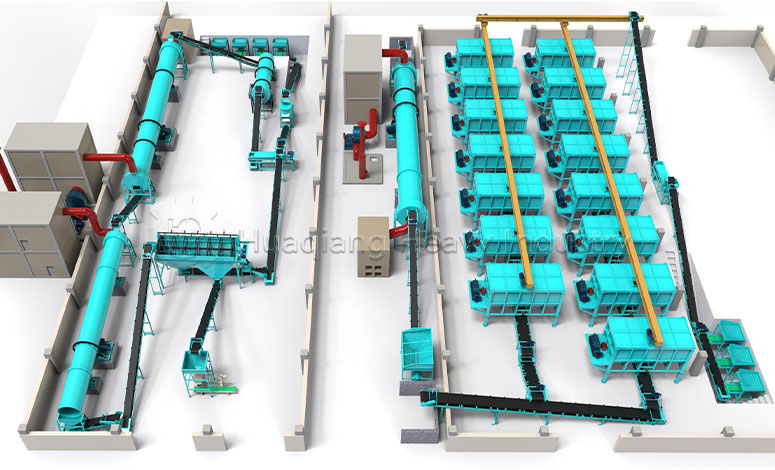
The popularity of bio-organic fertilizer production lines lies in their nature as complete solutions rather than single machines:
Core Equipment Combination:
Preprocessing System: Crushers, sorters, mixers
Fermentation System: windrow composting machine, fermentation tanks, temperature control devices
Post-processing System: new type two in one organic fertilizer granulator, dryers, coolers, screening machines
Packaging and Storage: Automatic packagers, storage systems
Anna, an organic farmer in Bavaria, Germany, notes: “We initially bought only a turner but soon realized we needed a complete production line. The current system, with all equipment working in synergy, is three times more efficient than standalone machines.”
Global Success Stories: Diverse Application Scenarios
Dutch Greenhouse Agriculture Revolution
In modern Dutch greenhouses, small modular bio-organic fertilizer production lines convert pruning residues and nutrient solution waste into specialized fertilizers. This circular system increases water use efficiency by 40% and reduces fertilizer costs by 30%.
Chinese Eco-Agricultural Park
An eco-agricultural park in Zhejiang uses a medium-sized production line to process manure from surrounding livestock farms and crop straw. Producing 20,000 tons of organic fertilizer annually, it not only solves environmental pollution but also generates $5 million in annual output value.
Australian Arid Region Innovation
In South Australia’s arid regions, farmers use solar-powered mobile fertilizer production lines to convert sparse vegetation and animal manure into water-retaining organic fertilizers, significantly improving soil water-holding capacity.