
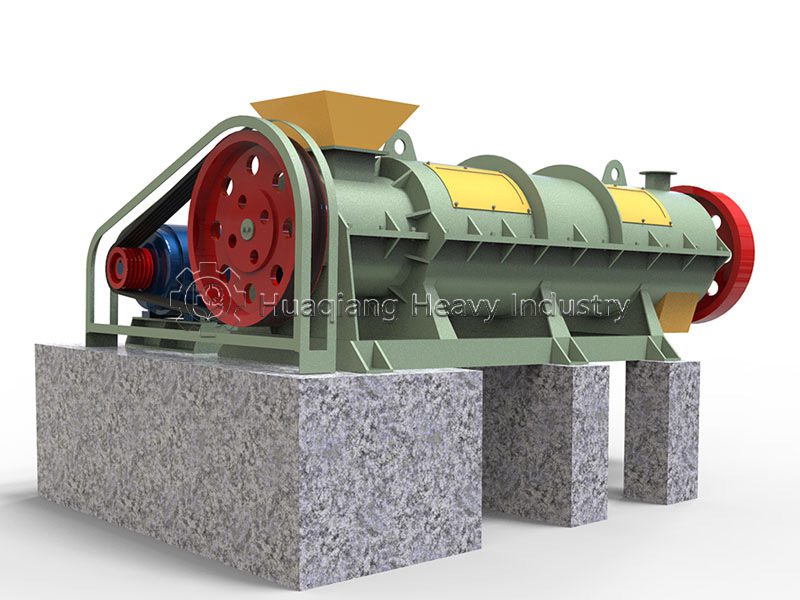
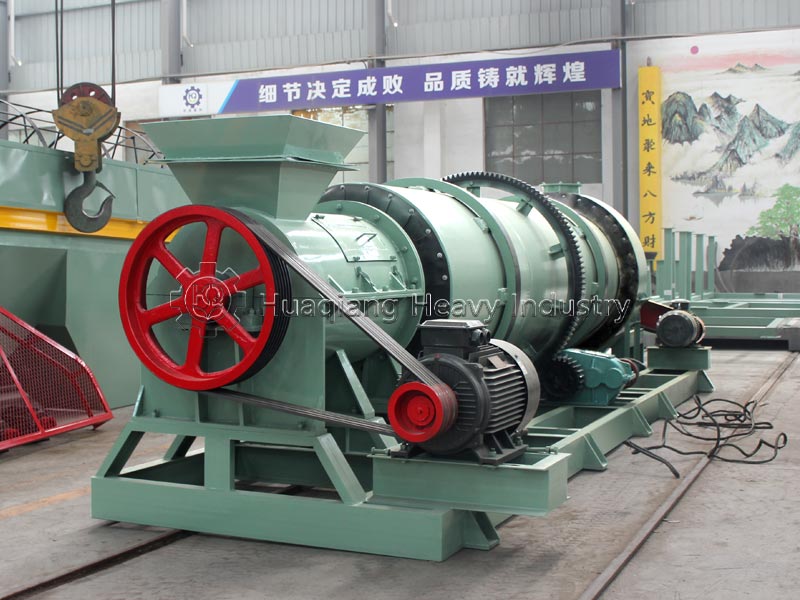

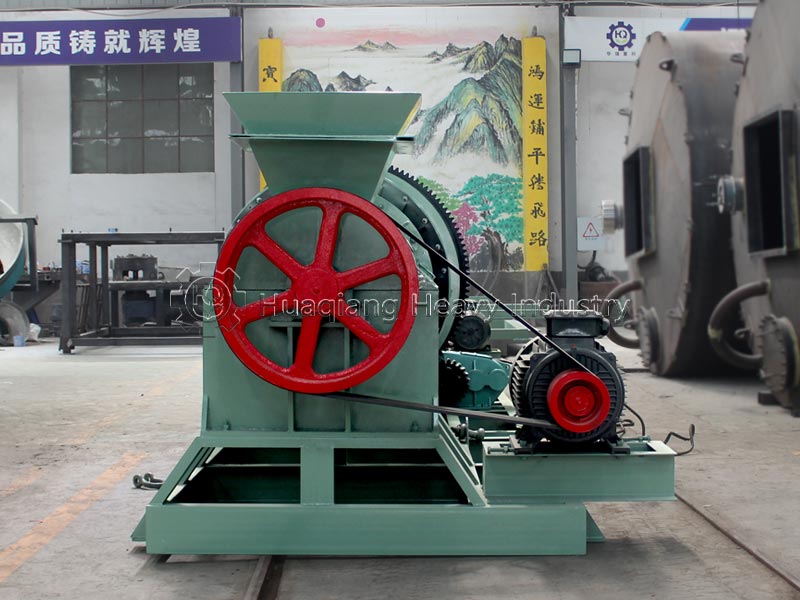
New Type Two In One Organic Fertilizer Granulator
Equipment Overview
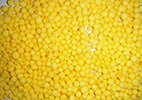
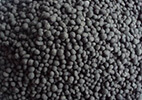
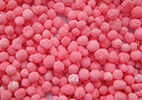
The core breakthrough of this equipment lies in breaking the single-process limitations of traditional granulators, integrating the “fine pelletizing” advantages of stirring tooth granulation with the “increased efficiency and mass production” advantages of drum granulation. After the raw material enters the granulator, it is first formed into semi-finished granules by the stirring tooth principle, and then enters the drum granulation section for secondary shaping and granulation. The finished granules are spherical with a smooth and rounded surface.
Equipment Structure and Composition
I. Core Component System
| Component Name | Function Description | Material & Process Requirements |
|---|---|---|
| Rotary Drum Body | Main chamber that holds materials and carries out granulation & polishing processes | Thickened seamless steel tube for sturdiness and durability; inner wall can be lined with special rubber plates or acid-resistant stainless steel liners for automatic scarring and lump removal |
| Internal Stirring Teeth | Spiral or paddle-type teeth fixed on the central shaft, responsible for stirring, shearing and propelling materials | Multi-layer spiral alloy teeth with wear-resistant alloy steel cutter heads; adjustable in length |
| Main Shaft / Rotor System | Core transmission component driving high-speed rotation of stirring teeth | Made of special materials, sturdy and durable |
| Transmission System | Motor + reducer combination providing stable power output | Y-series national standard motor with strong and energy-saving power; reducer interior uses special materials with high load-bearing capacity |
| Feed Inlet | Entry port for materials entering the granulation chamber | Aligns with belt conveyor; underground pit can be built for material transportation |
| Discharge Outlet | Discharge channel for formed pellets | Equipped with screen mesh to separate unqualified pellets |
| Frame & Base | Supports the whole machine structure and ensures stable operation | Stable steel frame structure with damping device; high-power motor has independent base |
| Liquid Spraying System (Optional) | Sprays binder or moisture to assist granulation | Automatically adjustable spray volume |
| PLC Control System (Optional) | Real-time monitoring of operating status with automated control | Touchscreen operation with adjustable parameters |
II. Five Major Functional Systems
1. Feeding System: A spiral pusher forcibly conveys materials to the granulation chamber.
2. Mixing and Stirring System: High-speed rotating stirring teeth achieve shearing, extrusion, and kneading of materials.
3. Granulation System: Under mechanical force, materials agglomerate, nucleate, grow, and become dense.
4. Polishing System: The rotating cylinder polishes the granules, improving sphericity.
5. Control System: A PLC touchscreen integrates monitoring parameters such as mixing time, granulation speed, material moisture content, and output.
III. “Two-in-One” Structural Features
“Two-in-One” Core Meaning:
1. Stirring Tooth Granulation Mechanism: Utilizing high-speed rotating mechanical stirring force and aerodynamics, fine powder materials continuously achieve mixing, granulation, spheroidization, and densification processes within the machine.
2. Rotary Drum Granulation Mechanism: The rotating cylinder causes granules to roll along the cylinder wall under centrifugal force, with fine powder adhering to the outer layer, gradually increasing granule size and polishing.
3. Synergistic Effect: The combination of the two granulation methods results in a higher spheroidization rate, more aesthetically pleasing granules, and energy savings.
Equipment Working Principle
The equipment adopts a wet composite mechanical granulation principle, combining high-speed mechanical stirring force and aerodynamics to achieve continuous material forming. The entire process is automated and integrated. The specific process is as follows: After being uniformly fed into the chamber, the material is driven by the high-speed rotation of the main shaft, which rotates the stirring teeth, generating high-intensity mechanical stirring, shearing, and extrusion forces. Simultaneously, a dynamic aerodynamic field is formed inside the chamber, causing the powdered material to sequentially complete six processes: mixing and homogenization, powder nucleation, extrusion agglomeration, rolling spheroidization, densification and compaction, and surface polishing. Utilizing the natural embedding and bonding characteristics of organic material particles, no chemical binders are needed to achieve powder agglomeration and forming.
The formed granules are standard spherical with a sphericity ≥0.7. The typical particle size can be controlled within the range of 0.3-3mm, and the granulation rate is ≥90%. The particle size can be adjusted bidirectionally: the lower the feed mixing rate and the higher the main shaft speed, the smaller the finished particles; the larger the feed rate and the lower the speed, the larger the particle size. After molding, the granules are firm with an extremely low pulverization rate, allowing for direct sieving without the need for prolonged drying, thus greatly simplifying the production process.
Application Scope of the Equipment
I. Main Application Areas
| Application Field | Specific Materials | Product Form |
|---|---|---|
| Bio-organic Fertilizer | Chicken manure, pig manure, cow manure, sheep manure and other livestock & poultry manures | Spherical organic fertilizer pellets |
| Organic-Inorganic Compound Fertilizer | NPK + organic matter compound formula | Spherical compound fertilizer pellets |
| Compost Ingredients | Crop straw, distiller’s grains, mushroom residues, herbal residues | Spherical fermented fertilizer pellets |
| Municipal Sludge Treatment | Municipal domestic waste, sewage treatment plant waste | Spherical sludge fertilizer pellets |
| Humic Acid Fertilizer | Humic acid, peat, turf | Spherical humic acid fertilizer pellets |
| Specialty Fertilizer | Microbial fertilizer, amino acid fertilizer, cake fertilizer | Spherical functional fertilizer pellets |
| Industrial Pellets | Carbon black, clay, kaolin, molecular sieve | Spherical industrial pellets |
II. Applicable Raw Material Characteristics
This machine is suitable for granulating lightweight fine powder materials, with particularly good granulation results for organic-inorganic compound fertilizers. The finer the basic particles of the fine powder material, the higher the sphericity of the granules and the better the granulation quality. Generally, the particle size of the material before granulation should be less than 50 mesh (300 mesh).
1. High Moisture Materials: Livestock and poultry manure with a moisture content of 20%-40% (can be granulated directly without pre-drying)
2. Coarse Fiber Materials: Crop straw, distiller’s grains, mushroom residue, medicinal residue, etc. (difficult to granulate with conventional equipment)
3. Sticky Materials: Fermented organic materials, humic acid, urban sludge, etc.
4. Powdered Materials: Carbon black, clay, kaolin, urea-formaldehyde molding powder, etc.
5. Mixed Materials: Organic-inorganic mixtures of various raw materials in different proportions
III. Typical Application Material List
| Raw Material Category | Specific Materials |
|---|---|
| Livestock & Poultry Manure | Manure from chicken, duck, rabbit, pig, cow, sheep and other livestock |
| Pond Sludge | Sludge from fish ponds, shrimp ponds, loach ponds, etc. |
| Residual Waste from Food Processing | Mushroom cultivation waste, brewer’s grains, starch residues, rice bran residues, bean dregs, sugar residues, fruit pomace, sauce residues, etc. |
| Other Organic Wastes | Garden waste, rice straw, crop straw, herbal residues, biogas residues, etc. |
| Industrial Raw Materials | Carbon black, white carbon black, clay, kaolin, urea-formaldehyde molding powder, molecular sieve, calcium carbonate, calcium hydrogen phosphate, etc. |
Core Product Advantages
1. Wide Raw Material Compatibility, Breaking Industry Limitations: Exclusively compatible with coarse fiber and high-moisture organic materials that conventional equipment cannot form, achieving 100% pure organic granulation content, truly realizing granulation without auxiliary materials or binders.
2. High Granulation Quality and Stable Appearance: Spherical granules are round and full, without sharp edges, with extremely low pulverization rate. Compressive strength is superior to traditional disc and drum granulation equipment, with a large granule rate ≤15%, and controllable and adjustable particle uniformity.
3. Precise and Controllable Particle Size, Concentrated Distribution: Relying on a stepless speed regulation system, particle size is precisely controlled, resulting in uniform particle size distribution, no drastically different particle sizes, and a significantly improved finished product qualification rate.
4. Energy Saving and Low Production Costs: Direct granulation of wet materials eliminates the need for drying processes, significantly reducing drying energy consumption; no binders are required, saving raw material costs; low equipment operating energy consumption makes it suitable for large-scale mass production.
5. Stable operation and high durability: Thickened seamless steel pipe body, alloy wear-resistant stirring teeth, and high-strength reducer make the whole machine wear-resistant, impact-resistant, and less prone to failure, with a service life far exceeding that of ordinary granulation equipment.
6. High production efficiency and suitable for mass production: Continuous wet process operation, high degree of automation, granulation rate ≥90%, stable production capacity, and adaptable to large, medium, and small production lines for large-scale production.
7. Flexible process and strong adaptability: Supports cold and hot granulation, high and low concentration fertilizer production, and is adaptable to the production of various organic fertilizer formulas, making it extremely versatile.
Equipment Parameters
| Model | Capacity (t/h) | Output Granules Size (mm) | Motor Power (Kw) | Outside Dimension (mm) |
|---|---|---|---|---|
| YSL2-80/120 | 4-8 | 1-5 | 37+18.5-5.5 | 7500×2300×1950 |
| YSL2-100/150 | 6-10 | 1-5 | 55+18.5+11 | 7700×2500×2260 |
| YSL2-120/180 | 8-15 | 1-5 | 75+22+15 | 9600×3000×2750 |
Equipment and its Application in Organic Fertilizer Production (Fermentation + Granulation Process)
I. Equipment Fermentation Process
Organic fertilizer production consists of two main stages: fermentation and granulation.
Fermentation Stage: Organic solid waste such as livestock and poultry manure is fermented, matured, dehydrated, deodorized, pulverized, and sieved to produce powdered bio-organic fertilizer.
Key Advantage: A major highlight of the two-in-one granulator is that the fermented organic matter can be directly granulated without drying, with a raw material moisture content of 20%-40%. This overcomes the limitation of conventional granulation processes requiring pre-drying, saving significant energy.
During the granulation process, the matured material undergoes granulation, cooling, sieving, and packaging to become granular bio-organic fertilizer.
II. Equipment Granulation Process
1. Granulation Process Flow
Raw material preparation (moisture content 20-40%) → Feeding and mixing → High-speed stirring and nucleation → Rolling polishing and growth → Sieving and discharging
2. Key Process Parameters
| Parameter | Control Range | Influence |
|---|---|---|
| Raw Material Moisture | 20%-40% (Optimal: 35%-40%) | Too low leads to loose pellets; too high causes sticking and machine blockage |
| Raw Material Fineness | <50 mesh (<300 mesh is better) | The finer the material, the higher the sphericity of pellets |
| Main Shaft Rotation Speed | Adjustable | Higher speed produces smaller pellets; lower speed produces larger pellets |
| Feeding Capacity | Adjust according to production output | Affects pellet size and uniformity |
| Gap Between Stirring Teeth & Drum Wall | 5-8mm | Excessively large gap reduces pelleting rate; too small gap causes collision easily |
| Pelleting Rate | ≥90% (Up to 98%) | Core indicator to evaluate granulation performance |
| Pellet Sphericity | ≥0.7 | Indicator for pellet roundness |
| Pellet Diameter | 0.3-3mm (Adjustable) | Adjust based on finished product requirements |
| Pellet Strength | 10-30N | Affects transportation and storage performance |
| Oversize Pellet Ratio | <15% | Proportion of unqualified large pellets |
3. Granulation Process Considerations for Different Materials
| Material Type | Moisture Control Range | Speed Adjustment | Special Requirements |
|---|---|---|---|
| Livestock & Poultry Manure | 35%-40% | Medium rotation speed | Complete fermentation and decomposition in advance |
| Crop Straw | 30%-35% | Relatively high rotation speed | Long fiber materials, must be fully crushed |
| Organic-Inorganic Compound Fertilizer | Adjust according to formula | Medium rotation speed | Pay attention to chemical reactions of raw materials |
| Municipal Sludge | 30%-40% | Medium rotation speed | Mix with straw to adjust C/N ratio |
| Carbon Black / Clay | 25%-35% | Relatively high rotation speed | Fine powder material with high pellet sphericity |
Standard Operating Procedures for Equipment
I. Installation Specifications
The entire machine frame should be placed horizontally on the ground, ensuring even contact with the foundation surface without any gaps or tilting. High-power motors should be equipped with independent bases. After leveling the main unit, align the motor coupling with the main unit coupling, ensuring the motor wheel and main unit wheel are parallel and coaxial. Tighten all connecting bolts.
II. Pre-Start Inspection
1. Check that all bolts and fasteners are tightened, ensuring no looseness or missing parts.
2. Check the gear oil level in the reducer and the lubricating oil level in the bearing housings, ensuring sufficient oil quantity and qualified oil quality.
3. Check that the machine body is free of debris and residual material, and that the cavities are clean.
4. Test the moisture content of the raw materials, strictly controlling it within the range of 20%-40%.
III. Trial Run and Production Operation
1. No-load Start-up: Starting the machine with material is strictly prohibited. Start the motor under no-load conditions and check that the rotation direction is correct. Feed material only if there are no abnormal noises or vibrations during operation.
2. Trial Run and Debugging: First, use low-moisture material to produce 200-300 kg of material. Fine-tune the material moisture content, feed rate, and spindle speed based on the granulation effect. If the particles are too large, reduce the moisture content; if the particles are too small or powder is produced, increase the moisture content.
3. Normal Production: Maintain a uniform and stable feeding speed to ensure uniform raw material moisture content and particle size. Avoid sudden increases or decreases in feed to prevent equipment load fluctuations.
4. Shutdown Procedure: First, stop feeding material. Stop the machine only after all material has been discharged from the machine. If the machine is jammed, restart it under no-load for 2-3 minutes to clear any remaining material from the cavity.
Common Equipment Problems and Solutions
| Fault Phenomenon | Possible Causes | Solutions |
|---|---|---|
| Over-sized pellets / Mass caking | Excessively high material moisture or too low rotation speed | Reduce material moisture and increase main shaft rotation speed |
| Excessive powder / Low spheronization rate | Insufficient moisture or uneven feeding | Spray appropriate water for adjustment and maintain continuous & uniform feeding |
| Severe machine vibration | Foreign impurities mixed in materials or unlevel base frame | Stop the machine to clear foreign objects and recalibrate the horizontal level of the unit |
| Sudden sharp rise of power load | Severe material sticking on inner wall or excessive feeding rate | Clean residual materials adhered to inner wall and reduce feeding volume |
Comparison of equipment with traditional granulation equipment
| Comparison Item | Two-In-One Granulator | Disc Granulator | Drum Granulator | Stirring Tooth Granulator | Flat Die Granulator |
|---|---|---|---|---|---|
| Pelleting Rate | ≥90% (Up to 98%) | 60-80% | 70-85% | 80-95% | 85-95% |
| Pellet Shape | Spherical | Spherical | Spherical | Spherical / Cylindrical | Cylindrical |
| Moisture Requirement | 20%-40% (Wet Process) | Pre-drying required | Humidification required | 20%-40% | 15%-25% |
| Crude Fiber Adaptability | Excellent | Poor | Average | Good | Good |
| High-Moisture Materials | Direct granulation available | Pre-drying required | Humidification required | Direct granulation available | Pre-drying required |
| Binder | Not required | Sometimes required | Sometimes required | Not required | Sometimes required |
| Investment Cost | Medium | Low | Medium | Medium | Low |
| Floor Space | Small (Integrated Design) | Large | Large | Medium | Small |
| Energy Consumption | Low (Drying process saved) | Medium | Medium | Low | Low |
The new type two in one organic fertilizer granulator (new type stirring tooth rotary drum granulator) organically integrates the forced stirring granulation mechanism of a stirring tooth granulator with the rolling polishing mechanism of a rotary drum granulator, achieving a major breakthrough in organic fertilizer granulation technology. This equipment boasts a granulation rate of 90%-98%, capable of processing high-moisture materials with a moisture content of 20%-40% and coarse fibrous materials that are difficult to granulate with conventional equipment. Furthermore, it achieves pure organic granulation without the need for binders, making it an ideal piece of equipment for the production of organic fertilizers and organic-inorganic compound fertilizers.
If you have any questions about fertilizer production equipment and processes, or would like to learn more about customized solutions, please contact us immediately. Whether it’s equipment selection and quotation, installation, commissioning and operation training, or after-sales maintenance and process upgrades, we can provide you with professional and timely answers and support, offering a full-process service.
Have Any Problem? Please, Contact
Integrity
Adhere to honesty and trustworthiness, be responsible to customers, employees, partners, and society, and establish long-term trust relationships.
Win win
Establish win-win relationships with all stakeholders such as customers, suppliers, and employees to share the fruits of enterprise development.