
Two in One, Simplifying Complexity: How the Dual-Function Granulator is Revolutionizing Organic Fertilizer Production?
In the world of organic fertilizer production, innovation often means achieving better results with fewer steps. Imagine integrating two core processes—crushing and granulation—into a single machine. What kind of transformation would that bring? This is the reality offered by the new type two-in-one organic fertilizer granulator. It is no longer just a link in the production chain but acts as a “Master of Process Simplification,” fundamentally changing the rules of the game for organic fertilizer formation.
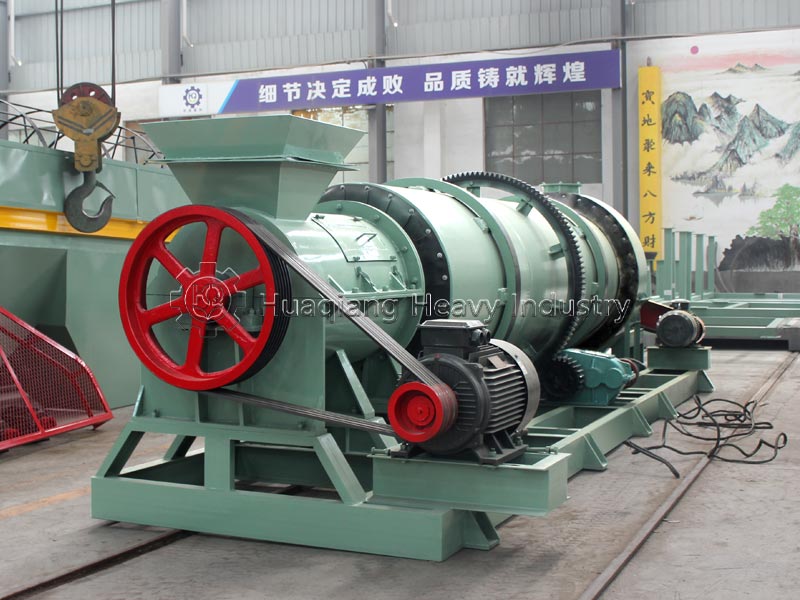
In traditional processes, semi-wet composted material first needs to be broken down by a chain crusher before being conveyed to a granulator for shaping. This requires two main machines, along with additional energy for conveying, more dust emission points, and more complex maintenance. The design philosophy of the two-in-one granulator is completely different. It features an innovative composite rotor: the front section acts as a decisive “deconstructor,” using high-speed rotating blades to forcefully break up clumped organic raw materials. The material then immediately enters the rear “forming zone,” where centrifugal and frictional forces cause it to coalesce into uniform granules, much like rolling a snowball.
The benefits of this integration are immediate. First, it significantly shortens the process flow, reducing equipment investment and floor space. This is a boon for small to medium-sized plants with limited space or those seeking rapid startup. Second, because the material proceeds to granulation immediately after crushing, it better retains the inherent moisture and tackiness of the raw material, reducing the need for additional binders and resulting in more natural, robust final pellets. More importantly, this integrated design means fewer material transfer points, significantly lowering the risk of dust emission and cross-contamination, creating a cleaner production environment.
Of course, an efficient two-in-one granulator does not work in isolation. It requires seamless coordination with a uniform feeder to receive a stable, controlled supply of raw material. Its successful operation also depends on the uniformly mixed feedstock provided by an upstream double shaft mixer, as well as the careful conditioning by downstream high-efficiency dryers and coolers to produce dry, stable, high-quality pellets. Finally, through the sorting by an intelligent screening machine, off-spec pellets are returned for reprocessing, forming an efficient closed loop.
Looking ahead, with the integration of smart sensor technology, this two-in-one equipment will be able to monitor material conditions in real time, automatically adjusting the intensity of crushing and granulation to achieve true “one-touch” intelligent production. In today’s pursuit of efficiency and sustainability, this innovation of simplifying complexity represents a clear direction for the development of organic fertilizer equipment—not about adding more, but about smart integration.