
Fineness Determines Quality: Optimizing the Entire Organic Fertilizer Grinding Process
In organic fertilizer production, the grinding process is often seen as a simple “crushing” step. However, those in the know understand that fineness determines product quality—it directly affects the fertilizer release rate, granulation rate, and even whether the product is low-end or high-end. Different forms of organic fertilizer have drastically different fineness requirements. Huaqiang Heavy Industry’s entire series of grinders allows for precise fineness adjustment, helping users optimize the grinding process to its fullest potential based on product positioning. This article will detail equipment adjustment techniques and key points of process integration, starting with the fineness requirements of three types of products: powdered fertilizer, granular fertilizer, and bio-organic fertilizer.
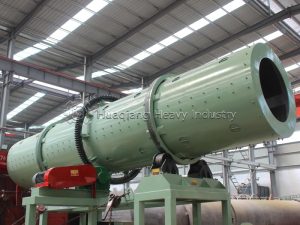
Powdered Organic Fertilizer: 60-80 mesh, pursuing ultimate uniformity
The core competitiveness of powdered organic fertilizer lies in “rapid dissolution” and “uniformity.” When the fineness reaches 60-80 mesh, the particle surface area increases significantly, allowing for rapid water penetration into the soil and uniform and rapid nutrient release. This is particularly suitable for high-value-added applications such as seedling substrates and facility agriculture.
Equipment Selection: Huaqiang cage mills are ideal for powdered fertilizer production. They gently grind materials into ultrafine powder through the impact and friction generated by two opposing rotating cages.
Fineness Adjustment Techniques: The fineness of a cage mill is mainly controlled by adjusting the blade spacing and feed rate. Adjusting the blade spacing to approximately 5 mm, while maintaining a uniform and stable feed, will achieve an ideal fineness of 60-80 mesh. It’s important to note that pursuing excessive fineness (e.g., above 100 mesh) not only significantly increases energy consumption but may also cause the material to absorb moisture and clump, negatively impacting the user experience.
Process Integration: The material processed by the cage mill fully meets the factory standards for powdered fertilizer and can directly proceed to the packaging stage. It is recommended to install a vibrating screen after the mill to separate any small amount of coarse particles that may occasionally occur and return them for regrinding, ensuring that the finished product meets 100% standards.
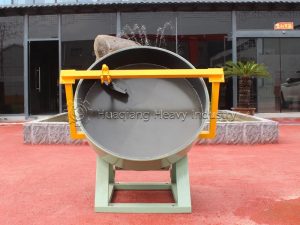
Granular Organic Fertilizer: 20-40 mesh, the “golden fineness” for granulation
The production of granular fertilizer has specific requirements for the fineness of the powder—too fine, and the material becomes too sticky, easily clumping together against the granulator walls; too coarse, and the particles lack sufficient binding, significantly reducing the forming rate. 20-40 mesh is widely recognized as the “golden fineness range” for granulation.
Equipment Selection: Depending on the characteristics of the raw materials, a Huaqiang chain crusher or a semi-wet material crusher can be selected. For relatively dry, hard raw materials after composting, the high impact force of the chain crusher is significantly effective; for wet materials with high moisture content, the screenless design of the semi-wet material crusher has a clear advantage.
Fineness Adjustment Techniques: The Huaqiang chain crusher is equipped with a fineness adjustment scale. By changing the screen with different aperture sizes, the output fineness can be easily controlled within any range between 10-60 mesh. When producing granular fertilizer, it is recommended to use a screen specification corresponding to 20-40 mesh. Semi-wet material crushers control fineness by adjusting the gap between the blades and the liner; a larger gap results in coarser output, while a smaller gap results in finer output. For granulation requirements, a gap of 8-10 mm is recommended.
Process Connection: Crushed materials should be fed into the granulation stage as soon as possible to avoid prolonged storage that could lead to moisture changes or absorption. If granulation cannot be done immediately, it is recommended to install an anti-bridging device in the hopper to maintain a loose material state.
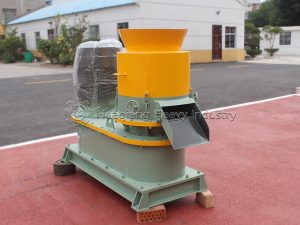
III. Bio-organic Fertilizer: 30-50 mesh, low-temperature protection for microorganisms
The production of bio-organic fertilizer places higher demands on the crushing process—not only must suitable fineness be achieved, but high temperatures must also be avoided during crushing to prevent the inactivation of functional bacteria.
Equipment Selection: Huaqiang horizontal crusher, due to its “low-temperature crushing” characteristics, is the preferred choice for bio-organic fertilizer production. It achieves crushing through the impact and kneading action of the hammer blades, with the material temperature rise controlled within 5-8℃ during the process, far lower than that of cage or chain crushers.
Fineness Adjustment Techniques: The recommended fineness for bio-organic fertilizer is 30-50 mesh. This range ensures even distribution of the microbial agent in the soil without causing excessive contact between the microorganisms and air, leading to inactivation. Horizontal pulverizers can precisely control the fineness by adjusting the number of hammers and the screen aperture. A two-step method of “coarse pulverization + fine adjustment” is recommended: first, coarsely pulverize using a larger screen aperture, then finely adjust to the target fineness based on the characteristics of the microbial strain.
Key Points for Process Integration: The pulverized bio-organic fertilizer should immediately enter the low-temperature drying or packaging stage to avoid prolonged exposure to high temperatures. It is recommended to connect the pulverizer to subsequent equipment via a closed conveyor system to reduce material exposure time.
Process Optimization Techniques: Integrating Pulverization and Screening
Regardless of the product type, adding a screening process after pulverization is a crucial step in improving quality.
Configuration Solution: Huaqiang Heavy Industry can provide integrated pulverization-screening units, seamlessly connecting the pulverizer and vibrating screen via a conveyor system. The crushed material enters a vibrating screen for grading. Qualified fine particles proceed to the next process, while unqualified coarse particles are automatically returned to the crusher inlet, forming a closed-loop cycle.
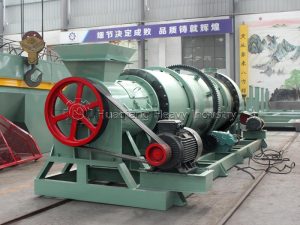
Screen Matching Principle: The screen aperture should match the target fineness. For powdered fertilizer requiring 60 mesh, the screen aperture should be slightly larger than 60 mesh (approximately 0.25 mm) to ensure throughput while avoiding over-crushing. For granular fertilizer raw materials, the screen aperture should be equal to or slightly smaller than the lower limit of the target particle size.
Return Material Control: The return material rate of integrated units is typically controlled between 10% and 20%. A return material rate that is too high indicates insufficient crushing fineness, requiring adjustment of equipment parameters; a return material rate that is too low may indicate over-crushing, wasting energy.
Practical Suggestions: Working Backwards from Product Positioning to Determine the Crushing Process
When planning a production line, it is recommended to adopt a “backwards” approach: first, clarify what product you want to produce (powdered fertilizer, granular fertilizer, or bio-fertilizer), then determine the required fineness of the raw materials for that product, and finally select crushing equipment that can accurately achieve that fineness.
If you target the high-end powdered fertilizer market, seeking ultimate fineness and rapid solubility, Huaqiang cage pulverizers are your best choice.
If you target the granular fertilizer market, needing ideal raw materials for your granulators, Huaqiang chain or semi-wet material pulverizers can precisely meet your needs.
If you target the bio-organic fertilizer market, needing to protect the activity of microorganisms during pulverization, Huaqiang horizontal pulverizers will be your best friend.
From the fineness of 60 mesh to the coarseness of 20 mesh, from the rapid solubility of ordinary fertilizers to the activity of bio-fertilizers—every product has its ideal pulverization fineness. Huaqiang Heavy Industry’s full range of pulverizers are equipped with precise fineness adjustment devices, coupled with professional process design services, helping you upgrade the pulverization process from a “necessary step” to “quality assurance.” When your products win market recognition for their uniformity and fineness, you’ll understand: fineness control is worth every effort.
The critical link between grinding fineness and product quality underscores that selecting the right organic fertilizer raw material processing equipment is only the first step. The true artistry lies in seamlessly integrating this prepared material with the subsequent organic fertilizer production granulation stage. For granular fertilizer, achieving the “golden fineness” of 20-40 mesh with a half-wet material crusher machine or chain crusher perfectly primes the material for a dedicated organic fertilizer disc granulation production line. Here, the disc granulator machine uses its tumbling action to roll this uniformly ground powder into high-quality spherical pellets. For operations seeking maximum flexibility, an organic fertilizer combined granulation production line offers a versatile solution. This approach might integrate a new type two in one organic fertilizer granulator, which combines the final stages of crushing with initial granulation, streamlining the process and minimizing material handling. This is particularly valuable for bio-organic fertilizers, where gentle processing is paramount. Ultimately, the most effective organic fertilizer production equipment strategy involves a holistic view, where the crusher, chosen for its precise fineness control and low-temperature operation, and the granulator, selected for its shaping characteristics, are designed to work in perfect harmony. This integrated approach, whether through a classic organic fertilizer disc granulation production line or a flexible combined line, transforms precise grinding into consistent, high-value granular products.