
Investment Guide for Small-Scale Organic Fertilizer Production Lines
Careful Planning, Steady Progress
With the continued advancement of ecological agriculture policies and the growing market demand for green agricultural inputs, small-scale organic fertilizer production lines are becoming a key investment focus for livestock enterprises, agricultural cooperatives, and agricultural entrepreneurs. These projects are favored for their flexible investment, strong adaptability, and moderate payback period. However, to achieve stable profits, investors must be well-prepared in three aspects: cost control, profit expectation, and risk management.
Cost Analysis: Rational Investment Structure Planning
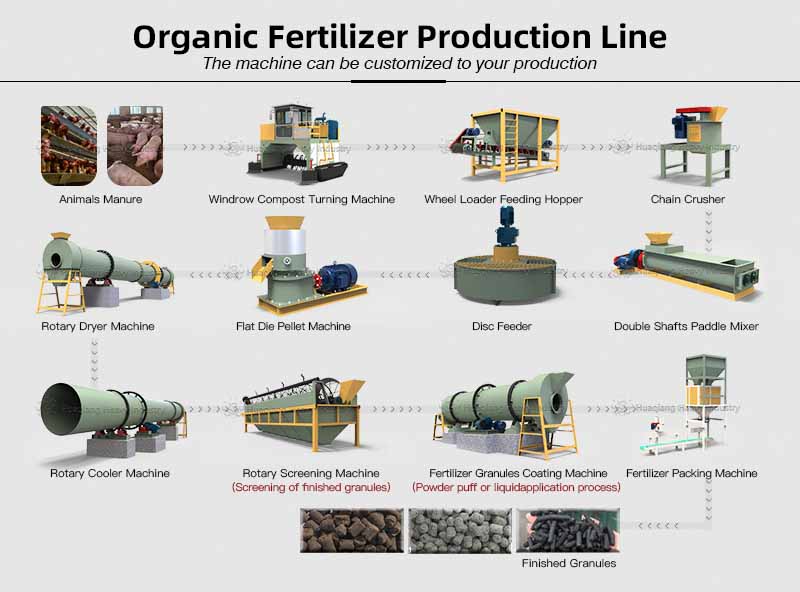
Investing in a small-scale organic fertilizer production line with a capacity of 2-5 tons/hour typically costs between 500,000 and 1.5 million yuan for equipment. Core equipment generally includes: a semi-wet material crusher, a hydraulic compost turner, a disc granulator, a drum screen, and a packaging machine. Currently, mature modular design solutions are available on the market. For example, Zhengzhou Huaqiang Heavy Industry offers customizable small-scale production lines, allowing investors to configure equipment in stages according to their financial situation, effectively alleviating initial investment pressure.
Besides equipment investment, operating costs must be fully included in the budget:
Site Costs: Approximately 1000-2000 square meters of space is needed for raw material storage, fermentation areas, and production workshops. Rental or self-construction costs vary significantly by region.
Raw Material Costs: The acquisition, transportation, and pre-treatment costs of major raw materials such as livestock manure and straw account for approximately 30%-40% of the total cost.
Labor and Energy Consumption: A production line typically requires 3-5 operators. Including electricity and water consumption, daily operating costs need careful calculation.
Overall, the initial total investment for a small-scale organic fertilizer project is approximately between 800,000 and 2 million yuan. Investors are advised to adopt a phased investment strategy, prioritizing the quality of equipment in core production processes.
Profit Analysis: Calculating Benefits Clearly Taking a production line with a capacity of 3 tons/hour as an example, if it operates effectively for 300 days a year, running 8 hours a day, the annual output can reach 2160 tons. Based on current market conditions, the selling price of commercial organic fertilizer is generally between 800 and 1500 yuan per ton. After deducting raw material costs (approximately 300-500 RMB/ton), labor, energy consumption, depreciation, and other operating expenses, the net profit per ton is approximately 200-500 RMB.
Based on this calculation, the annual net profit ranges from approximately 430,000 to 1,080,000 RMB, with an investment payback period generally between 1.5 and 3 years. If stable raw material procurement channels can be established (e.g., long-term manure treatment agreements with surrounding farms) and a fixed sales network can be expanded (e.g., supply cooperation with cooperatives and planting bases), the project’s profitability stability and return on investment will significantly improve.
III. Risk Control: Three Key Factors Cannot Be Ignored
Raw Material Supply Risk
A continuous and stable supply of raw materials is the foundation of production. It is recommended to sign long-term supply agreements with surrounding farms and agricultural processing enterprises to lock in prices and quantities, avoiding production disruptions due to seasonality or market fluctuations.
Product Quality Risk
The quality of organic fertilizer directly affects market competitiveness and brand reputation. Strict adherence to fermentation process parameters is essential, controlling moisture, carbon-nitrogen ratios, and fermentation cycles, and establishing a comprehensive quality testing system to ensure product compliance with national standards.
Policy and Environmental Risks
Environmental requirements have become increasingly stringent in recent years. Investors need to understand local environmental impact assessment requirements, emission standards, and agricultural support policies for organic fertilizer production in advance to ensure the project operates legally and compliantly. Choosing equipment with environmentally friendly process designs can effectively avoid subsequent rectification risks.
Furthermore, technical and management risks cannot be ignored. It is recommended to choose equipment suppliers that provide comprehensive technical training, installation and commissioning support, and long-term after-sales service. For example, cooperating with manufacturers like Huaqiang Heavy Industry, which have rich project experience, can provide full guidance from process design to production optimization, significantly reducing technical barriers and operational risks.
Optimizing Equipment Selection for Efficiency and Quality
Following the critical organic fertilizer fermentation process, selecting the appropriate granulation equipment is paramount for determining final product form and quality. For a small to medium-scale organic fertilizer disc granulation production line, the core is often the disc granulator machine, which utilizes centrifugal force and a binding agent to form uniform spherical granules, ideal for powdered organic materials. Alternatively, a rotary drum granulator offers higher capacity and is excellent for producing rounder, harder granules through a tumbling motion. For operations focused on producing high-density, non-spherical granules or dealing with materials that are difficult to agglomerate, the double roller press granulator (or extrusion granulator) provides a dry granulation solution. Innovations like the new type two in one organic fertilizer granulator, which combines crushing and granulation functions, can save space and initial investment. Preceding granulation, efficient composting is vital. While a large wheel compost turning machine or a standard wheel compost turner is suitable for open windrows, a chain compost turning machine offers superior efficiency and deeper turning for trough fermentation systems, ensuring thorough aerobic decomposition. The choice between a complete disc granulation production line and other configurations ultimately depends on raw material characteristics, target product specifications, and the desired balance between capital expenditure and operational versatility.
Conclusion: Small Investment, Big Returns, Stability First
Investing in a small-scale organic fertilizer production line is both a pragmatic choice to grasp the development trend of green agriculture and a systematic project requiring meticulous operation. The key to success lies in: precise cost control, rational profit expectations, and systematic risk prevention. Investors are advised to conduct in-depth research on the local market before making a decision, prioritize the integration of local resources, start small, and gradually improve processes and channels to achieve steady and long-term success in the growing organic fertilizer industry.