
Protecting Vitality: Core Equipment and Processes of Bio-Organic Fertilizer Production Lines
In the global wave of agricultural transformation towards green and sustainable practices, bio-organic fertilizers are taking center stage. They are not merely fertilizers providing nutrients, but also “soil doctors” that improve soil, suppress diseases, and enhance crop quality. However, the production of bio-organic fertilizers differs fundamentally from ordinary organic fertilizers: the core challenge lies in ensuring the high activity of functional microorganisms, invisible to the naked eye, throughout the lengthy production process. Improper processes lead to the death of a large number of microorganisms, rendering the product indistinguishable from ordinary organic fertilizers. This article will focus on the core techniques of microbial fermentation and equipment adaptation, analyzing how precise process configuration can protect the “life force” within every gram of fertilizer.
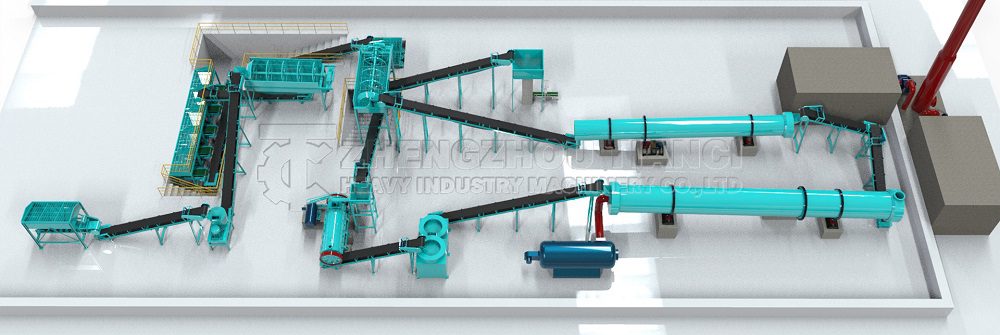
Step 1: Microbial Propagation and Mixing – A Gentle and Uniform First Encounter
The production of bio-organic fertilizers begins with the “combination” of functional microorganisms (such as Bacillus and nitrogen-fixing bacteria) with well-rotted organic raw materials. Microorganisms typically exist in liquid or solid form and need to be uniformly mixed with the fermented organic materials in precise proportions. The success or failure of this step hinges on the selection of the mixing equipment.
Traditional vertical mixers, due to their high-speed rotation and shearing force, are prone to damaging microbial cells. Therefore, horizontal mixers are recommended. Their working principle involves low-speed agitation and convection mixing, which can thoroughly mix the inoculum and materials in a very short time (usually 3-5 minutes), while minimizing thermal or mechanical damage to the inoculum caused by frictional heating. A homogeneous mixture is the foundation for the subsequent colonization and function of the inoculum in the soil.
Step Two: Sealed Fermentation – Creating an Ideal Home for Microorganisms
The mixed materials need to enter a stable environment for secondary fermentation, promoting the activation, reproduction, and firm colonization of the inoculum onto the organic matter particles. Ordinary open-air windrows or simple fermentation tanks are unsuitable for this stage due to their difficulty in temperature control and susceptibility to contamination by other microorganisms.
At this point, a fully automated sealed fermentation tank becomes the core equipment on the production line. It constructs a microcosm with constant temperature, humidity, and adjustable oxygen supply. Through an automated control system, the optimal growth temperature (usually 35-45℃) and humidity can be precisely maintained according to the biological characteristics of different inoculum species. More importantly, the sealed environment not only isolates the invasion of external bacteria but also effectively controls the fermentation process, achieving odorless production and completely resolving environmental concerns. Under this “nanny-like” care, functional bacteria can multiply rapidly, ensuring a high quantity and laying a solid foundation for achieving the required live bacteria count in the finished product.
Step 3: Low-Temperature Drying – Overcoming the “Life-or-Death Threshold”
For ordinary organic fertilizers, high-temperature drying is a common method for rapid moisture reduction. However, for bio-organic fertilizers, high temperatures are the “number one killer” of microorganisms. When the temperature exceeds 60℃, most beneficial bacteria will rapidly become inactive.
Therefore, this step must use a low-temperature drum dryer. Its core technology lies in controlling the hot air temperature and flow rate to maintain the temperature of the drying medium at 60℃ or even lower. It utilizes the principle of low-temperature, high-volume airflow to slowly remove moisture from the material. Although the drying time is slightly longer, it ensures that the final product meets the required live bacteria count (CFU). This is a key dividing line in equipment investment between bio-organic fertilizer production and ordinary organic fertilizer production.
Step 4: Granulation and Packaging – Gentle Final Shaping
For ease of application, bio-organic fertilizers typically need to be granulated. However, the granulation process must also adhere to the principle of “gentleness.” Specialized bio-fertilizer granulators (such as extrusion granulators or disc granulators) should be used at this stage. These devices rely on physical extrusion or rolling agglomeration to form the granules, generating almost no heat during the process – a “cold processing” method. Light pressure molding ensures granule strength while avoiding secondary damage to the microorganisms caused by high temperatures. After granulation, the finished product undergoes low-temperature air cooling before entering the packaging line, becoming a marketable commodity.
Technical Advantages and Practical Cases
Huaqiang Heavy Industry has deep expertise in the organic fertilizer equipment field and a profound understanding of the “temperament” of microorganisms. Our bio-organic fertilizer production lines offer high configurability, catering to both liquid and solid microbial cultures, and ranging from small lines producing thousands of tons annually to large lines producing tens of thousands of tons. We can find the most suitable combination of fermentation tanks and mixers.
For example, a biotechnology company using a production line designed by Huaqiang Heavy Industry achieves a capacity of 20 tons per hour. From the input of microbial agents to the finished product leaving the factory, the entire process strictly adheres to the principles of “low temperature, gentleness, and precise temperature control.” Since its inception, the product has consistently maintained a 100% compliance rate for effective live bacteria counts in all national quality spot checks. The product is sold to numerous high-end planting areas, earning the market’s full trust.
From the initial mixing of microbial strains to the final packaging of the finished product, the production of bio-organic fertilizer is a process of safeguarding the “life” of microorganisms throughout the entire process. Choosing the right equipment means choosing the core competitiveness of your product. Huaqiang Heavy Industry not only provides hardware but also offers each customer free inoculum and raw material ratio solutions and comprehensive technical guidance, helping you firmly seize your opportunities in this green industry wave.
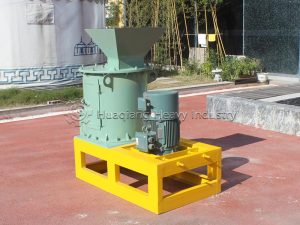
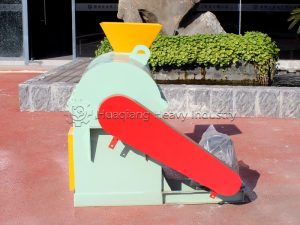
The careful protection of microorganisms extends beyond fermentation and drying into the crucial stages of size reduction and shaping within a bio organic fertilizer production line. Before granulation, the microbial-laden organic material may require crushing. A half-wet material crusher machine is essential for handling the typical moisture content (25-55%) without generating excessive heat. For drier or more fibrous materials, a chain crusher offers robust, yet relatively gentle, size reduction, while a cage crusher provides an even finer, more uniform grind, ideal for preparing a homogenous feed for the granulator. The subsequent organic fertilizer production granulation stage must also be gentle. While a dedicated disc or extrusion granulator is common, an innovative solution like a new type two in one organic fertilizer granulator combines final crushing and initial shaping in a single, enclosed process. This minimizes material handling and reduces the risk of mechanical damage to the microorganisms, ensuring a high viable count is preserved in the final, uniform granules.