
Roller Press Granulator Production Line: Squeezing Power into Pellets
What happens when you take dusty fertilizer powders and crush them between two massive, counter rotating steel rollers? You get something remarkable: dense, uniform, instantly usable granules—without a single drop of water. That’s the magic of the roller press granulator, the heart of a production line that’s changing how the world makes compound and NPK fertilizers.
But let’s be honest: a roller press alone isn’t a factory. Behind every perfect, coin shaped granule lies a carefully orchestrated lineup of equipment, each piece playing its part in a dry, efficient, and surprisingly elegant process.
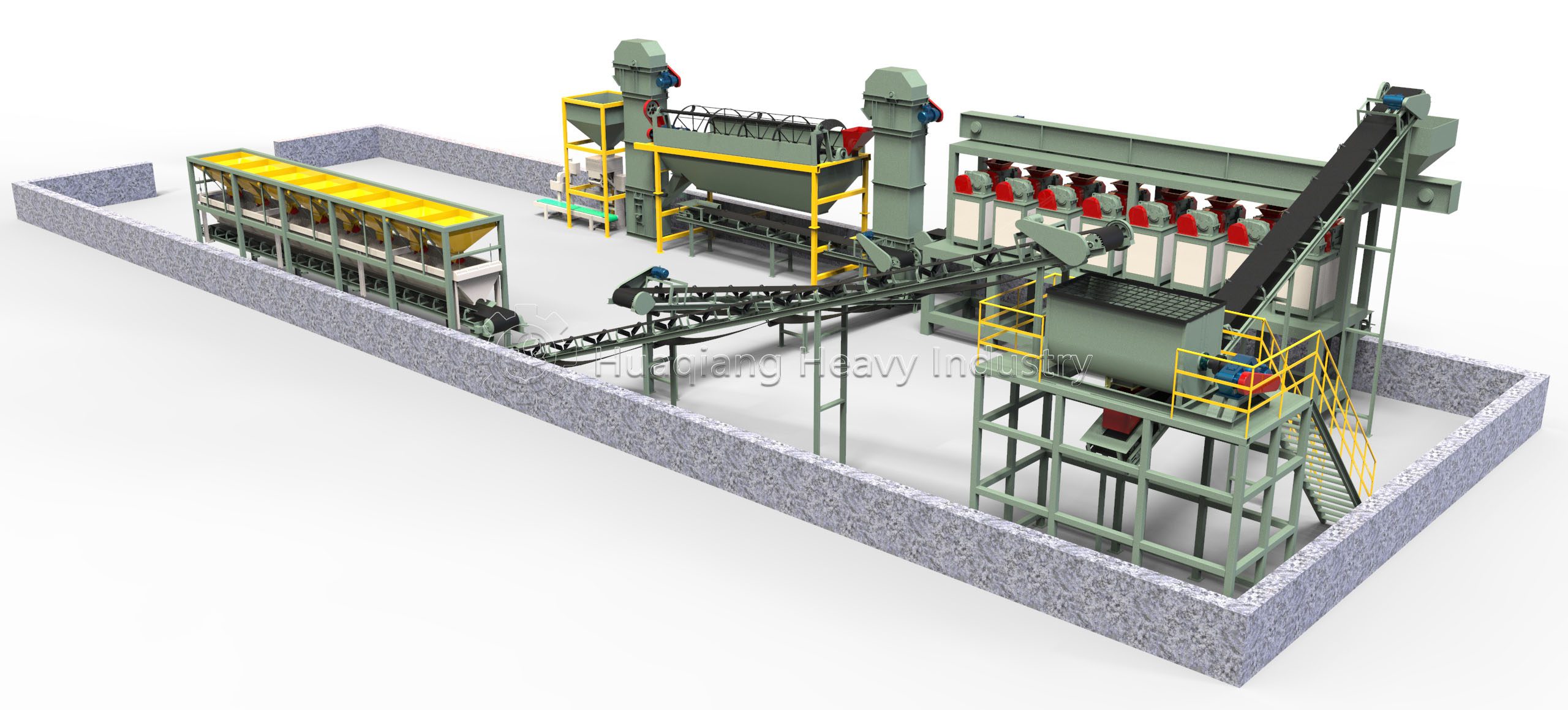
- Raw Material Preparation: The Perfect Recipe
It all starts with blending. Powders like ammonium sulfate, urea, potassium chloride, and phosphate rock arrive at the plant and head straight to a batching system and mixer. A horizontal paddle mixer or twin shaft blender combines them into a homogeneous recipe, often with micronutrients or fillers added. Because the roller press works best with a consistent, dry feed, the mix must be uniform in particle size and moisture—usually below 5%. Any lumps? They’re crushed ahead of time.
- The Star: Roller Press Granulator
Now the mixed powder flows into the double roller press granulator. Two counter rotating rollers, one fixed and one floating, squeeze the material under immense pressure—often 10 to 30 tons per square centimeter. The powder is forced into pocket shaped indentations on the roller surfaces, emerging as dense, flat “briquettes” or “pillows.” No water, no binder, no drying afterward. The pressure alone fuses the particles through molecular forces.
This dry granulation method is ideal for moisture sensitive materials and produces granules with exceptional hardness, minimal dust, and a smooth, round ish shape after the next step.
- Crushing & Shaping: From Pillows to Pellets
Fresh from the press, those pillow shaped briquettes need refinement. A chain fertilizer crusher gently breaks them into smaller granules. Followed by a screening machine—often a vibrating screener with multiple layers—the granules are separated. Perfect sized ones proceed; oversize particles return to the crusher; fines are recycled back to the mixer. This closed loop ensures zero waste and consistent output.
- Polishing (Optional but Common)
To give granules a smooth, uniform appearance, some lines include a granule polisher or rounding machine. It tumbles the particles gently, knocking off sharp edges and creating a spherical, elegant product that flows beautifully in spreaders.
- Drying & Cooling: A Rare Step
Because the roller press uses no moisture, a dryer isn’t always needed. But if the raw materials had slight humidity or if a coating is planned, a rotary dryer and counter flow cooler may be used to stabilize temperature and prevent caking. For most dry process lines, cooling alone suffices.
- Coating: Locking in Quality
To prevent clumping during storage or to add slow release properties, a coating machine applies a thin film of oil, wax, or anti caking agent. This step also reduces dust and gives the granules a professional finish.
- Packaging: The Final Bow
A vibrating screener gives the granules one last quality check before they reach the automatic packaging machine. The system weighs, fills, and seals bags—ranging from 5 kg retail bags to 1,000 kg bulk sacks—while conveyors and dust collectors keep the line clean and efficient.
Why Choose Roller Press Technology?
Compared to wet granulation (like drum or disc granulators), the roller press line offers distinct advantages:
No drying required – saves energy, reduces equipment, and cuts operating costs.
Works with heat sensitive materials – urea, for instance, won’t decompose.
High granule strength – pellets resist breakage during transport and spreading.
Environmentally friendly – no wastewater, fewer emissions.
The Big Picture
From dusty powders to rock hard pellets, the roller press granulator production line is a study in pressure and precision. But like any great performance, it’s the ensemble that matters. The mixer sets the stage; the roller press delivers the drama; the crusher and screener refine the act; and the packer takes the final bow.