
What Else Can an Organic Fertilizer Production Line Do? — More Than Just Fertilizer
Have you ever seen a production line like this? It not only turns foul-smelling livestock manure into odorless organic fertilizer, but can also switch modes on demand to produce nutrient-rich compound fertilizers and controlled-release fertilizers. That’s right—this is a modern organic fertilizer production line integrated with multiple fertilizer equipment, a true “magic factory” of fertilizers.
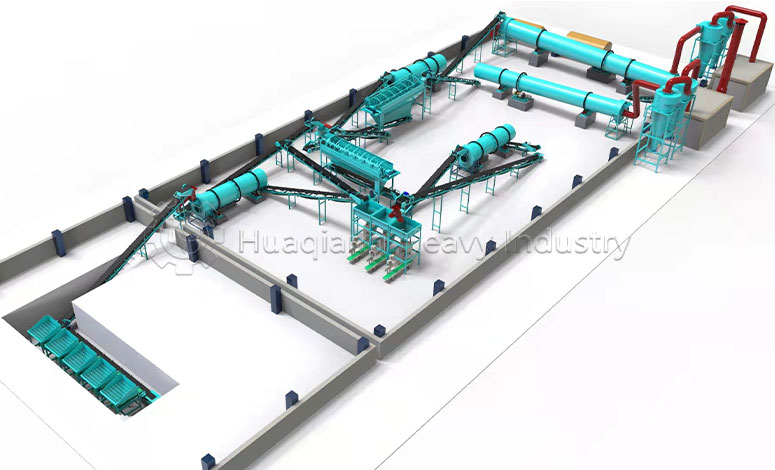
In today’s world, where agriculture pursues green and efficient solutions, traditional single-type fertilizers struggle to meet diverse needs. A well-designed organic fertilizer line, however, achieves “multi-functionality” by incorporating other fertilizer equipment. Its core consists of fermentation systems, crushing and screening units, granulation and drying modules, as well as flexible batching and packaging lines. But that’s just the beginning. Add an automatic batching system and a mixer, and the line instantly gains the capability to produce bulk blending fertilizer (BB fertilizer). Install a coating drum, and controlled-release fertilizers become readily available. By changing the granulation method and adjusting the formula, you can even produce organic-inorganic compound fertilizers, water-soluble fertilizers, and more.
How do these pieces of equipment work together? Imagine: after thorough composting, the raw materials are precisely mixed with nitrogen, phosphorus, potassium, and other nutrients in an intelligent batching station, then fed into the granulator. Under the action of steam or water, the fine particles gradually form round granules. Subsequently, a drum fertilizer dryer removes excess moisture, a cooler stabilizes the granules, and a screener ensures uniform particle size. Finally, an automatic packing scale bags and seals the product. The entire process runs automatically, with just one or two technicians monitoring from a central control room.
Even more impressive is the integration of environmental protection equipment—high-efficiency dust collectors and bio-deodorization towers—that make emissions clean and odorless, meeting European and American environmental standards. This undoubtedly solves the biggest headache in fertilizer production: pollution. In the Netherlands, a family farm used such a system to turn cow manure into popular organic fertilizers and custom BB fertilizers, boosting annual profits by 30%.
The advantages of a multi-functional production line are clear: first, it revitalizes waste resources, reduces reliance on chemical fertilizers, and protects soil health. Second, its flexible product portfolio helps farmers hedge against market risks—whether it’s the rise of organic farming or a surge in demand for compound fertilizers, they can adapt effortlessly. As an Australian farmer put it: “Since installing this line, my farm has achieved a closed-loop cycle, cutting fertilizer costs by 40% while boosting crop yields.”
Faced with such a transformation, can you remain indifferent? Perhaps your farm needs such an “all-in-one” production line to turn waste into gold and rejuvenate the land. Take action now and explore your own era of “organic plus”!