
Equipment Introduction
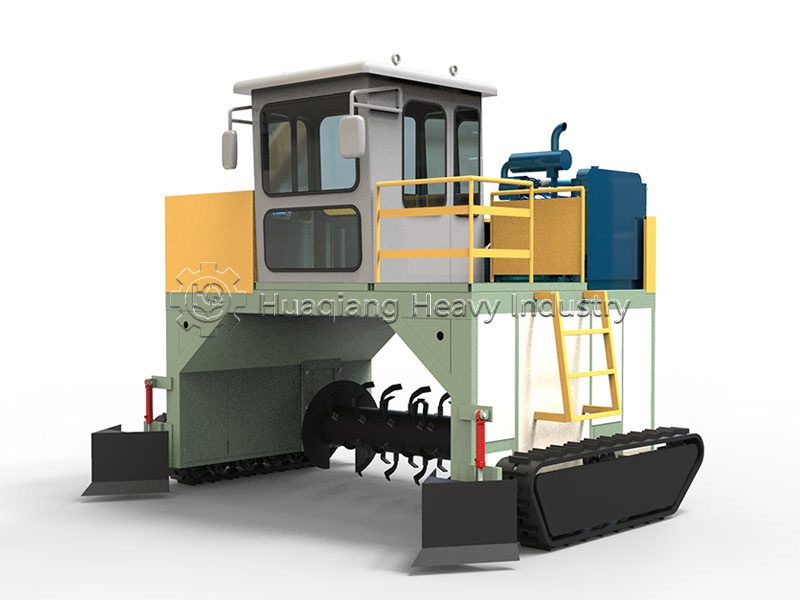
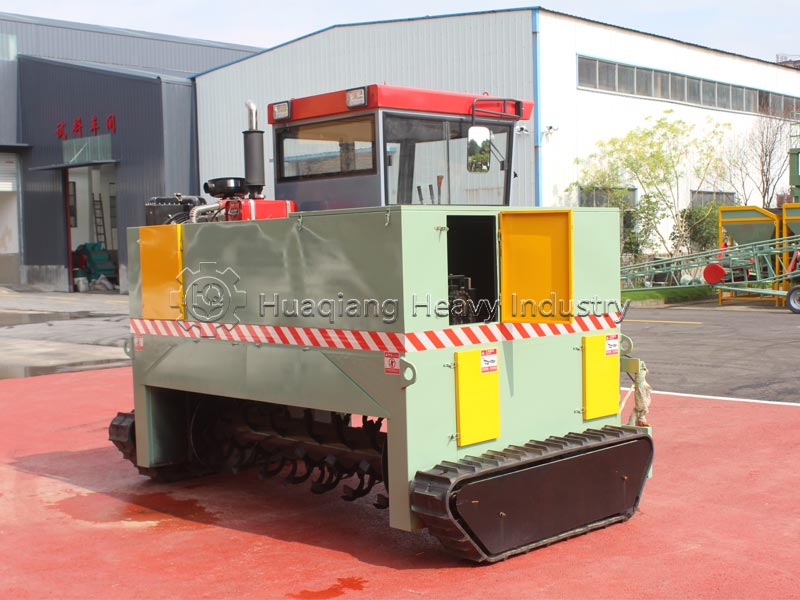
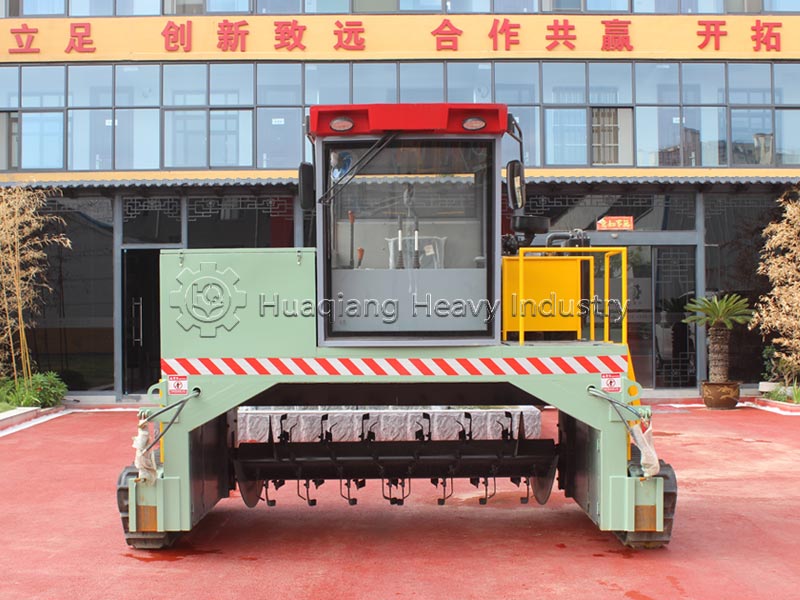
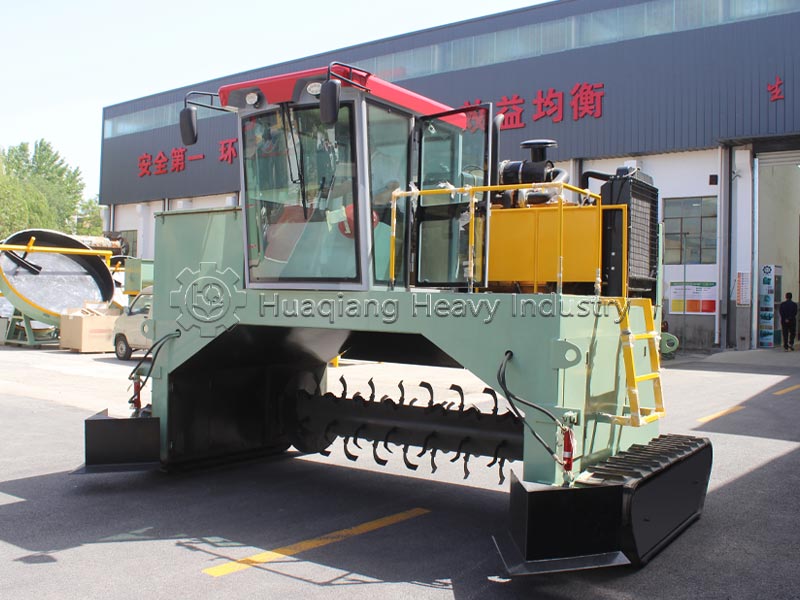
The windrow compost turner (also known as a self-propelled compost turner) is a large-scale ground compost turning device specifically designed for windrow aerobic fermentation. This equipment adopts a fully hydraulic operating system, tracks for movement, and is equipped with a high-power diesel engine. The turning width can reach 2.4 to 3.0 meters, and the turning height can reach 0.8 to 1.3 meters, with a processing capacity of 600–1500 cubic meters per hour. Its core function is to turn, oxygenate, crush, and mix the material pile during the organic material fermentation process, making it a key piece of equipment in the fermentation section of an organic fertilizer production line.
The windrow compost turner is also a core piece of equipment in the bio-organic fertilizer production process. It uses a tracked design to straddle pre-piled long, narrow compost piles, using a high-speed rotating turning shaft to crush, mix, oxygenate, and move the material. This model integrates mechanical intelligence technology, achieving stepless speed regulation for both movement and turning, making it one of the most efficient and versatile machines currently available for ground windrow fermentation processes.
Equipment Structure Composition
The windrow compost turner can be divided into the following core components:
1. Frame Section
It adopts a portal frame structure, consisting of two side plates and a middle connecting plate, allowing it to straddle strip-shaped manure piles. The frame and guard plates are all thickened using national standard materials to meet the demands of operation in highly corrosive environments.
2. Power System
The core is a diesel engine, a vertical water-cooled diesel engine, providing ample power, high efficiency, and low fuel consumption. Part of the power is mainly output, driving the turning drum via a belt pulley reduction drive; the other part is output through a diesel engine power distribution box to drive the hydraulic pump. The power generated by the engine is adjusted by the reducer to drive the various actuators.
3. Turning Device (Turning Roller/Cutter Shaft)
It mainly consists of the turning shaft and the turning cutters mounted on it. The working cutter diameter is typically 500mm. It adopts a horizontal spiral turning structure. The drum turning shaft uses a double sprocket and double chain drive, which greatly extends its service life. All components utilize universal joints for transmission, resulting in minimal twisting and durability.
4. Walking System
It employs a tracked walking system. A hydraulic motor drives the track drive wheel via a reducer, which, in conjunction with the track support wheels, drives the track movement. The hydraulic lines allow for independent control of the left and right tracks, enabling independent forward and backward movement without interference and with a small turning radius. The track design allows free movement on soft composting sites, providing a large ground contact area and low pressure to prevent burrowing into the material.
5. Hydraulic System
It employs a hydraulic operating system. The hydraulic pump is connected to the actuators (such as the roller lifting cylinder). The hydraulic system controls the raising and lowering of the turning shaft and the front pusher plate. The turning shaft’s ground clearance is adjusted hydraulically to prevent the turning shaft blades from touching the ground.
6. Driving and Control System
It features a driver’s cab equipped with all electrical buttons and joysticks, offering flexible and convenient operation. Air conditioning can be installed upon request. It uses a lever-type steering wheel.
7. Turning Shaft Speed Variable System The equipment is equipped with a turning shaft speed variable gear, which can adjust the rotation speed of the turning shaft according to the material characteristics and the difficulty of turning.
Equipment Application Scope
The windrow compost turner has a wide range of applications, covering aerobic fermentation treatment of various organic materials:
1. Organic Fertilizer Production:
Fermentation treatment of livestock and poultry manure (chicken manure, pig manure, cow manure, sheep manure, etc.)
Fermentation and turning of mixed materials (manure mixed with straw, sawdust, etc.)
2. Agricultural Waste Treatment:
Composting and fermentation of crop straw
Green manure, oilseed cake, and other organic materials
3. Organic Solid Waste Treatment:
Aerobic composting of urban sludge
Treatment of organic waste such as kitchen waste
Fermentation of contaminated soil and garbage compost
4. Large-Scale Livestock Farms:
Directly treats livestock and poultry manure near livestock pens, eliminating the need for manure transfer and achieving on-site fermentation, solving environmental emission problems.
5. Organic Fertilizer Plants:
Used in conjunction with open-air fermentation areas, flexibly processing batches of organic raw materials and overcoming the limitations of fixed compost turning equipment.
6. Other Fields:
Horticulture, biomass fermentation, etc.
Effectively prevents the generation of various harmful and odorous gases during fermentation, suitable for both viscous and powdery materials.
Raw Materials for the Equipment
The windrow compost turner can handle a wide range of raw materials, mainly including:
| Raw Material Category | Specific Raw Materials | Moisture Content Requirement |
|---|---|---|
| Livestock & Poultry Manure | Pig manure, chicken manure, cow manure, sheep manure, duck manure | 50%–65% |
| Crop Straw | Corn straw, wheat straw, rice straw, bean straw | Shall be crushed to ≤10 cm |
| Agricultural By-products | Rice husk, peanut shell, cottonseed hull, mushroom residue | Used as auxiliary material to adjust C/N ratio |
| Sludge Type | Municipal sludge, sugar mill filter mud, papermaking sludge | Mix with dry materials to adjust moisture |
| Domestic Garbage | Kitchen waste, fruit peel, vegetable leaves | Sort and remove non-biodegradable substances |
| Others | Biogas residue, distiller’s grains, traditional Chinese medicine residue, bone meal | Proportioning according to material characteristics |
Raw Material Pretreatment Requirements:
C/N ratio adjusted to approximately 25:1
Moisture content controlled at 50%–65%
pH value controlled at 6–9
Materials need to be pre-piled into long windrows.
Equipment Parameters
| Item | HQ-FD 2500 | HQ-FD 2600 | HQ-FD 3000 |
|---|---|---|---|
| Model | HQ-FD 2500 | HQ-FD 2600 | HQ-FD 3000 |
| Compost Turning Width (mm) | 2500 | 2600 | 3000 |
| Compost Turning Height (mm) | 500-1000 | 500-1100 | 500-1200 |
| Stack Spacing (m) | 1.0-1.2 | 1.0-1.2 | 1.0-1.2 |
| Max Particle Size of Raw Material (mm) | 250 | 250 | 250 |
| Power | R4102 Turbocharged 90HP Diesel Engine | R4105 Turbocharged 105HP Diesel Engine | R6105 Turbocharged 136HP Diesel Engine |
| Rated Power Speed (r/min) | 2200 | 2200 | 2200 |
| Working Travel Speed (m/min) | 6-18 | 6-18 | 6-18 |
| Transfer Driving Speed (m/min) | 50 | 50 | 50 |
| Processing Capacity (m³/h) | 400-600 | 600-800 | 1000-1200 |
| Overall Dimension (m) | 3.64×2.6×2.7 | 3.75×2.6×2.7 | 4.36×2.75×2.95 |
Working Principle of the Equipment
The working principle of the windrow compost turner is based on the biological requirements of aerobic fermentation, revolving around three core aspects: power transmission, material turning, and aeration fermentation:
Step 1 – Equipment Mounting and Positioning
The entire vehicle mounts a pre-piled, elongated compost base during operation. The equipment moves across the material pile via its tracked walking mechanism.
Step 2 – Power Distribution and Transmission
The diesel engine power is divided into two paths: one part is the main output, driving the turning drum rotation via a belt pulley reduction drive; the other part is output through a diesel engine power distribution box, driving the hydraulic pump to provide power to the hydraulic system.
Step 3 – Turning and Crushing
The auger blades under the frame turn the compost base material. The turning shaft rotates at high speed, and the turning blades turn, break up, and throw the material from the bottom to the rear. The blade shaft effectively crushes clumps formed during the raw material fermentation process. During the turning process, the material is fully stirred and loosened, achieving uniform mixing.
Step 4 – Oxygen Supply and Aeration
While turning the material, the compost turner introduces air (oxygen) into the pile. Turning the compost pile allows for ample exchange of temperature, humidity, and oxygen between the pile and the outside environment. Aerobic microorganisms accelerate the decomposition of organic matter under sufficient oxygen conditions, maintaining a high-temperature fermentation environment of 60-70℃.
Step 5 – Compost Reshaping: After the turner operates, new windrows are formed, eliminating the need for manual manpower to maintain the compost pile. As the turner continues to move forward, the material is turned, broken, and repositioned, forming new windrows.
The core value of the turner for aerobic fermentation lies in: achieving the exchange of temperature, humidity, and oxygen between the internal structure of the compost pile and the outside environment through turning, accelerating the organic fertilizer fermentation process and shortening the production cycle.
Equipment Operation Method
Break-in Period: New machines require 5-6 hours of no-load or light-load break-in (moving, reversing, turning).
Before Start-up: Check the electrical circuit, belt tension, engine oil, and coolant.
Start-up Operation: Depress the clutch fully, ignite, and idle for 10 minutes. During operation, engage first gear and move at low speed. The turning shaft speed should be stabilized at approximately 2400 rpm. Adjust the travel speed according to the dryness of the material.
Stopping: First stop the turning shaft, then disconnect the power.
Equipment Maintenance Methods
1. Routine Maintenance (Daily/Per Shift): Perform maintenance weekly when operation is infrequent; perform maintenance daily when operation is frequent.
| Maintenance Item | Specific Content |
|---|---|
| Bolt Inspection | Check whether all connecting bolts, nuts and oil drain plugs are loose. |
| Pin Inspection | Check for damage to pins and cotter pins at all positions; replace them in a timely manner (no substitutes allowed). |
| Blade Inspection | Check if composting blades are damaged and whether the fastening bolts are loose; supplement, tighten or replace the blades when necessary. |
| Electrical Inspection | Check if all connectors are fastened and the wire insulation is intact; repair or replace wires if required. |
| Component Fastening Check | Check the fastening screws of diesel engine, gearbox, bearing housings and other components for looseness. |
| Cleaning Work | Remove caked attachments on the compost turner. |
| Fluid Level Inspection | Check the residual fluid volume of oil tank and water tank. |
2. Periodic Maintenance (Quarterly/Every 500–2000 Working Hours)
| Maintenance Item | Specific Content |
|---|---|
| Gear Oil Replacement | Replace the reducer gear oil (220#) after one full season of operation. |
| Hydraulic Oil Replacement | Fill the travel gearbox with 68# hydraulic oil, and fill the hydraulic tank with 46# hydraulic oil. |
| Bearing Maintenance | Inspect all bearings and chains at each position; disassemble and clean them before applying new grease. Replace severely worn parts. |
| Dust Cover Inspection | Remove dust covers and check & tighten all bolts on transmission rods. |
| Drive Shaft Inspection | Remove the cab seat and cover plate, then check and fasten the bolts on the drive shaft base. |
| Winter Protection | Add antifreeze liquid to the water tank when operating in winter. If antifreeze is not added, fill warm water before operation; drain all water from the water tank, machine body and cooler after work to avoid frost damage. |
| Electrical Inspection | Check whether all electrical components work normally and the circuit insulation performance is good; replace wires when necessary. |
| Belt Inspection | Regularly check the tension of drive belts and adjust it if needed; inspect belts for cracks, wear or aging, replace them as required. Re-adjust the tension of new belts after 2–3 weeks of use. |
| Anti-rust Treatment | Apply anti-rust oil to all exposed parts during long-term shutdown; cover the whole machine when stored outdoors. |
Common Equipment Problems and Solutions
| Fault Phenomenon | Possible Causes | Solutions |
|---|---|---|
| Weak traveling power of compost turner | Worn chassis components; unbalanced crawler tightness | Inspect core chassis parts; adjust crawler tightness |
| Crawler slipping | Slippery and muddy working ground; over-loose crawler | Lay wood boards or steel plates on slippery ground to increase friction; adjust crawler tension; avoid working on steep slopes exceeding the climbing capacity of the machine |
| Black smoke from engine | Material overload; excessive composting load | Step on the clutch, and move forward again after the diesel engine speed returns to normal |
| Materials wrapped around composting shaft | Long-fiber materials such as rice straw wrapped on the composting shaft | Stop the machine for cleaning in time; never force turning or reverse movement |
| Poor composting effect | Worn or missing composting blades; improper rotating speed | Inspect and replace worn blades; adjust the rotating speed of composting shaft |
| Abnormal equipment noise | Loose parts; worn bearings | Stop the machine for inspection immediately, and resume work after troubleshooting |
| Insufficient pressure of hydraulic system | Insufficient hydraulic oil; blocked oil circuit | Check hydraulic oil level; clean hydraulic pipelines; replace hydraulic oil |
| Low battery power | Frequent short-time operation; generator fails to charge in time | Charge the storage battery timely; disconnect battery wiring when the machine is not used for a long time |
| Belt slipping or breaking | Insufficient belt tension; aging and worn belt | Adjust belt tension; replace damaged or aged belts |
Application of Equipment in Organic Fertilizer Production Lines
The windrow compost turner is the core fermentation unit in a windrow organic fertilizer production line. It is equipped with front-end raw material pretreatment and rear-end crushing, screening, hydraulic roller granulation, and packaging equipment. There are two production line configurations:
1. Small-scale organic fertilizer production line (10,000-30,000 tons/year)
Process flow: Mixing livestock and poultry manure and straw → Windrow stacking → Periodic turning and composting by tracked compost turner → Crushing of composted organic fertilizer → Screening → Hydraulic roller dry granulation → Packaging of finished granules
2. Large-scale organic fertilizer production line (50,000-100,000 tons/year)
Process flow: Solid-liquid separation of manure and sludge → Automatic batching and mixing of raw materials → Large windrow composting yard → Circulating turning by multiple tracked compost turners → Secondary composting and aging → Fine crushing → Screening and impurity removal → Hydraulic roller granulation / disc wet granulation → Coating and cooling → Automatic weighing and packaging
3. Standalone independent operation mode: For farms without a fixed production line, a tracked compost turner can be purchased separately, and a manual loader can be used to assist in stacking. After fermentation and decomposition, the powdered organic fertilizer can be sold directly without the need for granulation equipment.
Equipment Fermentation Process
The windrow compost turner serves the aerobic composting fermentation process and is the core equipment in the fermentation section of organic fertilizer production.
(I) Windrow Composting Process
Windrow composting technology refers to the aerobic fermentation process where materials are piled into long, narrow stacks and mechanically aerated using a specialized turner. Tracked turners are used in ground-based windrow composting fermentation processes. Materials need to be piled into long windrows, and the turner periodically stirs and breaks up the materials, allowing organic matter to decompose under aerobic conditions.
(II) Aerobic Fermentation Stage
Aerobic composting fermentation typically involves the following stages:
1. Pre-mixing: Livestock manure, fillers, etc., are mixed evenly in a specific ratio.
2. Heating Stage: The pile temperature gradually rises from ambient temperature to approximately 45°C. The dominant microorganisms are primarily mesophilic microorganisms (fungi, bacteria, and actinomycetes), and the decomposed substrates are mainly sugars and starches. 3. High-Temperature Stage: The turner introduces air into the compost pile through turning, providing oxygen for aerobic microorganisms. The compost temperature can reach 55-70℃. Maintain a high temperature of 60-70℃ for 3-4 days. High temperatures kill pathogens and weed seeds.
4. Maturation Stage: As easily decomposable organic matter is depleted, the temperature gradually decreases, and the material becomes mature and stable.
(III) The Role of Turning in Fermentation
Turning is an important measure to improve composting efficiency and product quality. The core value of the turner for aerobic fermentation lies in:
Oxygen Supply: Turning introduces air (oxygen) into the compost pile, meeting the metabolic needs of aerobic microorganisms.
Temperature Regulation: Turning dissipates heat, preventing excessively high pile temperatures that inhibit microbial activity.
Humidity Regulation: Turning promotes moisture evaporation, regulating pile humidity.
Crushing: The cutter shaft effectively crushes clumps formed during raw material fermentation.
Homogeneity: Ensures uniform mixing of materials within the pile, preventing localized anaerobic conditions.
The turning process typically involves 4-5 cycles. The compost turner also functions as a crusher, eliminating the need for an additional crusher during production, thus significantly improving work efficiency and reducing costs.
(IV) Fermentation Effect Through continuous turning, the compost turner effectively breaks down clumps formed during the fermentation process. The fermented organic matter is fully decomposed and can be directly fed into the granulation stage. Aerobic composting not only solves environmental pollution problems but also provides a source of organic fertilizer for agriculture.
Core Target Audience:
1. Large-scale livestock and poultry farms: Large-scale pig, chicken, cattle, and sheep farms requiring environmentally friendly and resource-based manure treatment to address environmental regulations regarding manure discharge and reduce fertilizer procurement costs by producing their own organic fertilizer.
2. Organic fertilizer production plants: Plants producing 10,000-100,000 tons of powdered/granular organic fertilizer annually require low-cost windrow fermentation equipment to replace high-infrastructure trough-type compost turners.
3. Environmental solid waste treatment companies: Environmental engineering contractors undertaking harmless composting projects for municipal sludge, kitchen waste, and garden waste.
4. Agricultural planting bases and family farms: Thousands of acres of orchards and vegetable bases requiring self-made fermented organic fertilizer for fruit and vegetable cultivation.
5. Organic fertilizer equipment dealers and production line contractors: Procurement of complete organic fertilizer fermentation + granulation production lines, selling complete machines to end-user farms and fertilizer plants.
6. Agricultural and forestry waste recycling and processing enterprises: Recycling and composting straw and mushroom residue into organic fertilizer for export.
Core Advantages of the Equipment
Compared to wheeled models,windrow compost turners offer better maneuverability and higher stability. Their “dual stepless speed control” technology automatically adjusts according to material resistance, ensuring fermentation quality (sufficient oxygen intake) and significantly extending machine lifespan, making them a core tool for the industrialization of windrow composting.
Equipment Safety Prohibitions and Important Supplementary Instructions
1. Unauthorized modification of the machine structure or addition of external equipment is prohibited. The manufacturer will not be liable for after-sales service for damage caused by modifications.
2. Operation on sloping ground or areas with unevenness exceeding 20cm is strictly prohibited to prevent track rollover and chassis damage.
3. This equipment is a site-specific fermentation machine and is prohibited from long-distance road travel. Cross-site transport must be carried by flatbed trailer.
4. When the equipment is running, no one is allowed to stand around the rollers or tracks. Personnel are prohibited from staying in front of or behind the operating area to prevent injury from falling materials.
5. In damp, sewage-filled working environments, the circuit insulation must be checked regularly to prevent short circuits that could burn out the electrical control system.
6. Overloading, exceeding width limits, and exceeding height limits are strictly prohibited. Long-term overloading will damage the reducer and hydraulic system.
Windrow compost turners, as core equipment in the fermentation section of organic fertilizer production lines, have become the preferred choice for large-scale organic fertilizer plants, large-scale livestock farms, and sludge treatment centers due to their advantages such as full hydraulic drive, tracked movement, on-the-spot turning, and high-power turning. Their aerobic fermentation technology can transform livestock manure, agricultural waste, and other organic raw materials into high-quality organic fertilizer within 15-20 days, achieving the dual goals of resource utilization and environmental protection.
Whether you are building a new organic fertilizer/compound fertilizer/feed production line and need a complete equipment solution, upgrading an existing production line and need equipment selection advice, or encountering difficulties in granulating high-moisture, sticky, or coarse-fiber materials and need technical support—we are always ready to provide you with professional and sincere service.
Have Any Problem? Please, Contact
Integrity
Adhere to honesty and trustworthiness, be responsible to customers, employees, partners, and society, and establish long-term trust relationships.
Win win
Establish win-win relationships with all stakeholders such as customers, suppliers, and employees to share the fruits of enterprise development.