
Biological Organic NPK vs. Compound Fertilizer vs. Organic Fertilizer: Which is the Optimal Solution for Agriculture?
Faced with a dazzling array of fertilizers on the market, growers often face a dilemma: compound fertilizers are fast-acting but the soil becomes increasingly compacted with continued use; organic fertilizers nourish the soil but have a slow-release effect; and biological organic NPK seems comprehensive but the cost is a concern. What are the fundamental differences between these three types of fertilizers? Which one can truly achieve a win-win situation of “high yield + soil nourishment”? This article provides an in-depth analysis from four dimensions.
Nutrient Release: The Game Between Quick-Acting, Long-Lasting, and Dual-Effect Fertilizers Ordinary compound fertilizers are known for their quick-acting nature, being absorbed by crops within days of application to the soil. However, their nutrient release curve is steep, leading to potential nutrient deficiency later on. Organic fertilizers, on the other hand, are “slow-release,” requiring microorganisms to slowly mineralize nutrients, resulting in a long-lasting effect but insufficient initial supply. Bio-organic NPK achieves a synergistic effect of “rapid-acting + long-lasting”: inorganic NPK provides immediately available nutrients, organic matter provides slow-release energy, and functional microorganisms further activate nutrients fixed in the soil, perfectly matching the supply curve with the peak demand of crops.
Soil Impact: Compaction, Improvement, and Deep Remediation
Long-term single application of compound fertilizers is a major contributor to soil compaction. Excessive salt accumulation, lack of organic matter, and a monotonous microbial community lead to the destruction of soil aggregate structure and a gradual decline in water and fertilizer retention capacity. Ordinary organic fertilizers can significantly improve soil physical structure and increase organic matter content, but their repair effect on degraded microbial ecosystems is limited. Bio-organic NPK achieves a dual repair effect of “physical + biological”: organic matter rebuilds aggregate structure, functional microbial communities (Bacillus subtilis, phosphorus- and potassium-solubilizing bacteria) restore soil microecology, activate fixed nutrients, and allow the soil to enter a virtuous cycle.
Cost-Effectiveness: Short-Term, Long-Term, and Overall Optimal
From the perspective of single input, ordinary compound fertilizers are the cheapest, followed by organic fertilizers, and bio-organic NPKs are the most expensive. However, from a comprehensive benefit perspective, the results are drastically different: While compound fertilizer has a low unit price, its application needs to be increased annually to maintain yield, and soil degradation leads to diminishing fertilizer effectiveness; organic fertilizer input is moderate, but its yield-increasing effect is limited; bio-organic NPK has a high initial input, but a 15%-20% reduction in chemical fertilizer use can maintain high yields, and agricultural inputs decrease year by year after soil improvement. Three-year tracking data from a tomato base in Shandong shows that bio-organic NPK reduces overall costs by 12% and increases benefits by 25% compared to ordinary compound fertilizer.
Yield and Quality: High Yield, Stable Yield, and High Quality
Compound fertilizer can guarantee high basic yields, but crops have weak resistance and mediocre quality; organic fertilizer has good yield stability, but its yield ceiling is relatively low; bio-organic NPK achieves simultaneous improvement in “high yield + high quality.” The auxins, antibiotics, and other active substances produced by beneficial microbial metabolism promote root development, inhibit diseases, increase fruit sugar content by 1-2 degrees, enrich flavor compounds, and enhance storage and transportation resistance. Experiments in Henan province showed that bio-organic NPK fertilizer increased yield by 8.6% and grain protein content by 0.8 percentage points compared to compound fertilizers with equal nutrients.
When considering products on the market, three core indicators are crucial: total nutrients (NPK content) reflect immediate supply capacity; organic matter content reflects soil improvement potential; and the number of effective viable bacteria (≥0.2 billion/gram) determines microbial efficacy. All three are indispensable; insufficient levels in any one area will hinder the achievement of the combined effects of “quick effect + long-lasting effect + soil nourishment.”

From single-function to synergistic enhancement, the evolution of fertilizers has always focused on unifying “crop needs and soil health.” Bio-organic NPK is not a simple replacement, but rather combines the three advantages of quick effect, long-lasting effect, and soil nourishment, making it the preferred solution for modern green agriculture.
Fertilizer Comparison: Compound vs. Organic vs. Bio-Organic NPK
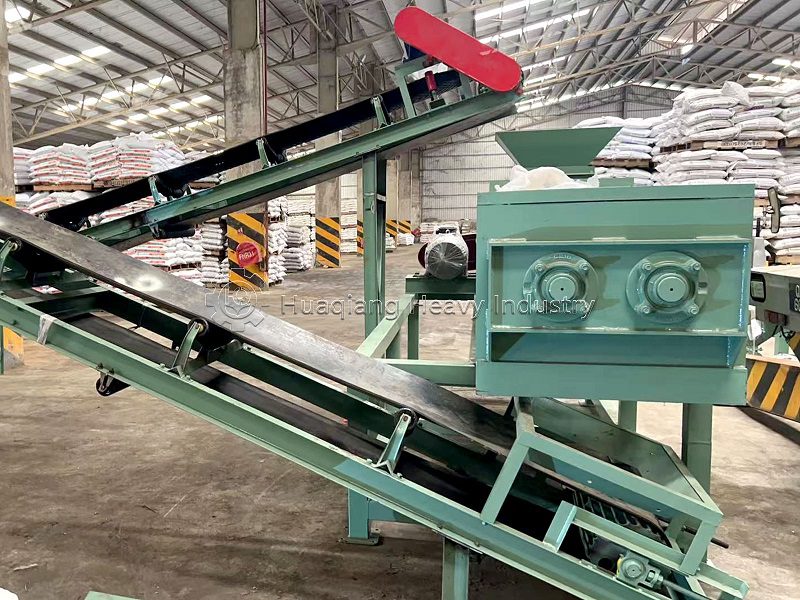
The compelling advantages of bio-organic NPK—its quick action, long-lasting effect, and soil-nourishing properties—are achieved through a sophisticated production process. This process relies on a complete set of organic fertilizer production equipment designed to integrate these three key components. The journey begins with organic fertilizer raw material processing equipment, such as a half-wet material crusher machine, which prepares the fermented organic base to the ideal particle size. This finely processed material is then ready for the organic fertilizer production granulation stage. Within the organic fertilizer granulator series, several options exist to create the final, easy-to-apply product. For producing the high-quality, spherical granules that define premium fertilizers, a complete organic fertilizer disc granulation production line is a classic and effective choice. For operations seeking a compact, efficient solution, a new type two in one organic fertilizer granulator can combine the final stages of conditioning and initial granulation. This integrated production system ensures that the organic matter, inorganic NPK, and beneficial microorganisms are uniformly combined into a stable, high-quality granule, delivering the synergistic benefits that make bio-organic NPK the preferred choice for growers seeking both high yields and long-term soil health.