
Six Steps to Master the Complete Organic Fertilizer Production Process
With the advancement of green agricultural development, more and more farmers are paying attention to the production and application of organic fertilizer. Converting agricultural waste such as livestock and poultry manure and crop straw into high-efficiency organic fertilizer not only solves environmental pollution problems but also helps farmers save costs and increase income. Below is a detailed introduction to the latest complete organic fertilizer production process in 2026.
Step 1: Raw Material Preparation and Crushing The first step in organic fertilizer production is the collection and pretreatment of raw materials. Commonly used raw materials include livestock and poultry manure (chicken manure, pig manure, cow manure, etc.), crop straw, rice husks, sawdust, and other agricultural waste. For straw-based raw materials, a crusher is needed to pulverize them to an appropriate length, usually 1-3 cm, to increase the contact area between microorganisms and the material, accelerating fermentation and decomposition. If it is whole corn stalks, they also need to be flattened to break down their structure. At the same time, different raw materials should be mixed in proportion according to the formula, adjusting the carbon-to-nitrogen ratio (C/N) to between 25:1 and 30:1 to create favorable conditions for subsequent fermentation.
Step Two: Aerobic Fermentation and Intelligent Turning
Fermentation is the most crucial step in organic fertilizer production. The mixed materials are piled up or placed in a fermentation tank, and highly efficient fermentation agents such as EM bacteria and enzyme bacteria are added to initiate the aerobic fermentation process. An intelligent aerobic fermentation system is used, which collects real-time data on pile temperature and oxygen concentration through an oxygen and temperature monitoring device. When the temperature exceeds the set safety value (usually above 70℃), the turning machine automatically performs the turning operation. Simultaneously, the aeration system supplies oxygen to the pile, ensuring the continuous activity of aerobic microorganisms. A complete composting process generally requires 7-10 days to reach initial maturity, with the pile temperature maintained at 50-65℃ for more than 10 days, effectively killing pathogens, insect eggs, and weed seeds. The entire fermentation cycle takes approximately 20-30 days, requiring 2-3 turnings to ensure uniform fermentation.
Step Three: Automatic Batching and Mixing
The matured materials enter the batching system. This step utilizes an automated batching system to precisely measure and add inorganic nutrients such as nitrogen, phosphorus, and potassium, or functional additives, according to the nutrient requirements of the target organic fertilizer. An electronic weighing system ensures accurate proportions, and a twin-shaft mixer thoroughly mixes all raw materials. For the production of bio-organic fertilizer, functional microbial agents are also added at this stage, and the material moisture content is controlled at approximately 30%-35% to prepare for subsequent granulation.
Step Four: Granulation and Forming
Granulation is the crucial step in turning powdered materials into granules. There are three common granulation methods: disc granulators are suitable for small-scale production, producing round and uniform granules; drum granulators have high output and are suitable for large-scale production lines; and roller extrusion granulation requires no drying or only low-temperature drying, making it particularly suitable for the preservation of heat-sensitive functional bacteria. An appropriate amount of binder is added during granulation to ensure moderate granule strength for easy transportation and application. Some processes employ a secondary granulation method combining drum granulation and disc granulation to make the granules even smoother and more aesthetically pleasing.
Step 5: Drying, Cooling, and Screening The granulated granules have a high moisture content and require drying. The drying temperature is typically controlled at 60-70℃ to avoid damaging organic matter and beneficial microorganisms. A two-stage drying and two-stage dust removal process is used to prevent nutrient loss and effectively reduce dust pollution. The dried granules are still hot and need to be cooled to room temperature in a cooler to prevent clumping after packaging. Finally, they are screened using a grading vibrating screen. Granules with the correct diameter proceed to the next stage, while those that fail are returned to the granulation process for reprocessing.
Step 6: Coating and Packaging To prevent clumping of the organic fertilizer granules during storage and transportation, coating is required. A protective film is formed on the granule surface using powder coating or liquid coating. Depending on the product positioning, coloring agents can also be added at this stage to enhance the product’s appearance. Finally, the granules are weighed and packaged by an automatic packaging machine according to a set weight (e.g., 40 kg/bag), and the finished product is stored for sale. Standardized production processes not only improve fertilizer quality but also provide strong guarantees for enterprises’ compliant production and market sales.
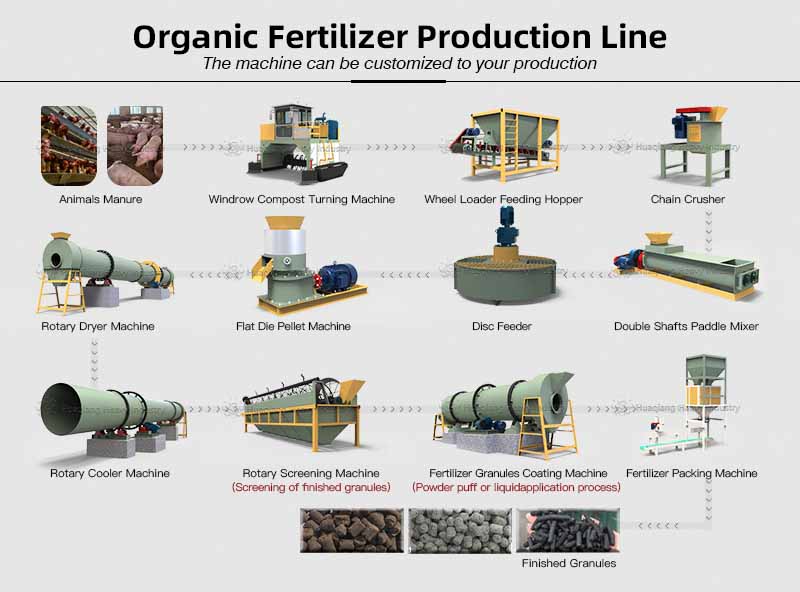
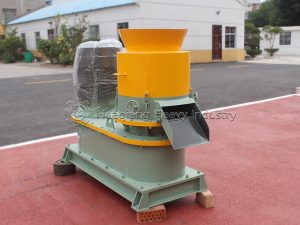
The six-step process described above forms the backbone of a modern organic fertilizer production equipment line. The journey begins with organic fertilizer raw material processing equipment, such as a half-wet material crusher machine and a straw crusher, which prepare the diverse feedstocks into a uniform state for the organic fertilizer fermentation process. Following maturation, the material is ready for the organic fertilizer production granulation stage. Within the organic fertilizer granulator series, several options exist to create the final product. For producing high-quality, spherical granules, a complete organic fertilizer disc granulation production line is a classic and effective choice. For operations seeking a compact, efficient solution, a new type two in one organic fertilizer granulator can combine the final stages of conditioning and initial granulation. For those focusing on cylindrical pellets, a flat die press pellet machine for sale offers a simple, low-cost entry point. In a dedicated bio organic fertilizer production line, the focus shifts to preserving microbial activity, often favoring low-temperature drying and gentle granulation methods. The integration of these technologies—from the initial crusher to the final granulator—is what transforms raw organic waste into a stable, consistent, and high-value product, ready to nourish crops and improve soil health. Whether a small farm or a large-scale production base, selecting the right organic fertilizer production equipment from this diverse granulator series is the key to success.