
Aerobic vs. Anaerobic: How to Choose the Right Equipment for Organic Fertilizer Fermentation?
In organic fertilizer production, the fermentation process is the core element determining product safety and nutrient conversion. According to industry technical specifications for organic fertilizer production lines, the mainstream fermentation methods are divided into aerobic fermentation and anaerobic fermentation, each with drastically different equipment requirements. Choosing the wrong process can lead to fermentation failure or, in severe cases, serious environmental pollution.
What are Aerobic and Anaerobic Fermentation?
Aerobic fermentation refers to the process where, under aerobic conditions, aerobic microorganisms decompose complex organic matter into humus. This process releases a large amount of heat, with the pile temperature reaching 60-70℃, effectively killing pathogens and parasite eggs. Typical equipment includes trough-type compost turners and tracked compost turners.
Anaerobic fermentation, on the other hand, occurs in an anaerobic environment, where anaerobic bacteria convert organic matter into methane, carbon dioxide, and a small amount of compost residue. This process occurs at lower temperatures (35-55℃) and requires a completely sealed reaction vessel. Typical equipment is the anaerobic fermentation tank (CSTR or UASB).
Equipment Requirements and Configuration for Aerobic Fermentation The core requirements of aerobic fermentation are sufficient oxygen supply and uniform turning. Equipment selection should revolve around these two points.
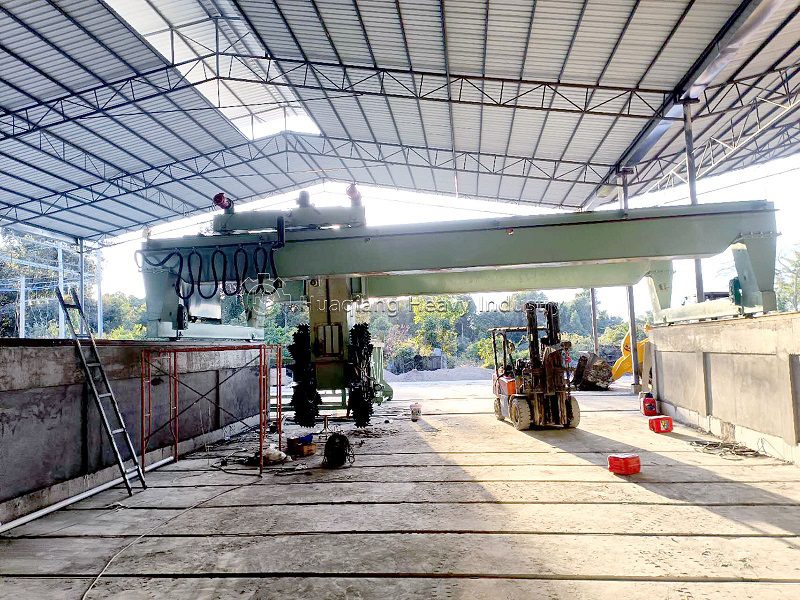
Essential Equipment List:
Turning Equipment: Trough-type turning machines are suitable for medium to large-scale production lines. A single trough width is 3-6 meters, and the turning depth can reach 1.2-1.5 meters, with a processing capacity of 50-150 cubic meters per hour. Tracked turning machines are more flexible and suitable for rotating operations across multiple piles. According to the equipment parameters of Zhengzhou Tianci Machinery, the turning frequency is usually once every 1-2 days to ensure that the core temperature is maintained above 55℃ for at least 5 days.
Aeration System: Perforated ventilation pipes are laid at the bottom of the fermentation tank, and forced air is supplied by a high-pressure blower at regular intervals. The air volume is designed at 0.2-0.5 cubic meters per minute per cubic meter of material, and the air pressure must be greater than the pile resistance (usually 3000-5000 Pa).
Deodorization Device: Aerobic fermentation inevitably produces malodorous gases such as ammonia and hydrogen sulfide. It is recommended to configure a biological filter or an acid washing spray tower. The former has low operating costs and a removal rate of up to 95%; the latter has moderate investment and is suitable for factories located near residential areas.
Key control parameters:
Material moisture content: 55%-65%
C/N ratio: 25:1-30:1
Oxygen concentration in the digester: ≥8%
III. Equipment Requirements and Configuration for Anaerobic Fermentation
The core requirement for anaerobic fermentation is strict sealing and constant temperature control, resulting in significantly higher equipment investment than aerobic processes.
Essential equipment list:
Anaerobic digester: Generally made of steel or concrete, with a volume ranging from 100 cubic meters to 5000 cubic meters. The tank must be equipped with a double-layer insulation layer (rock wool + polyurethane) and heating coils, utilizing a biogas boiler or waste heat to maintain the internal temperature at 35-38℃ (mesophilic fermentation) or 52-55℃ (high-temperature fermentation).
Mixing Device: A submersible mixer or biogas circulation mixing system is installed inside the tank to prevent material stratification and scum crusting, ensuring full contact between microorganisms and the substrate.
Biogas Collection and Purification System: Includes a gas holder (dual-membrane or wet type), a desulfurization tower (dry or wet desulfurization), and a dehydrator. Biogas can be used for power generation or boiler heating, with a gas production rate of approximately 300-500 cubic meters per ton of dry matter.
Feeding and Discharging Equipment: A screw pump pumps the pre-treated material (85%-90% moisture content) into the tank; the biogas residue and biogas slurry discharged from the bottom of the tank need to be treated by a solid-liquid separator.

Key Control Parameters:
Material Solids Content: 8%-12%
C/Nitrogen Ratio: 20:1-30:1
pH Value: 6.8-7.5
HRT (Hill Retention Time): 20-40 days
Applicable Raw Materials:
Aerobic Fermentation: Suitable for livestock and poultry manure, straw, mushroom residue, and kitchen waste (solids content ≥25%)
Anaerobic Fermentation: Suitable for high-concentration organic wastewater, pig manure, and kitchen waste (solids content <15%)
Aerobic Fermentation: Produces well-rotted organic fertilizer (for direct sale), with no secondary pollution.
Anaerobic Fermentation: Produces biogas residue fertilizer (requires post-fermentation) + biogas (can generate electricity or be connected to the grid), resulting in higher overall returns, but with more complex operation and management.
From Fermentation Choice to Integrated Organic Fertilizer Value Chain
The decision between aerobic and anaerobic fermentation is merely the first chapter in constructing a profitable organic fertilizer enterprise. Once the optimal biological pathway is validated through pilot-scale testing, the operational focus shifts to building a cohesive organic fertilizer production equipment ecosystem that transforms raw biomass into market-ready product with maximum efficiency and minimum environmental liability. For aerobic operations processing livestock manure and agricultural residues, trough-type fermentation composting technology provides the controlled channel environment where oxygen concentration remains ≥8% and core temperatures sustain 55°C+ for the critical five-day pathogen inactivation window. Complementing this, a high-capacity large wheel compost turning machine ensures uniform turning across expansive windrow layouts, accelerating thermophilic phases while minimizing anaerobic pockets that would otherwise generate malodorous emissions requiring costly biofilter treatment. Once fermentation reaches maturity—organic matter exceeding 45%, moisture stabilized, and pathogens fully inactivated—the downstream value chain begins with robust organic fertilizer raw material processing equipment: a precision half-wet material crusher machine reduces composted substrate to ≤0.5mm fineness, eliminating oversized clods that would compromise granule density and nutrient uniformity. This refined feedstock then enters a versatile organic fertilizer granulator series, where equipment selection is calibrated to product positioning. A new type organic fertilizer granulator engineered for high-pressure compaction produces dense, interlocked cylindrical pellets with crushing strength exceeding 15 Newtons—ideal for mechanized field application and long-distance transport. Alternatively, an organic fertilizer disc granulation production line delivers spherical granules with uniform 2-4mm sizing and smooth surface aesthetics, commanding premium pricing in horticulture and greenhouse markets where visual quality drives purchasing decisions. Whether the fermentation front-end is aerobic or anaerobic, the plants that dominate the 2026 organic fertilizer landscape are those that engineer every stage—from compost turning and substrate crushing through granulation and packaging—as an integrated, data-validated system rather than a collection of independently procured machines. This end-to-end integration ensures that biological efficiency upstream translates directly into product quality, market premium, and regulatory compliance downstream.
Practical Conclusions
If your raw material is solid waste with moderate moisture content (such as chicken manure, cow manure, and straw), and you have a limited budget, aerobic fermentation + compost turner is a more practical choice—the technology is mature, the operation is simple, and the product is directly marketable.
If your raw materials are high-moisture liquids (such as sewage flushing water or organic wastewater from food factories) and you have energy needs for self-use (power generation or heating), the anaerobic fermentation + tank system, although requiring a higher initial investment, offers better overall economic benefits in the long run.
Regardless of the process chosen, please be sure to take raw material samples to the equipment supplier’s pilot plant for fermentation testing before starting the project—this is the most reliable way to avoid investment mistakes.