
A Crucial Step Before Fermentation: The Application of Half-Wet Material Crusher in Organic Fertilizer Production
In organic fertilizer production, the pretreatment of raw materials before fermentation is often overlooked, yet it is precisely the key step determining fermentation efficiency and finished product quality. Livestock manure, wet straw, and fermentation substrate—these main raw materials for organic fertilizers—are all semi-wet materials, with a moisture content typically between 50% and 80%. Traditional crushers struggle with these materials. The semi-wet material crusher was developed to solve this problem. With its core strength in handling high-moisture materials, it has become the core equipment for pretreatment before organic fertilizer fermentation. This article will detail the practical points and process matching of this equipment in organic fertilizer production.
Suitable Types of Organic Fertilizer Raw Materials
The semi-wet material crusher can process a wide range of organic fertilizer raw materials:
Fresh livestock manure: chicken manure, cow manure, pig manure, etc., with a moisture content as high as 60%-80%. These types of materials are highly viscous and prone to clumping, making them impossible to process with ordinary crushers. However, semi-wet material crushers, through high-speed impact and tearing, can break them into uniform, fine fragments, creating favorable conditions for subsequent fermentation.
Straw/Rice Husks After Rain: Straw and rice husks stored outdoors, once rained on, experience a sharp increase in moisture content to over 50%, becoming soft and difficult to crush. The cutting action of a half-wet material crusher can effectively cut them to 3-5 cm, preventing large pieces of straw from forming a “barrier layer” in the fermentation pile.
Incompletely Fermented Lumped Base Material: Lumps and large particles in the returned material that appear during fermentation can be returned to the machine for re-crushing, achieving raw material recycling.
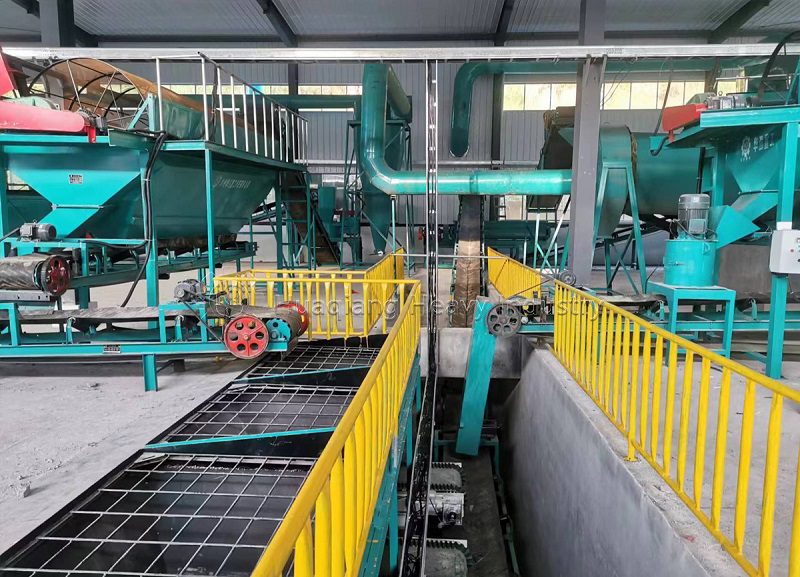
Key Points for Practical Operation of Organic Fertilizer Production
Treatment of Livestock and Poultry Manure: Fineness Determines Fermentation Efficiency
When crushing livestock and poultry manure, the output fineness can be adjusted according to the subsequent fermentation requirements. It is recommended to crush the material to a uniform fineness of 80-100 mesh by adjusting the rotor speed and blade gap. Higher particle size results in a larger specific surface area of the material, allowing for more thorough contact with microorganisms and faster fermentation initiation. Simultaneously, uniform particle size facilitates precise adjustment of the subsequent carbon-nitrogen ratio—when finely crushed manure is mixed with straw powder, the two can truly achieve a state of mutual interdependence, preventing localized carbon-nitrogen imbalances during fermentation.
Handling Wet Straw: Length Control is Key
Straw is an important auxiliary material for adjusting the carbon-nitrogen ratio, but wet straw is prone to tangling and difficult to chop. The high-speed cutting action of a semi-wet material crusher can instantly cut wet straw. It is recommended to control the output length at 3-5 cm during operation. This length ensures uniformity when mixed with manure and also acts as a framework in the fermentation pile, maintaining its aeration. Too short (less than 2 cm) will lead to powdering and loss of support; too long (more than 8 cm) will easily form clumps, affecting fermentation uniformity.
Handling Clumped Fermentation Material: Remove Impurities Before Crushing
Occasionally, clumps may form during fermentation, or small amounts of stones, nails, or other impurities may be mixed into the returned material. Before feeding materials into the crusher, it is recommended to perform manual or magnetic separation to remove impurities and prevent hard debris from damaging the crushing elements. Although Huaqiang equipment is designed with overload protection, prevention is still the most efficient maintenance method.
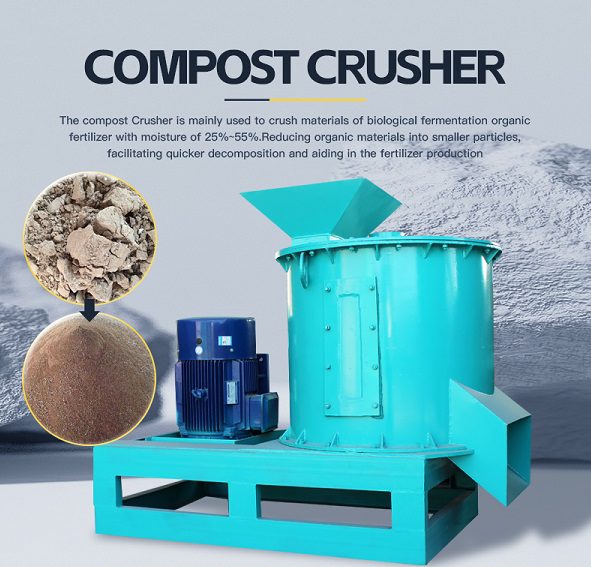
III. Process Matching Techniques: Creating a Seamless Pre-treatment Line
The semi-wet material crusher is not an isolated piece of equipment. Its efficiency can be maximized through proper matching:
Automatic Belt Conveyor Feeding: A belt conveyor is installed at the crusher’s feed inlet to achieve continuous and uniform feeding of raw materials. The conveyor speed can be linked to the crusher’s current; it automatically slows down when the current is too high to prevent overload.
Direct Discharge to Mixer: The crushed material can be directly fed into the mixer via an elevator or belt conveyor to be mixed with auxiliary materials (straw powder, microbial agents). This design eliminates intermediate transfer links, avoiding secondary dust and material loss.
Integrated “Crushing-Mixing-Fermentation”: The crusher, mixer, and turner are linked through a control system to achieve full automation from raw material entry to fermentation start-up. Operators only need to set parameters in the central control room to complete the raw material pretreatment process.
Practical Results: A Small Step in Crushing, a Giant Leap in Efficiency
The physical state of the raw materials processed by the semi-wet material crusher undergoes a qualitative change:
Fermentation area significantly increases: The previously compacted manure is broken up, allowing microorganisms to penetrate deep into the particles and colonize.
Aeration is significantly improved: The uniform particle size distribution increases the porosity of the pile by more than 20%.
Microbial activity is enhanced: The finely crushed material provides microorganisms with more attachment sites and nutrient sources.
The direct result of these changes is that the fermentation cycle can be shortened by 3-5 days. Based on a 25-day fermentation cycle, efficiency is improved by 15%-20%. For large-scale organic fertilizer plants, this means that more batches of products can be produced in the same amount of time, significantly increasing equipment turnover.
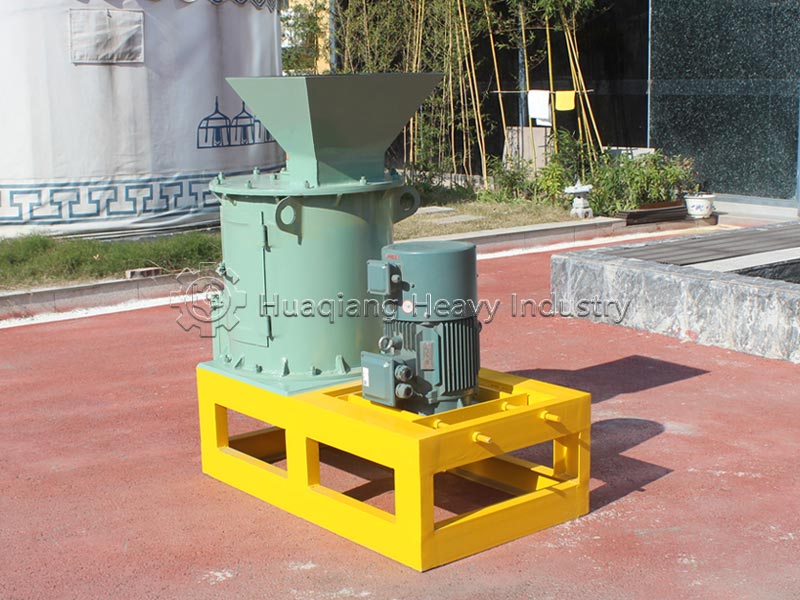
The Critical Role of Pre-Fermentation Crushing
The detailed application of the half-wet material crusher machine in organic fertilizer production underscores its vital role as the first step in a successful organic fertilizer fermentation process. By transforming sticky, high-moisture raw materials into a uniform, fine, and aerated feedstock, it creates the ideal conditions for rapid and efficient microbial activity. This optimized material then proceeds through the fermentation stage and is ready for the final shaping phase. For producing premium spherical granules, a complete organic fertilizer disc granulation production line is a classic and effective choice within the broader organic fertilizer production equipment family. The uniformly prepared material from the half-wet material crusher machine feeds perfectly into a disc granulator machine, one of the key machines in the organic fertilizer granulator series. For operations seeking a compact, streamlined workflow, an innovative new type two in one organic fertilizer granulator can combine the final stages of conditioning and initial organic fertilizer production granulation. Whether using a classic disc line or a combined machine, the synergy between robust organic fertilizer raw material processing equipment like the half-wet crusher and the chosen granulation technology is fundamental to transforming raw, challenging wastes into consistent, high-value organic fertilizer products.
In the entire process of organic fertilizer production, the crushing and pretreatment before fermentation is often considered a “simple step.” However, it is precisely this step that determines whether the raw materials can enter the fermentation system in their optimal state. With its core strength in handling high-moisture materials, the semi-wet material crusher transforms sticky manure, soft, damp straw, and hardened substrate into uniform and fine “good fermentation material.” Improving quality from the source, making fermentation more efficient, and the finished product of higher quality—this is the true value of the pre-treatment stage.