
Equipment Overview
A belt conveyor is a continuous conveying device that uses a flexible conveyor belt as both the material carrier and traction component, relying on the principle of friction drive to achieve continuous material transport. It is one of the most fundamental and core conveying equipment in modern industrial production and logistics systems, often referred to as the “arteries” of the logistics system.
A telescopic belt conveyor is a special conveying device that adds a telescopic mechanism to a standard belt conveyor. It can freely extend and retract along its length, achieving a flexible connection between fixed loading/unloading points and variable target points (such as inside trucks or containers). Its segmented, nested design, resembling a telescope, allows for significant adjustment of the operating length.
Equipment Structure Composition
(I) Standard Structure of Fixed Belt Conveyor
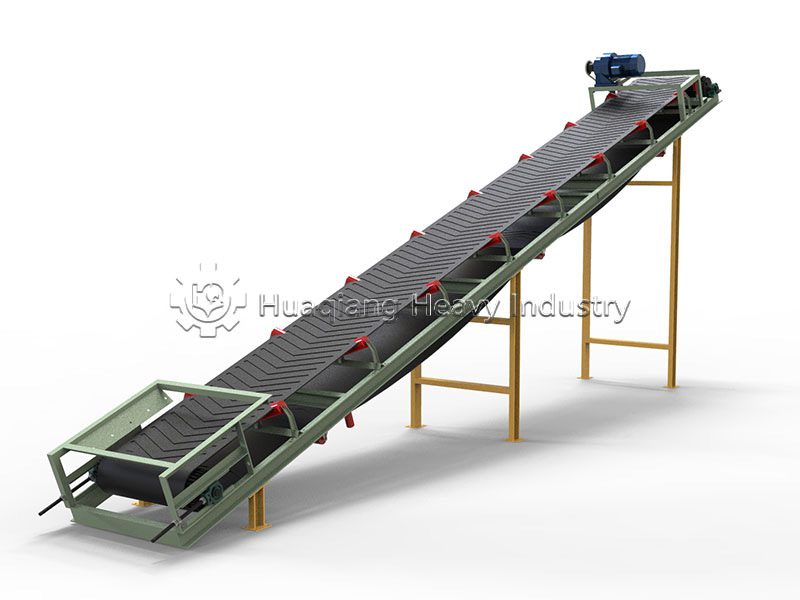
- Conveyor Belt: The core load-bearing component; wear-resistant troughed rubber belts are commonly used in fertilizer plants; troughed idlers create a U-shape to prevent powder spillage; heat-resistant belts can be selected for high-temperature conditions, and acid- and alkali-resistant rubber belts are used for acid and alkali fertilizers.
- Support Idler System
- Troughed load-bearing idlers: Support the belt when fully loaded with materials;
- Return flat idlers: Support the empty belt;
- Self-aligning idlers: Automatically correct belt misalignment.
- Roller Assembly
- Drive Roller (Head): Surface coated with rubber to increase friction, driven by a motor and reducer;
- Idling Roller (Tail): Changes the direction of the belt loop;
- Drive Unit: Standard motor + reducer / electric roller, frequency conversion speed control optional;
- Tensioning Device: Tail-end spiral tensioning / counterweight tensioning, adjusts belt tension and prevents slippage;
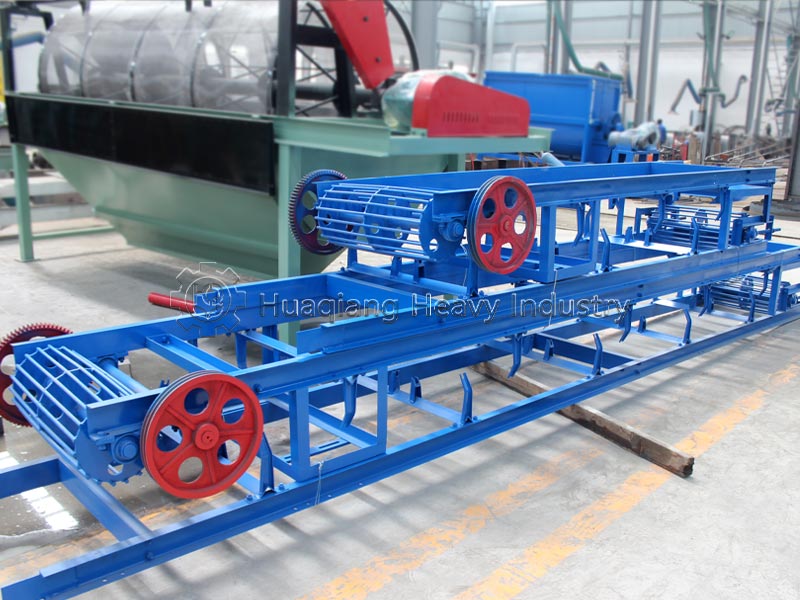
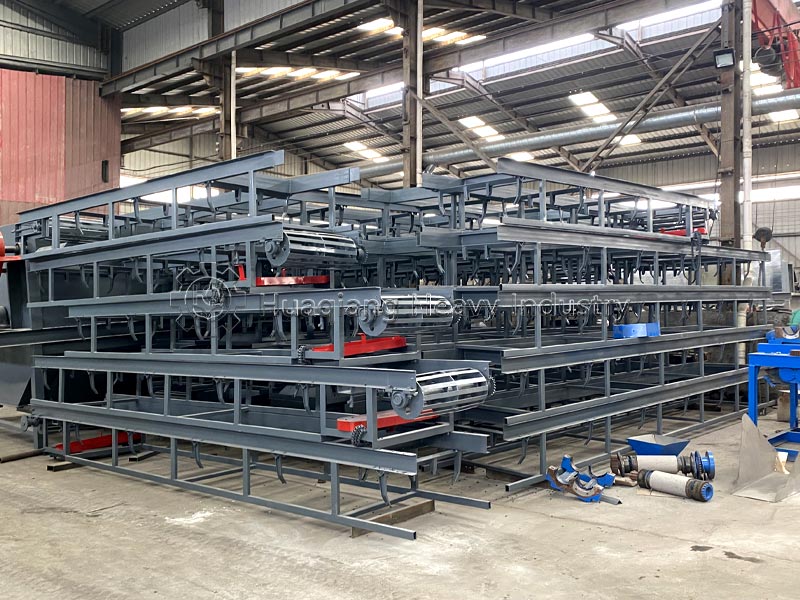
- Frame: Channel steel / square tube welded fixed bracket, floor-mounted;
- Auxiliary Accessories: Feed chute, belt cleaner, side guards, dust cover, backstop, emergency stop switch.
(II) Unique Structure of Telescopic Belt Conveyors (Additions to Ordinary Belt Conveyors)
- Nested Telescopic Frame: 2–4 sliding rail telescopic sections, chain/rack and pinion driven telescopic movement;
- Belt Storage Bin: Built-in multiple guide rollers automatically store/release excess belt during telescopic movement, maintaining belt tension throughout;
- Hydraulic Lifting System: Cylinder-supported height adjustment for different truck bodies;
- Dedicated Telescopic Drive Motor: Dual motor configuration, one controlling belt conveying and the other controlling machine telescopic movement;
- Safety Control System: Front-end anti-collision photoelectric sensor, emergency stop, anti-pinch protection, and remote telescopic function; The structures of other belts, idlers, rollers, and cleaners are the same as ordinary belt conveyors.
Working Principle
(I) Fixed Belt Conveyor Principle: The motor drives the head rubber-coated drive roller to rotate, relying on the friction between the roller and the annular belt to drive the belt in a closed loop circulation; material falls from the tail guide chute to the middle of the belt, the trough roller lifts the belt to form a trough, and the belt is conveyed forward at a uniform speed to the head roller to complete unloading; the tail tensioning device continuously maintains the belt tension to prevent slippage and deviation, achieving continuous and uninterrupted conveying.
(II) Telescopic Belt Conveyor Dual Working Principle:
- Belt Conveying Logic: Completely consistent with ordinary belt conveyors, frequency converter controls the forward and reverse rotation of the belt to complete loading and unloading;
- Telescopic Adjustment Logic: The telescopic motor drives the gear rack/chain to drive the multi-section nested frame to extend/retract along the slide rail; the guide roller in the belt storage bin synchronously releases/retracts redundant belt, ensuring that the belt remains flat and taut throughout the telescopic process; combined with hydraulic cylinders to raise the overall height, matching the height difference of the carriage, the machine body can penetrate deep into the carriage to reach the cargo stacking position, shortening the manual handling distance.
Application Scope
(I) Fixed Belt Conveyor Application Scenarios
- Fertilizer Complete Production Line (Core Supporting Equipment)
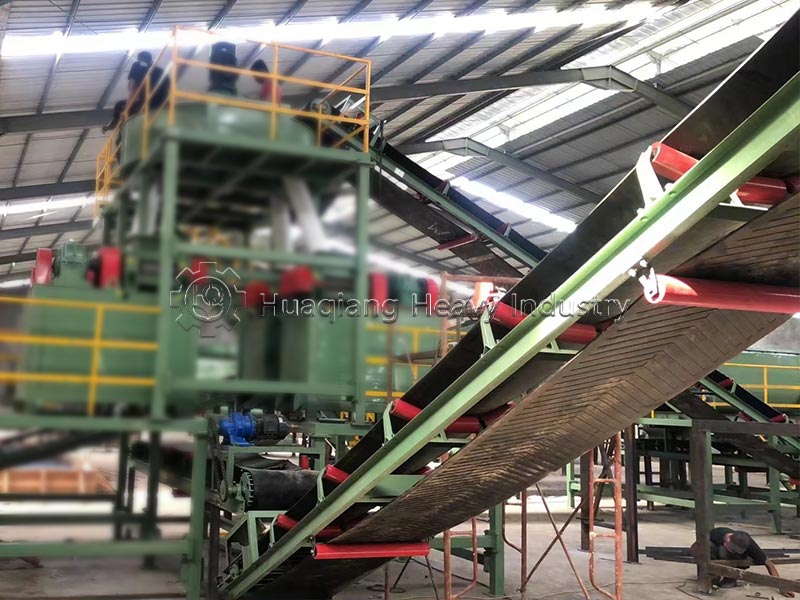
- 1)Raw Material Section: Transferring raw materials such as straw and livestock manure between crushers and mixers;
- 2)Granulation and Drying Section: Transferring material from the granulator to the dryer, from the dryer to the cooler, and from the cooler to the coating machine;
- 3)Finished Product Section: Transferring granular fertilizer between screening machines, silos, and packaging machines;
- Plant Yard Transfer: Long-distance material transportation from workshops to raw material storage sheds and finished product warehouses;
- Cross-Industry Expansion: Grain, feed, chemical powder, and building material sand and gravel transportation.
(II) Telescopic Belt Conveyor Application Scenarios
- Fertilizer Plant Finished Product Warehouse: Rapid loading/unloading of bagged fertilizer trucks and containers;
- Organic fertilizer and compound fertilizer sales transfer warehouses, agricultural material logistics sorting centers;
- Used only for finished product bagging transfer, not connected to internal process sections of the production line.
Summary table of common faults and solutions for belt conveyors
| Equipment Category | Fault Phenomenon | Main Cause | Solution |
|---|---|---|---|
| General faults of ordinary belt conveyor | Belt deviation | Mis‑installed pulley/idler, crooked belt joint, assembly errors, uneven tension | Adjust positions of head‑tail pulleys and idlers to guarantee installation precision; adjust tension device; add self‑aligning idlers; standardize feeding position |
| Belt slipping | Insufficient tension, worn drive pulley, water on belt, overload operation | Adjust tension device to increase tension; clean pulley surface and inspect belt; control feeding capacity; add lagging on pulley if necessary to wrap larger angle | |
| Belt crack / tear | Long‑term wear without replacement, sharp foreign objects jamming, poor joint quality, overload impact | Regularly inspect and replace aged belt; clear jammed foreign objects; adopt vulcanized joint for higher strength; install iron remover and anti‑tearing protection device | |
| Idler stuck / abnormal noise | Bearing lack of lubrication, seal failure with dust ingress, idler abrasion | Inject lubricating grease periodically; replace damaged idlers; select high‑quality idlers with good sealing performance | |
| Reducer overheating / oil leakage | Insufficient or deteriorated lubricating oil, bearing damage, aging seal | Check oil level and oil quality, replace oil on schedule; repair or replace bearings; change sealing parts | |
| Telescopic belt conveyor special faults | Poor telescopic movement / jamming | Deformed guide rail, loose / broken steel wire rope, worn chain | Check and calibrate guide rail; adjust or replace steel wire rope / chain; lubricate sliding parts |
| Lifting failure | Insufficient hydraulic oil, pump failure, stuck solenoid valve | Refill hydraulic oil; repair oil pump and valve group; inspect electric control circuit | |
| Belt deviation at telescopic section | Center‑line offset of each frame, uneven idlers inside storage belt bin | Calibrate centering for each frame; adjust idler sets inside storage belt bin |
Applications in Production Lines
- The Role of Belt Conveyors in Production Lines
Belt conveyors primarily perform the following functions in production lines:
1) Main Conveying: Serving as the main artery for long-distance, high-volume material transport, connecting mining faces with crushing stations, raw material warehouses with production workshops, and production workshops with finished product warehouses;
2) Process Integration: Interacting with equipment such as crushers, ball mills, packaging machines, and palletizers to form a continuous production process;
3) Multi-Point Unloading: Achieving multi-point feeding and unloading along the line through unloading trolleys or plow-type unloaders;
4) Metering and Batching: Working in conjunction with belt scales and feeders to achieve precise quantitative conveying and batching control.
- The Role of Telescopic Belt Conveyors in the Production Line
Telescopic belt conveyors are a key flexible interface at the end of modern logistics production lines:
1) Loading and Unloading Bridging: Establishing a seamless connection between fixed warehouse conveyor lines and moving vehicles, eliminating the “last mile” bottleneck of manual handling;
2) Flexible Expansion: Freely expandable according to vehicle length, one unit can adapt to various vehicle types, from 4.2m trucks to 17.5m trailers;
3) System Integration: Can be integrated with roller conveyors, sorting machines, elevators, barcode scanning systems, etc., to build automated loading and unloading systems;
4) Two-Way Operation: The same equipment can complete both outbound loading and inbound unloading, improving equipment utilization.
Have Any Problem? Please, Contact
Integrity
Adhere to honesty and trustworthiness, be responsible to customers, employees, partners, and society, and establish long-term trust relationships.
Win win
Establish win-win relationships with all stakeholders such as customers, suppliers, and employees to share the fruits of enterprise development.