
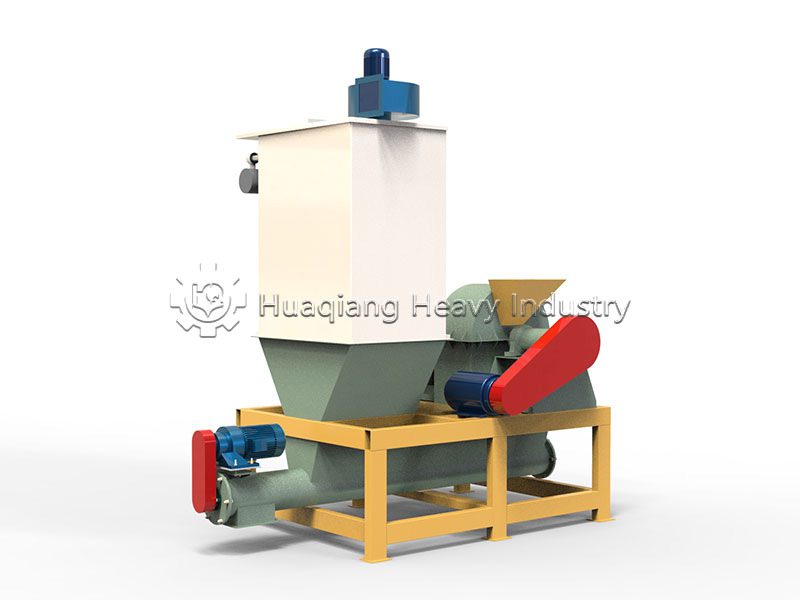
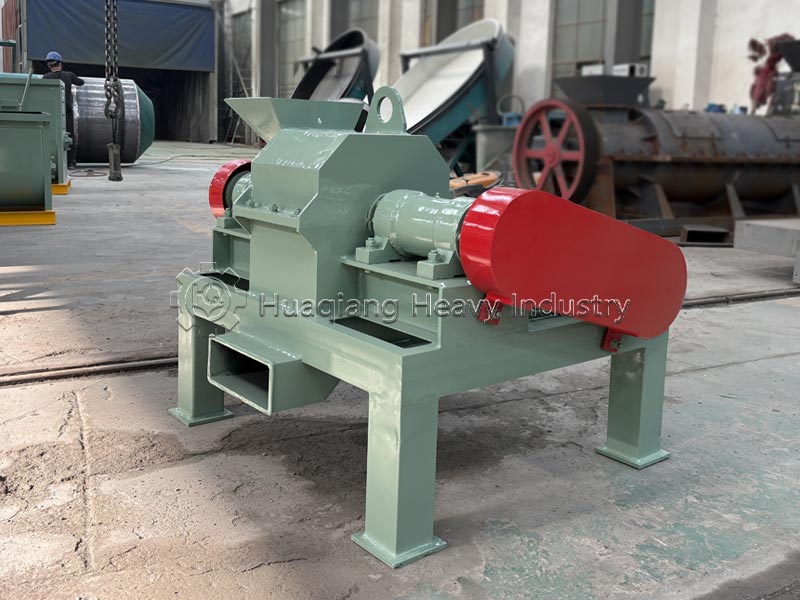

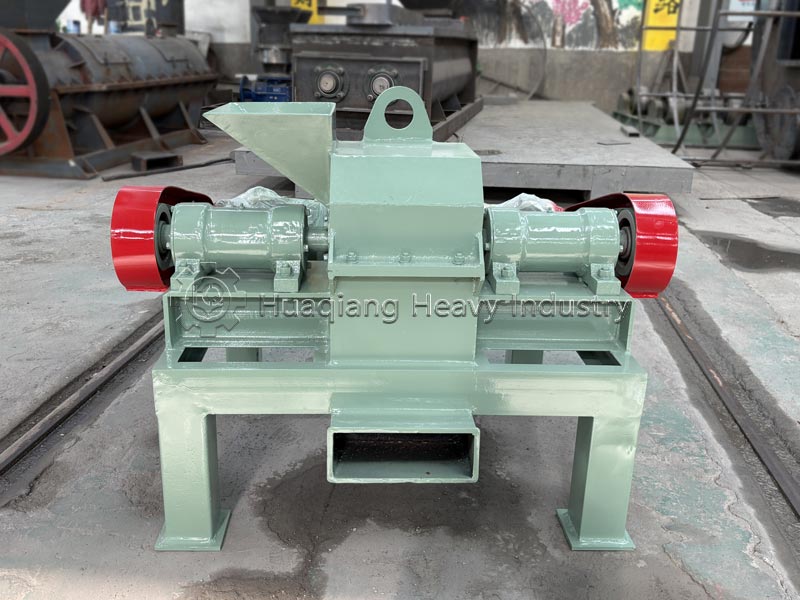
Equipment Introduction
A cage crusher, also known as a cage mill, squirrel cage crusher, or medium-sized horizontal cage bar crusher, is an industrial crushing equipment designed based on the principle of impact crushing. This equipment belongs to the category of mechanical impact crushers. Its core feature is the repeated impact, collision, and shearing of materials by two sets of high-speed, counter-rotating cage rotors, thereby achieving fine crushing of the materials.
Cage crushers are widely used in various industries such as fertilizer, mining, building materials, chemicals, feed, food, pharmaceuticals, and plastics due to their simple and compact structure, high crushing efficiency, stable operation, good sealing performance, and ease of cleaning and maintenance. They are especially considered a powerful tool for crushing compound fertilizers.
Equipment Structure
The cage crusher mainly consists of the following components:
- Foundation Support
Base and Frame: The overall supporting foundation of the equipment, bearing all working parts.
Bearing Seats and Bearing Support Frames: Used to support the main shaft and rotor system, ensuring operational accuracy.
- Power Transmission
Electric Motors: Usually two independent motors, driving the inner and outer cages respectively.
Transmission Components: Including V-belt pulleys, belts, etc., transmitting the motor’s power to the main shaft.
Main Shaft: The core transmission shaft connecting the motor and the rotating cage.
- Core Working Component – Rotating Cage System
The rotating cage is the core working component of the cage crusher, with the following structural features:
Disc: Each cage has a steel disc fixed to the hub.
Steel Bars (Cage Bars): Two or three rings of steel bars are fixed on each disc, arranged concentrically and perpendicular to the disc.
Steel Rings: The other end of each ring of steel bars is fixed by a steel ring to increase overall strength.
Staggered Arrangement: The steel bar rings of the two rotating cages are staggered to form a crushing chamber.
- Casing and Feed/Discharge Sections
Casing (Upper and Lower Housings): Metal outer shell enclosing the two cages.
Feed Inlet: Located at the top of the casing, used for material input.
Discharge Inlet: Located at the bottom of the casing, used for finished product discharge.
- Auxiliary Devices
Screw Feeder: Equipped on some models, used to push materials axially for initial crushing.
Cage Loading/Unloading Device: For easy maintenance and replacement of steel bars, a device is provided to facilitate cage loading and unloading. A screw and handwheel allow the bearing bracket to move the bearings, shaft, and cages horizontally on the base.
- Structural Types
Cage crushers are mainly divided into two types:
Double-Rotor Cage Crusher: Both cages rotate independently, each driven by a motor, rotating at high speed in opposite directions. High crushing efficiency and large output.
Single-Rotor Cage Crusher: Only one cage rotates, while the other remains stationary. Compared to the double-rotor type, it has one less shaft and related transmission components, resulting in a smaller overall size, but lower productivity.
Working Principle of the Equipment
The cage crusher employs the “reverse high-speed impact” principle: Material enters the center of the inner cage through the side feed inlet. Under the action of centrifugal force, the material is thrown towards the high-speed rotating cage ribs. The inner and outer cages rotate in opposite directions driven by two motors. As the material shuttles between the inner and outer cage ribs, it undergoes extremely violent repeated impacts, friction, and collisions.
- Multi-stage crushing: The material first contacts the inner cage ribs, is crushed, and then flies towards the counter-rotating outer cage ribs.
- Self-collision crushing: The material also undergoes violent collisions with each other during high-speed motion, further refining the particle size.
Finally, the material that meets the particle size requirements is discharged from the bottom under the combined action of gravity and centrifugal force.
Suitable Raw Materials for the Equipment
Cage crushers have certain requirements for raw materials and are mainly suitable for materials with the following characteristics:
| Material Property | Specific Requirements |
|---|---|
| Hardness | Low to medium hardness materials are preferred, with Mohs hardness of 1–3. |
| Moisture Content | Generally required moisture content below 6%; some improved models can handle materials with 10%–20% moisture; new dust-free type can process single chemical fertilizers with moisture content below 40%. |
| Material Form | Block, granular and agglomerated materials |
| Typical Raw Materials | Urea, Monoammonium Phosphate, Diammonium Phosphate, Potassium Chloride, Potassium Sulfate, Fermented Livestock & Poultry Manure, Straw, Shale, Slag, Coal, Gypsum, Clay, etc. |
| Forbidden Materials | High-hardness materials (accelerate steel rod wear), high-moisture & high-viscosity materials (prone to blockage), hard foreign objects such as metals. |
Applications of the Equipment
The cage crusher has a wide range of applications, mainly covering the following industries and scenarios:
- Fertilizer Industry (Main Application Area)
Compound Fertilizer Production: Crushing hard granular raw materials such as monoammonium phosphate, diammonium phosphate, urea, ammonium chloride, ammonium sulfate, superphosphate, and heavy calcium carbonate.
Organic Fertilizer Production: Processing fermented livestock and poultry manure, straw, biogas residue, sludge, and other organic materials.
Blended Fertilizer Production: Raw material pretreatment and return material crushing.
BB Fertilizer Production: Raw material refinement.
- Chemical Industry
Fine crushing of various chemical raw materials.
Material crushing in salt production.
- Building Materials and Mining Industry
Crushing of low-hardness materials such as limestone, shale, gypsum, slag, and coal.
Crushing of ceramic raw materials such as clay and earthenware.
Fine crushing in iron ore processing.
- Feed and Food Industry
Crushing of feed raw materials such as grains and soybean meal.
Fruit and vegetable crushing (dedicated cage crusher).
Crushing of traditional Chinese medicine and food additives.
- Other Industries
Plastics, pharmaceuticals, environmental protection (sludge treatment), etc.
Equipment operation and maintenance methods
| Inspection Category | Inspection Item | Inspection Standard | Inspection Result | Remarks |
|---|---|---|---|---|
| Equipment Inspection | Fastening of Components | All connecting screws are free of looseness and falling off. | Focus on checking bearing housing, machine casing and cage fixing bolts | |
| Equipment Inspection | Steel Rod Condition | Steel rods on the cage are free of fracture, crack and firmly installed. | Stop the machine immediately if broken or loose steel rods are found | |
| Equipment Inspection | Drive Belt Condition | Appropriate belt tension; no cracking, slipping or excessive wear. | Too loose causes slipping; over-tightening increases bearing load | |
| Equipment Inspection | Smoothness of Inlet & Outlet | No blockage or jamming foreign objects at feed inlet and discharge outlet. | Clean residual materials in advance | |
| Lubrication System Inspection | Lubricant Level | Oil level is within the normal range marked on the equipment. | Replenish timely if below lower limit | |
| Lubrication System Inspection | Oil Quality Status | Clean oil, free of sludge, impurities and leakage. | Replace oil immediately if abnormality occurs | |
| Lubrication System Inspection | Lubrication of Moving Parts | All moving parts are sufficiently lubricated without dry running risk. | Add lubricant one by one at each lubrication point | |
| Material Inspection | Material Adaptability | Materials to be crushed meet the applicable range of equipment, no ultra-hard or high-viscosity materials. | It is forbidden to crush materials with compressive strength>150MPa | |
| Material Inspection | Foreign Object Control | No hard impurities such as metal blocks and stones mixed in materials. | Magnetic separator must be installed at feed inlet | |
| Material Inspection | Moisture Content Control | Material moisture content is controlled within allowable range of equipment, ≤12% is optimal. | Dry high-moisture materials in advance |
Equipment Applications in Production Lines
(I) Applications in Compound Fertilizer Production Lines
In the compound fertilizer production process, the cage crusher mainly undertakes the two core processes of raw material crushing and screening/return material crushing. It is a key piece of equipment to ensure granulation quality and stabilize the particle size of the finished product.
Complete Process Flow: Raw Material Batching → Raw Material Mixing → Cage Crushing → Raw Material Granulation → Granule Drying → Granule Cooling → Granule Grading → Finished Product Coating → Finished Product Packaging
Raw Material Crushing Before Batching
Urea, ammonium phosphate, potassium salt, and other easily agglomerated, large-particle fertilizer raw materials are finely crushed to the fineness required for the granulation process, ensuring uniform batching and stable granulation in subsequent batching.
Return Material Crushing After Screening
Oversized and unqualified particles screened out in the granulation grading process are returned to the cage crusher for further crushing. After being refined, they are re-involved in batching and granulation, reducing waste loss and improving the finished product qualification rate.
(II) Application in Organic Fertilizer Production Lines
In the organic fertilizer production process, cage crushers are mainly used for the fine crushing of fermented and decomposed materials. They are suitable for medium- to high-moisture organic materials, are not prone to clogging, and are a core piece of equipment in organic fertilizer pretreatment.
Complete Process Flow: Organic raw material collection → High-temperature fermentation and decomposition → Cage crusher fine crushing → Ingredient mixing → Granulation → Drying and dehydration → Finished product screening → Finished product packaging
The moisture content of the fermented organic materials is generally 30%–35%. After screening and iron removal, they enter the cage crusher for fine crushing. The crushed powder is uniform in particle size, loose, and free of lumps. It can be fully mixed and homogenized with nitrogen, phosphorus, and potassium inorganic raw materials, significantly improving the subsequent granulation rate and particle uniformity, ensuring stable quality of the finished organic fertilizer.
(III) Production Line Equipment Combinations
The cage crusher can be flexibly combined with various fertilizer equipment to form a complete automated production line. The supporting equipment is divided into front-end, back-end, and auxiliary systems:
- Front-end Supporting Equipment
Belt conveyor, bucket elevator, automatic batching system, screening and impurity removal equipment, iron remover
- Back-end Supporting Equipment
Twin-shaft mixer, rotary drum granulator, extrusion granulator, drum dryer, cooler, grading and screening machine, automatic packaging machine
- Auxiliary Supporting Equipment
Cyclone dust collector, induced draft fan, complete electrical control system, safety protection and sealing dust removal device
Common Equipment Problems and Solutions
| Problem | Cause Analysis | Solutions |
|---|---|---|
| Severe machine vibration | Uneven wear of cage bars, material buildup on casing or foreign matter entering | Clear foreign objects, inspect cage bar wear, re-perform dynamic balancing |
| Coarser discharge particle size | Severe wear of cage bars leading to increased clearance | Replace cage bars or rotor components |
| Motor overheating / Motor stalling | Blockage caused by excessive feeding speed or excessive material moisture | Stop machine for cleaning, control feeding speed and material moisture content |
| Bearing overheating | Insufficient lubricating oil, deteriorated oil quality or damaged bearing | Fill lubricating oil or replace the bearing |
Key Features of the Equipment:
- Simultaneous crushing and mixing: Multiple materials can be fed simultaneously, achieving both crushing and mixing.
- Concentrated and uniform particle size range in the finished product, with minimal over-crushing.
- Compact structure, small footprint, simple foundation construction, and some models can be made mobile.
- Sealed casing facilitates the integration with dust collection systems, ensuring controllable dust levels.
- Wear parts are concentrated in the cage bars, allowing for convenient disassembly and replacement, and intuitive maintenance.
Cage crushers, as a classic impact crushing equipment, occupy an irreplaceable position in industries such as fertilizer, chemical, and building materials due to their advantages of simple structure, high crushing efficiency, and uniform particle size. Although traditional limitations such as rapid steel bar wear and high noise levels exist, the development of technologies such as dust-free operation, intelligent systems, and wear-resistant materials has significantly improved modern cage crushers in terms of environmental friendliness, reliability, and automation. When selecting a model, users should fully consider material characteristics, production capacity requirements, environmental requirements, and maintenance costs to choose the most suitable model for their production scenario. Through standardized operation and scientific maintenance, long-term stable and efficient operation of the equipment can be ensured.
We have been deeply involved in the fertilizer equipment field for many years, and our products cover process design, equipment manufacturing, installation, commissioning, and after-sales maintenance for multiple categories of production lines, including organic fertilizer, compound fertilizer, BB fertilizer (blended fertilizer), and bio-fertilizer, providing you with full-process services.
Have Any Problem? Please, Contact
Integrity
Adhere to honesty and trustworthiness, be responsible to customers, employees, partners, and society, and establish long-term trust relationships.
Win win
Establish win-win relationships with all stakeholders such as customers, suppliers, and employees to share the fruits of enterprise development.