

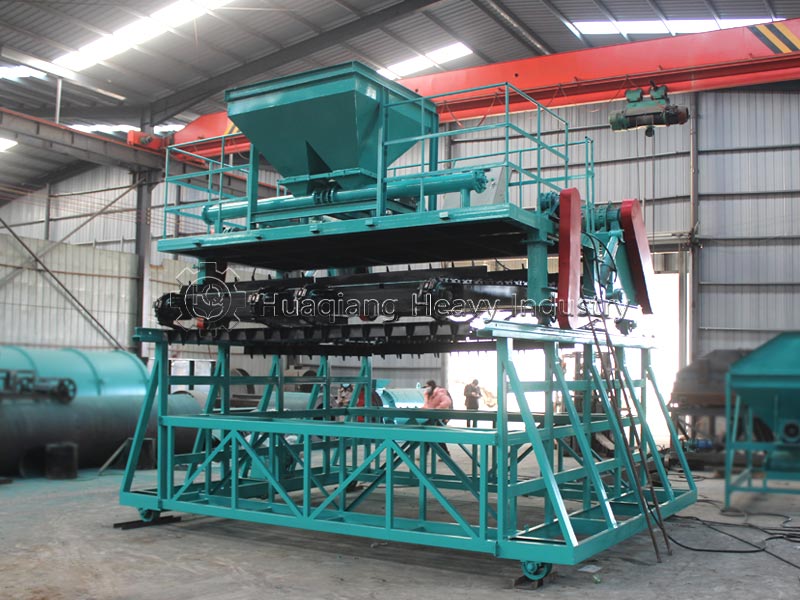
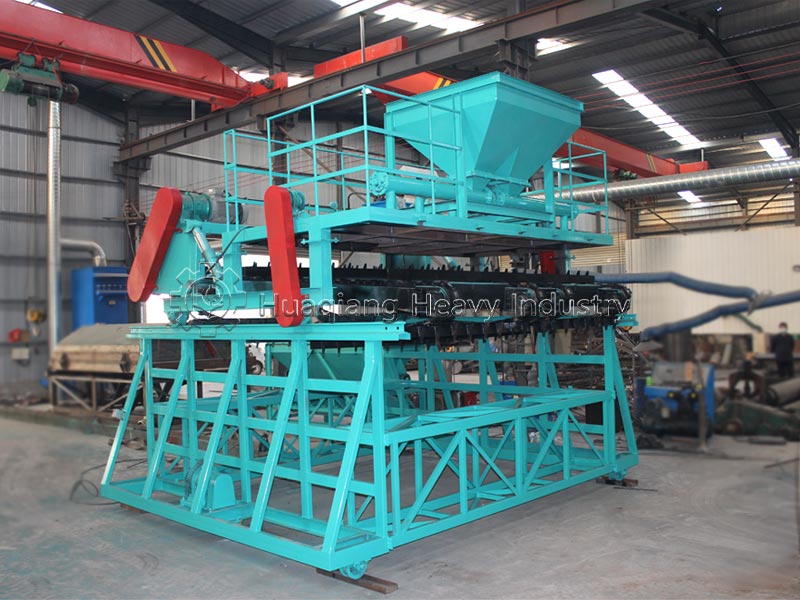

Equipment Introduction
The chain plate compost turner (also known as a chain plate turner or chain plate compost turner) is a large-scale, fixed compost turning device specifically designed for deep aerobic fermentation in trough-type environments. The entire machine spans the fermentation trough and moves back and forth along tracks on both sides of the trough via wheels. It is equipped with a high-power motor drive system, a hydraulic lifting system, and a chain plate turning system. The turning width can reach 3–5 meters, the turning depth can reach 1.5–2 meters, and the processing capacity is 150–500 cubic meters per hour. It is a core fermentation equipment in large and medium-sized organic fertilizer production lines. Its core function is to deeply turn, oxygenate, crush, and mix the materials in the trough during the organic material fermentation process, achieving efficient aerobic fermentation.
The chain plate compost turner is one of the main supporting equipment in fertilizer machinery units, suitable for trough-type fermentation, and is a core piece of equipment for the industrial-scale harmless treatment of livestock farming, municipal waste, and municipal sewage sludge. This machine features a reasonable design, high efficiency, low energy consumption, high degree of automation, ease of use, low cost, and wide application. It can turn the compost to a depth of 1.5–2 meters and is a highly efficient machine that is well received by users.
Equipment Structure and Composition
The chain plate turning machine mainly consists of the following major systems:
| System Name | Main Components | Function Description |
|---|---|---|
| Turning Power Transmission Device | Main motor, reducer, sprocket, bearing housing, main shaft | Provide power for compost turning chain plates; the motor drives the main shaft through the reducer |
| Traveling Device | Travel motor, reducer, transmission shaft, traveling wheel, bearing | The whole machine moves longitudinally along the tracks on both sides of the fermentation trough |
| Hydraulic Lifting Device | Hydraulic pump station, solenoid valve block, hydraulic oil pipe, hydraulic cylinder column, shaft base | Control the lifting height of compost turning chain plates to adapt to different stacking depths |
| Compost Turning Unit | Support main beam frame, motor reducer, main shaft, driven shaft, sprocket, chain, compost turning chain plate | Core working component; continuous rotation of chain plates realizes material turning and mixing |
| Trough Transfer Cart (Transfer Vehicle) | Travel motor, transmission gear, transmission shaft, traveling wheel | Temporary transport tool for the compost turner to switch fermentation troughs, realizing one machine serving multiple troughs |
| Electric Control System | Control cabinet, soft starter, limit travel switch | Centralized control, supports manual or automatic operation mode |
Key Structural Features:
1. The electric motor directly transmits power to the reducer, driving the main shaft, which in turn drives the chain.
2. The turning chain plates, mounted on the chain, are driven by the main shaft to perform a cyclical motion.
3. The chain plates transport the material from the bottom of the trough to a higher position and scatter it down, capable of moving the material backward by 3-4 meters.
4. The chain plates have staggered manganese steel blades that can crush clumps of material.
5. The turning chain plates are made of manganese steel, making them sturdy and durable, and providing a certain degree of crushing and mixing capabilities for materials.
6. Equipped with a soft starter, resulting in low impact load during startup.
7. Limit switches provide safety and limit functions.
Raw Materials for the Equipment
The chain plate compost turner primarily processes various types of organic solid waste, including but not limited to:
1. Livestock waste: chicken manure, pig manure, cow manure, sheep manure, and other livestock and poultry manure
2. Municipal waste: urban sludge, sewage sludge
3. Agricultural processing waste: sugar factory filter mud, residue cake
4. Agricultural waste: straw, sawdust
5. Industrial organic waste residue: distiller’s grains, medicinal residue, cassava residue, furfural residue, etc.
6. Kitchen and garden waste: fruit peels, garden waste
The chain plate compost turner has extremely high material adaptability, especially suitable for processing large, high-viscosity organic waste with a moisture content of 50%-70%. Unlike ordinary compost turning equipment that is susceptible to moisture and stickiness, the chain plate compost turner, with its strong chain plate structure, can effectively handle high-moisture, high-viscosity materials.
Working Principle of the Equipment
The working principle of the chain plate turner is based on aerobic fermentation technology. The core mechanism is as follows:
1) Power Transmission Principle
The electric motor directly transmits power to the reducer, driving the main shaft. The main shaft drives the chain, and the turning chain plates mounted on the chain are driven by the main shaft to perform a cyclic motion.
2) Turning and Composting Operation Principle
1. Chain Plate Cyclic Motion: The chain plates perform continuous cyclic motion driven by the chain.
2. Material Grabbing and Lifting: The chain plates continuously grab material from the trough and obliquely convey it to the rear of the work frame.
3. High-Level Scattering: After being conveyed to a high position, the material is scattered and falls, making full contact with the air.
4. Material Rearward Movement: Each turning and composting operation can move the material back 3-4 meters.
5. Crushing and Mixing: The manganese steel blades distributed in a staggered pattern on the chain plates crush lumpy material, achieving uniform mixing.
3) Aerobic Fermentation Principle
Through regular turning and composting, the pile temperature rapidly rises to 50-65℃. Under this high-temperature condition:
1. Pathogens, insect eggs, and weed seeds are effectively killed.
2. Microorganisms fully decompose organic matter.
3. The fermentation cycle is shortened.
4. The oxygen content of the pile increases, and moisture evaporates.
5. To avoid problems such as odor and seedling burn caused by anaerobic fermentation, this equipment (4) Deep fermentation advantages: This equipment does not require high-pressure aeration equipment. During the turning process, oxygen is supplied to the materials evenly and without dead zones, resulting in strong aeration penetration and uniform aerobic fermentation. Because the materials can fully contact oxygen in the air during the conveying and descent process, the fermentation effect is better. The uniform speed of the equipment movement is also more conducive to the mixing and fermentation of various materials in the tank.
Common Equipment Problems and Solutions
| Fault Phenomenon | Fault Performance | Root Cause | Standard Solutions |
|---|---|---|---|
| Severe deformation or foreign object winding of chain plates and shafts | Abnormal operation of chain plates, poor compost turning effect | Long-term overload operation or foreign objects stuck in chain plates | Repair chain plates or shafts, clear foreign objects |
| Difficult compost turning | High turning resistance, heavy equipment load | Foreign objects stuck on transmission gears or damaged gears | Remove foreign objects on transmission gears or replace gears |
| Unstable traveling, abnormal noise or overheating of reducer | Bumpy traveling, abnormal heat or noise from reducer | Bent transmission shaft, insufficient lubricating oil, excessively worn or damaged bearings | 1. Calibrate or replace transmission shaft 2. Add lubricating oil 3. Replace excessively worn bearings |
| Difficult or failed motor startup with buzzing noise | Motor cannot start normally or startup difficulty | Deformed & bent reduction shaft, excessively low or high voltage | 1. Calibrate or replace deformed reduction shaft 2. Restart after voltage returns to normal |
| Foreign objects on traveling wheels or tracks | Stuck traveling, traveling deviation | Debris on tracks or damaged traveling wheels | Clear foreign objects on traveling wheels or tracks |
| Insufficient compost turning power | Shallow turning depth, incomplete material crushing | Abnormal hydraulic system pressure or worn chain plates | Check whether hydraulic system pressure is normal, inspect wear condition of chain plates, replace severely worn chain plates or blades if necessary |
| Chain wear or breakage | Abnormal chain noise, tooth skipping or even breakage during operation | Insufficient lubrication, over-tight or loose chain | 1. Check chain temperature daily. Touch the middle of chain after shutdown; hot temperature (>60℃) indicates excessive friction 2. Wipe chain plates with white cloth to check oil film; transparent oil film shall be retained for ideal lubrication 3. Adjust chain tightness in time if inappropriate |
Application of the Equipment in the Production Line
The chain plate compost turner is one of the main supporting equipment in fertilizer machinery units. Suitable for trench-type fermentation, it is a core piece of equipment for the industrialized harmless treatment of livestock farming, municipal waste, and urban sewage sludge.
1. Positioning in the Production Line
In the entire organic fertilizer production line, the chain plate compost turner plays a crucial role in turning and disposing of materials. Located between material pretreatment and subsequent processing, it is a key link in the harmless, resource-based, and volume-reduced treatment of organic waste.
2. Multi-Trench Operation with One Machine
With the aid of a transfer vehicle (shifting machine), it can achieve “one machine, multiple troughs” operation in rotation. Where equipment capacity allows, simply adding fermentation tanks can expand production scale, significantly increasing the equipment’s value.
3. Seamless Integration
The chain plate compost turner can be used in conjunction with automatic feeding and discharging equipment, achieving multi-purpose functionality and saving manpower and resources in processes such as loader feeding. It can seamlessly connect with crushers, screening machines, granulators, and other equipment to form a large-scale organic fertilizer production line with a daily processing capacity of hundreds of tons.
4. Value in the Production Process: The chain plate turning machine continuously replenishes oxygen to the compost pile through high-frequency, deep turning operations, effectively shortening the fermentation heating time and allowing the pile to quickly enter the high-temperature maturation stage. Stable turning quality provides high-quality raw materials with suitable moisture content and uniform fineness for subsequent crushing and granulation processes.
Fermentation Process of the Equipment
1) Aerobic Fermentation Process
1. Raw Material Pretreatment: Mix livestock and poultry manure with straw powder and other auxiliary materials in a certain proportion, adjust the moisture content to 50-65%, and the C/N ratio to about 25:1.
2. Inoculation with Microorganisms: Add special organic fertilizer fermentation inoculants.
3. Composting and Feeding: Feed the mixture into the fermentation tank using a loader, ensuring the pile height does not exceed the turning depth (1.5-2 meters).
4. Turning and Fermentation: Use a chain plate turner to turn the pile regularly, generally every 2-3 days.
5. Temperature Monitoring: Raise the pile temperature to 50-65℃ and maintain it, with the high-temperature period lasting 5-7 days.
6. Relocation and Pushing: Each time the pile is turned, push the material backward 3-4 meters, gradually moving the material from the feeding end to the discharging end.
7. Post-Ripe Aging and Aging: After the temperature drops below 40℃, the aging stage begins.
8. Discharge: Fully decomposed material reaches the end of the fermentation tank and is discharged by a loader to proceed to the next process.
2) Key Control Parameters for Fermentation
| Parameter | Control Range | Adjustment Method |
|---|---|---|
| C/N Ratio | About 25:1 | Adjust by adding straw, rice husk and other carbon-rich materials |
| Moisture Content | 50%–65% | Adjust by adding dry materials or spraying water |
| Ventilation Oxygen Content | 8%–18% | Controlled by compost turning frequency |
| Fermentation Temperature | 50–65℃ | Adjust heat dissipation by turning or heat preservation |
| pH Value | 6–9 | Adjust by adding lime or acidic raw materials |
| Compost Turning Frequency | Once every 2–3 days | Adjust according to temperature and material condition |
| Turning Depth | 1.5–2 m | Adjust the height of chain plates through hydraulic system |
3) Fermentation Cycle
1. High-Temperature Fermentation Period: 7–10 days (temperature 50–65℃)
2. Transfer Fermentation Period: Material is gradually moved from the feed end to the discharge end.
3. Post-Ripe Aging Period: 7–10 days
4. Total Fermentation Cycle: Usually 15–25 days, depending on the tank length and turning frequency.
4) Advantages of Chain Plate Turner Fermentation
Chain plate turners provide excellent composting results, maintaining a uniform mixture of main and auxiliary materials, and preventing material stratification. During turning, the material remains on the pallets for a long time, is scattered at a high level, and has a large contact area with air, facilitating moisture reduction. This equipment does not require high-pressure aeration equipment; it provides oxygen to the material evenly and without dead zones during the turning process, ensuring strong aeration penetration into the material layer and uniform aerobic fermentation.
The chain plate turner uses a chain drive and rolling support chain plate mechanism, resulting in low resistance during back-throwing, energy saving, and suitability for deep trench operations. During back-throwing, the material stays on the pallet for a long time, is scattered at a high level, and has sufficient contact with air, facilitating moisture reduction. The chain plate has staggered manganese steel blades that can crush clumps of material. This equipment does not require high-pressure aeration equipment; it provides oxygen to the material evenly and without dead zones during the turning process, ensuring strong aeration penetration into the material layer and uniform aerobic fermentation.
Have Any Problem? Please, Contact
Integrity
Adhere to honesty and trustworthiness, be responsible to customers, employees, partners, and society, and establish long-term trust relationships.
Win win
Establish win-win relationships with all stakeholders such as customers, suppliers, and employees to share the fruits of enterprise development.