

Disc Granulator
Equipment Introduction
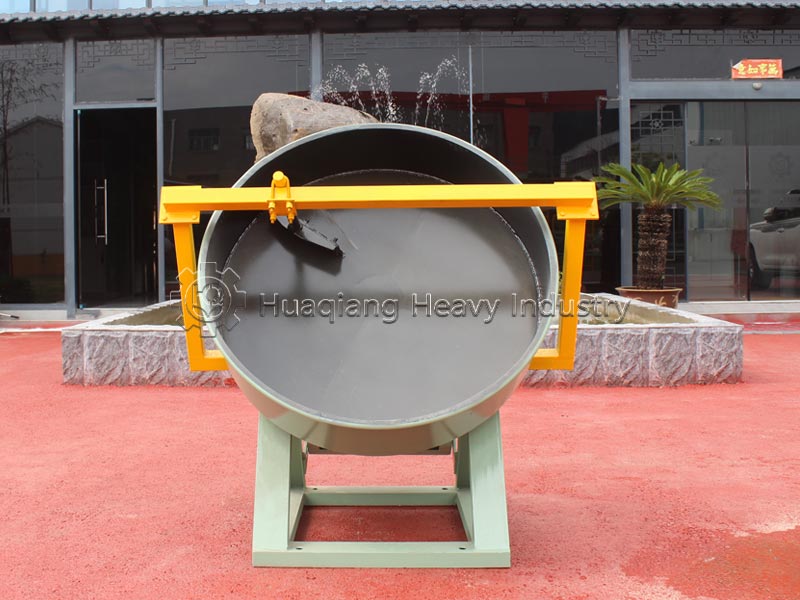
The disc granulator, also known as a pelletizing disc, is one of the most commonly used wet granulation equipment in the fertilizer, environmental protection, and powder processing industries. It utilizes the centrifugal force and friction generated by a rotating disc to agglomerate powdery or fine-grained materials into spherical particles. It features a simple structure, convenient operation, and low investment cost; a high pelletizing rate (over 90%); good particle roundness; a wide range of applications, capable of processing various materials; particle size can be controlled by adjusting the disc angle and rotation speed; and advantages such as stable operation, low energy consumption, low maintenance cost, low investment, high pelletizing rate, and intuitive operation. It holds an important position in the granulation of compound fertilizers, organic fertilizers, coal powder, and mineral powders.
Equipment Composition and Structure
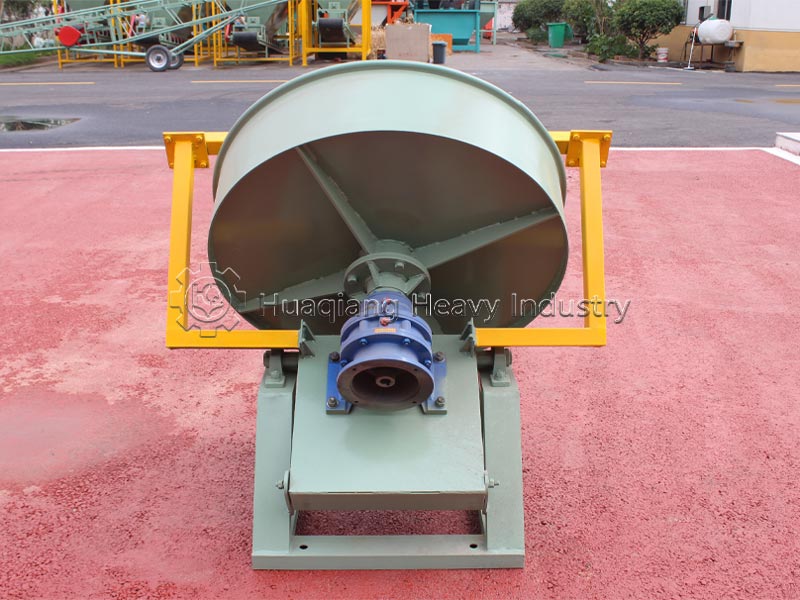
The disc granulator mainly consists of the following core components:
| Component Name | Function Description | Material / Specification Key Points |
|---|---|---|
| Pan / Disc | Core working surface for holding materials and rotating granulation | Generally Q235 carbon steel or stainless steel (304/316), lined with wear-resistant rubber or polished stainless steel |
| Driving Device | Supply rotational power for the disc | Motor + reducer combination; reduction ratio configured according to output requirements |
| Scraper System | Clean adhered materials at the bottom and edge of the disc to ensure uniform granulation | Adjustable angle, made of wear-resistant alloy steel |
| Water / Slurry Spraying Unit | Spray binder or water onto materials to promote particle agglomeration | Atomizing nozzle with controllable flow rate |
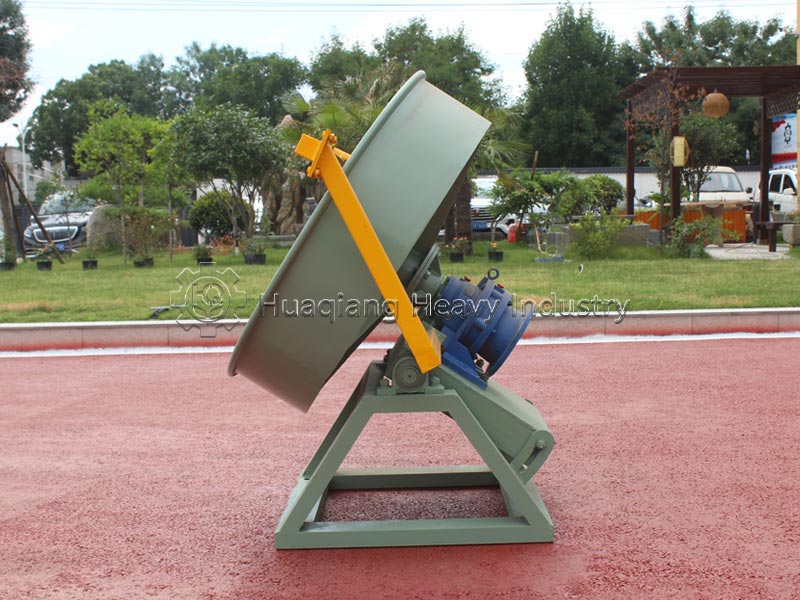
| Frame / Base Stand | Support the whole machine and guarantee stable operation | Welded steel structure with vibration aging treatment |
| Inclination Adjustment Mechanism | Adjust disc tilt angle to control particle size and material residence time | Handwheel or hydraulic adjustment, tilt angle range: 35°–55° |
| Discharging Unit | Discharge finished granules from the edge of the disc | Scraper type or gravity flow type |
Working Principle of the Equipment
The working principle of the disc granulator can be summarized as “snowball-like agglomeration and granulation,” and the entire process is divided into the following stages:
Stage 1: Wetting and Nucleation After the powder enters the disc, it is wetted by spraying water or a binder. A thin water film forms on the surface of the powder particles. Due to the surface tension of water, the water and powder combine to form very small nuclei.
Stage 2: Rolling Growth As the disc rotates, the nuclei are subjected to the combined effects of centrifugal force, friction, and gravity, moving along a parabolic trajectory. The nuclei continuously attract surrounding powder during rolling, gradually growing larger. This process is similar to a “snowball”—small particles adhere to material and grow larger as they roll.
Stage 3: Grading and Discharge When the tilt angle of the granulating disc, the height of the disc edge, the rotation speed, and the moisture content are constant, particles of different sizes leave the disc edge and roll downwards at different release angles due to different gravitational forces. Particles that reach the target particle size are discharged from the disc edge under the action of centrifugal force; particles that do not meet the target size continue to roll and grow within the disc.
The entire process repeats itself continuously, with new materials constantly being added and existing particles being continuously discharged, thus achieving continuous production.
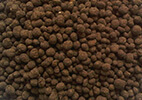
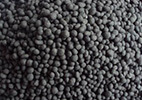
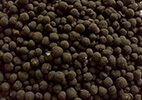
Granulation Process of the Equipment
The disc granulator is a physical agglomeration wet forming equipment. Its granulation process relies on the synergistic effect of three physical forces: centrifugal force, gravity, and surface tension.
Four-Stage Granulation Process
Stage 1: Nucleation
Powdered material is continuously added from the top of the equipment, while a liquid binder (usually water or a dilute molasses solution) is sprayed through a spray system. A thin water film forms on the surface of the powder particles. Due to the surface tension of water, the water and powder combine to form tiny nuclei.
Stage 2: Snowballing
As the disc rotates, the nuclei continuously adsorb surrounding material, gradually enveloping and enlarging, forming a “snowball effect.” During this process, the particles continuously adhere to powder and become spherical.
Stage 3: Compaction and Rounding
The material is carried to the upper part of the disc under centrifugal force, and then rolls down the inclined disc surface under gravity, forming a continuous tumbling motion. This cyclical motion gradually compacts and rounds the particles through collisions, ultimately forming dense spherical particles.
Stage Four: Natural Classification and Discharge When the particles reach the target size (typically 2–5 mm), their increased mass leads to increased centrifugal force, causing the particles to migrate towards the edge of the disc and eventually discharge naturally beyond the edge. Smaller particles remain in the disc to continue growing. This self-classification effect is a significant advantage of disc granulators, significantly reducing the return ratio.
Common Problems and Solutions
| Common Problems | Causes & Countermeasures |
|---|---|
| Too small granules & excessive dust | Insufficient material moisture or excessively high rotating speed |
| Oversized granules & agglomeration | Excessive moisture or too long material residence time inside disc |
| Material sticking to disc surface | High viscosity of raw material or insufficient smoothness of disc lining |
| Low pelletizing rate | Uneven raw material particle size or improper binder addition |
Equipment parameters
| Model | Capacity (t/h) | Diameter (mm) | Side Height (mm) | Rotation Speed (r/min) | Motor Power (kW) |
|---|---|---|---|---|---|
| ZL-500 | 0.05-0.15 | 500 | 150 | 25 | 1.5 |
| ZL-800 | 0.1-0.3 | 800 | 200 | 25 | 1.5 |
| ZL-1000 | 0.1-0.35 | 1000 | 250 | 25 | 2.2 |
| ZL-1200 | 0.1-0.35 | 1200 | 250 | 25 | 3 |
| ZL-1500 | 0.3-1 | 1500 | 300 | 18 | 3 |
| ZL-1800 | 0.5-1.2 | 1800 | 350 | 18 | 4 |
| ZL-2000 | 0.5-1.5 | 2000 | 400 | 18 | 5.5 |
| ZL-2500 | 1-2.5 | 2500 | 400 | 13.6 | 7.5 |
| ZL-2800 | 2-3 | 2800 | 500 | 13.6 | 11 |
| ZL-3000 | 2-3 | 3000 | 500 | 11 | 11 |
| ZL-3200 | 3-5 | 3200 | 500 | 10 | 11 |
| ZL-3600 | 3.5-6 | 3600 | 500 | 10 | 18.5 |
If you still have any questions about fertilizer production equipment and processes, or would like to learn more about customized solutions, please feel free to contact us. Whether it’s equipment selection and pricing, installation, commissioning and operation training, or after-sales maintenance and process upgrades, we can provide you with professional and timely answers and support to help your project be implemented efficiently.
Have Any Problem? Please, Contact
Integrity
Adhere to honesty and trustworthiness, be responsible to customers, employees, partners, and society, and establish long-term trust relationships.
Win win
Establish win-win relationships with all stakeholders such as customers, suppliers, and employees to share the fruits of enterprise development.