
Hydraulic Roller Granulator
Equipment Overview
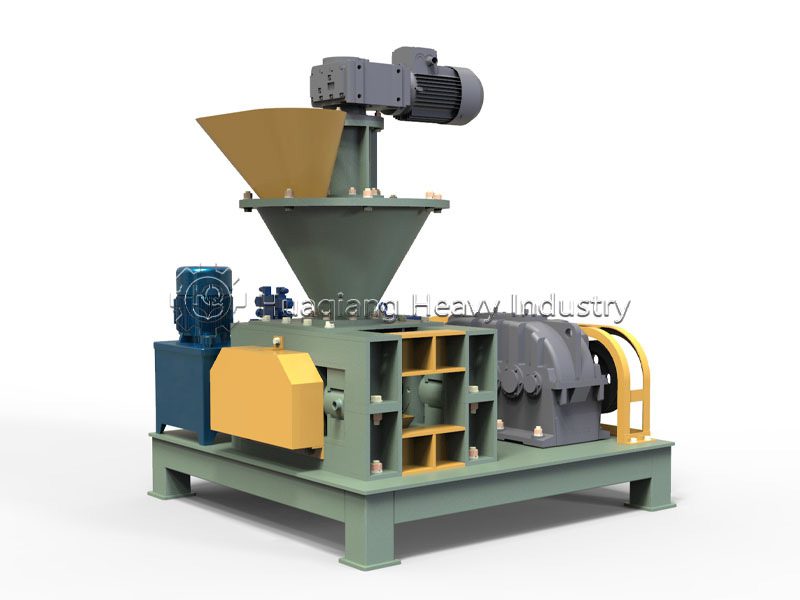
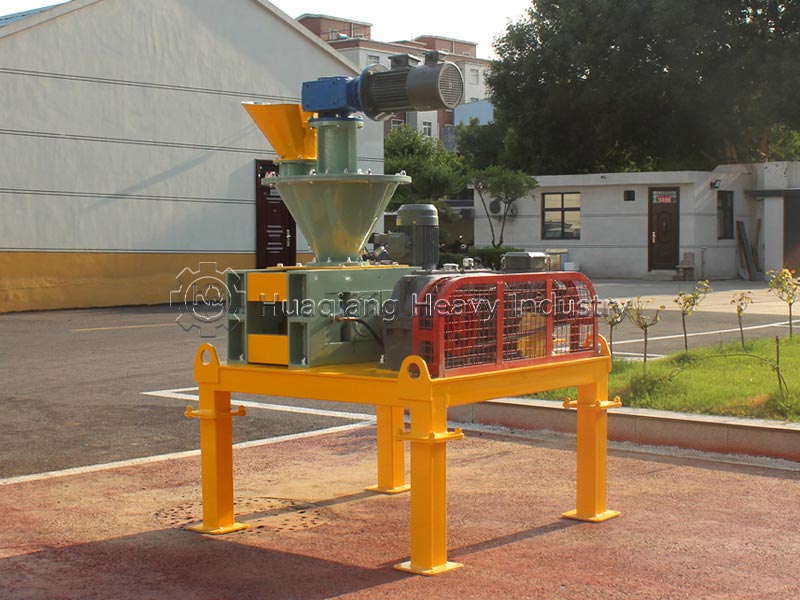
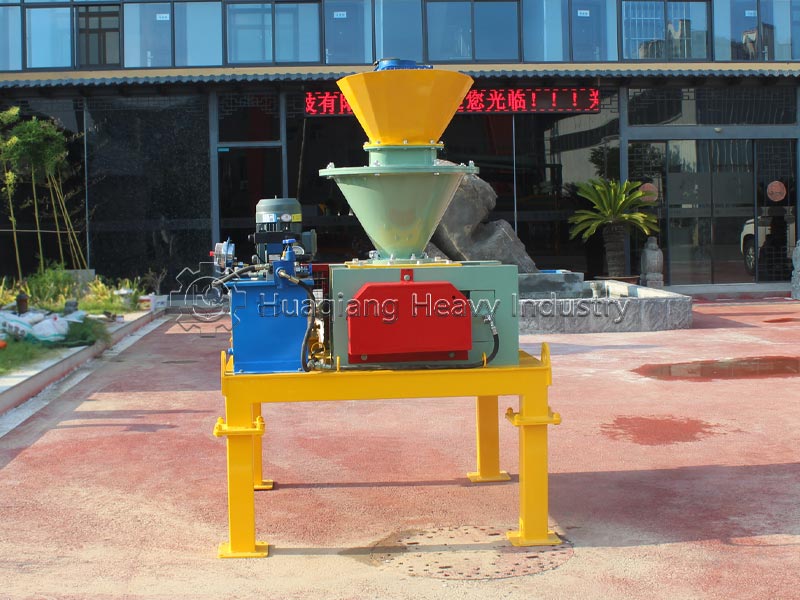
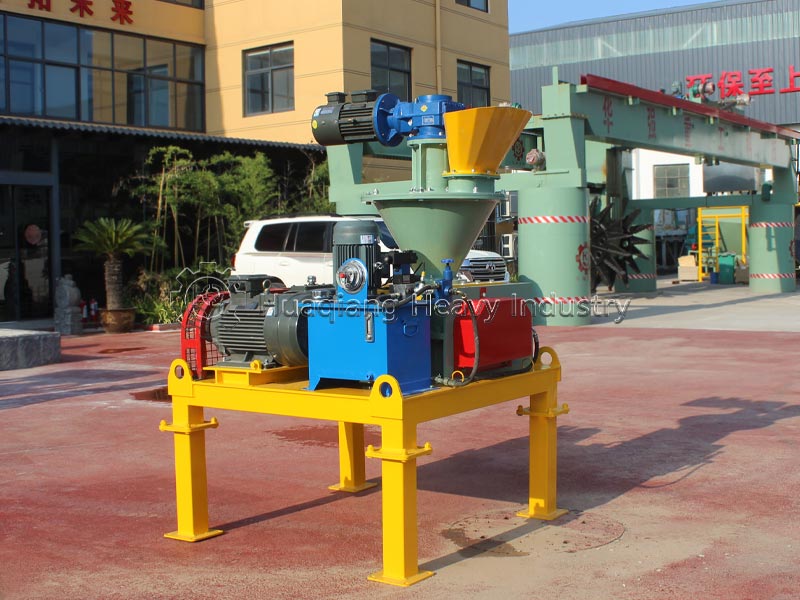
The hydraulic double-roller granulator is an upgraded version of the double-roller extrusion granulator. It employs dry roller pressing technology, primarily relying on pressure feeding to force material through the gap between two opposing rotating rollers, compressing it into flakes. After crushing, shaping, and screening, the flakes are transformed into granules that meet usage requirements. During the roller pressing process, the actual density of the material can increase by 1.5 to 3 times.
This equipment utilizes the principle of “high-pressure double-roller extrusion + hydraulic automatic compensation,” enabling direct forming of materials without drying. No water spraying is required throughout the process, eliminating complex steps such as drying and cooling, significantly simplifying the production line.
The core competitiveness of the hydraulic double-roller granulator lies in its precise hydraulic control, overcoming the shortcomings of traditional granulation equipment. With “precision, efficiency, cost-effectiveness, and adaptability” as its core features, it meets the granulation needs of various scenarios.
Equipment Structure and Composition
I. Core Component System
| Component Name | Function Description | Material / Process Requirements |
|---|---|---|
| Frame Assembly | Main structure supporting all working components | Welded medium carbon steel plates and channel steel under strict quality control and specific process requirements; lifting holes arranged at the middle of four corners |
| Extrusion Rolls (Double Rolls) | Two counter-rotating rollers to apply high pressure for material extrusion | Alloy steel base, surface laser cladded with tungsten carbide wear-resistant layer; equipped with die cavities / grooves on surface |
| Hydraulic System | Provide stable extrusion pressure, equipped with overload protection device | Driven by hydraulic cylinder, pressure range 50-300MPa; roll gap can be adjusted automatically |
| Transmission System | Drive double rolls to rotate synchronously in opposite directions | Combination of hard-tooth surface reducer and universal coupling; Power route: Motor → Pulley → Reducer → Driving Roll Shaft |
| Feeding System | Deliver materials evenly into the gap between double rolls | Screw feeder / Vibrating feeder with variable frequency speed regulation; with degassing and pre-compression functions |
| Crushing & Granulating System | Crush extruded flaky materials into pellets | Dual-shape tooth bar / rotating cutter group crushing; driven by sprocket and chain |
| Screening System | Separate pellets by specification, return unqualified materials | Vibrating screen / Rotary screen; adjustable mesh aperture |
| Adjustment Mechanism | Precisely adjust roll gap and extrusion force | Hydraulic push rod for precise roll gap adjustment with adjustable clearance |
| Cleaning System | Prevent materials from sticking to roller surface | Automatic scraper device; optional air-blow cleaning accessory |
| Dust Removal System | Collect dust to avoid environmental pollution | Cyclone dust collector / Pulse dust collector; collected dust returns to raw material system |
II. Five Major Functional Systems
1. Feeding System: Screw feeder/vibrating feeder, equipped with a degassing and pre-compression device to ensure uniform material entry into the extrusion zone.
2. Extrusion Forming System: Hydraulically driven high-pressure extrusion by rollers compresses powder into flakes/blocks.
3. Crushing and Granulating System: Crushes and granulates flake materials.
4. Screening and Grading System: Vibrating screen separates qualified granules from return materials.
5. Hydraulic Control System: Provides extrusion pressure, adjusts roller gap, and provides overload protection.
III. Core Features of the Hydraulic System
The hydraulic system is a core advantage of the roller granulator:
Pressure Adjustment: The extrusion pressure can be adjusted by the hydraulic cylinder according to the granulation operation requirements. Different pressure settings yield finished granules of different strengths.
Roller Gap Adjustment: Hydraulic push rods enable precise roller gap adjustment to adapt to different material characteristics.
Overload Protection: When encountering hard objects such as iron blocks, the hydraulic system automatically retracts to protect the equipment and prevent damage.
Pressure Range: 50-100MPa (standard) to 50-300MPa (high-pressure type)
Working Principle of the Equipment
I. Dry Roller Granulation Principle
The hydraulic double-roller granulator adopts dry roller granulation technology. Its core principle is: relying on external pressure, the material is forced through the gap between two relatively rotating rollers and compressed into blocks. During the rolling process, the actual density of the material can increase by 1.5 to 3 times, thereby achieving a certain particle strength requirement.
Five-Stage Workflow:
Raw Material Preparation (Moisture Content ≤5%) → Deaeration and Pre-compression → High-Pressure Extrusion Molding → Crushing and Granulation → Screening and Grading
1. Raw Material Preparation: Dry powdery material (moisture content ≤5%-10%) is fed into the hopper via conveying equipment.
2. Deaeration and Pre-compression: Before entering the gap between the rollers via a screw feeder, the material undergoes deaeration and screw pre-compression to remove air between the particles, allowing the particles to rearrange and eliminating voids between the materials.
3. High-Pressure Extrusion Molding: The material enters between two opposing rotating rollers and is squeezed and sheared under the powerful pressure (50-300MPa) provided by the hydraulic system. Under extrusion pressure, the material undergoes plastic deformation and is compressed into sheets or blocks. The pressure roller surface has concave molds/grooves, into which the material is pressed and shaped.
4. Crushing and Granulation: The extruded sheet/block material undergoes primary crushing (biaxial toothed roller or rotating cutter bar) and then enters the particle size adjustment system for granulation.
5. Screening and Grading: A vibrating screen separates the particles according to specifications. Qualified products enter the packaging process, while powdery undersize material is returned to the raw material system for regranulation, achieving a closed-loop operation.
II. Material Force Analysis
In the extrusion molding area, the material forces are analyzed as follows:
Force hindering material fall: F<sub>resistance</sub> = 2N·sin(α/2)
Force propelling material into the extrusion zone: F<sub>push</sub> = 2Q·cos(α/2)
Friction force: F<sub>friction</sub> = 2μN·cos(α/2)
When F<sub>push</sub> > F<sub>resistance</sub>, the material falls smoothly into the extrusion molding area. Within the extrusion molding zone, the pressure at various points on the surface of the pressure rollers is essentially equal. The pressure on the material gradually increases, significantly reducing the distance between material particles. Intermolecular forces begin to take effect, causing the material particles to adhere and fuse together.
III. Working Principle of the Hydraulic System
One roller is fixed, while the other can move horizontally.
The hydraulic system acts on the movable roller, creating high pressure between the two rollers.
The roller press is designed based on the material bed crushing mechanism; a dense layer of material is required between the two rollers.
After passing through the roller press, the particle size decreases and the density increases.
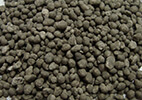
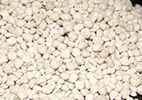

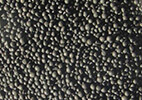
Applicable Raw Materials for the Equipment:
1. Compound Fertilizers/Chemical Fertilizers: Potassium chloride, potassium sulfate, urea, ammonium salts, ammonium phosphate, etc.
2. Fine Chemicals: Antioxidants, catalysts, dyes, pesticide intermediates.
3. Minerals/Metals: Coal powder, metal powder, gypsum, lime powder.
4. Organic Fertilizers: Pure organic fertilizer powder or organic-inorganic compound fertilizer with low moisture content (<10%).
Equipment Manufacturing Process
1. Capacity and Specifications
Common Output: Single-machine output ranges from 1 ton/hour to 5 tons/hour; multiple machines combined can form a production line with an annual output of over 100,000 tons.
Particle Shape: Spherical, semi-spherical, pillow-shaped, cylindrical, oblate, etc.
Particle Strength: Due to high-pressure extrusion, the particles have high strength and are not easily pulverized.
2. Granulation Process (Dry Method)
Ingredient Mixing: Dry powder raw materials are mixed in proportion, with the moisture content typically controlled below 5%.
Forced Feeding: The material is pushed into the rollers.
Roller Extrusion: Hydraulic constant-pressure extrusion molding.
Crushing and Granulation: Large pieces are crushed into uniform particles.
Finished Product Screening: Qualified particles are packaged, and unqualified powder is recycled for granulation.
Standardized Operating Procedures for the Equipment
1. Pre-start Inspection: Check that the frame, rollers, oil lines, and transmission components are intact and not loose; check that the hydraulic oil level and quality meet standards; clean the roller surface and hopper of any residual debris; adjust the roller gap and pressure parameters, and run the equipment under no-load for 3-5 minutes to confirm there are no abnormal noises, vibrations, or oil leaks.
2. Feeding Operation: After the equipment has stabilized under no-load operation, start the screw feeding system and feed material at a uniform speed. Do not feed large amounts of material at once, as this may cause blockages. Fine-tune the hydraulic pressure, feeding speed, and roller gap according to the material characteristics until the pellets are formed to the required standard.
3. Normal Production Monitoring: Observe the pellet forming effect, equipment pressure, and operating noise in real time; promptly clean any slightly sticky material from the rollers; avoid prolonged operation under overload or excessive pressure.
4. Shutdown Operation: First, stop feeding material. After the material inside the equipment has been completely emptied, shut down the feeding system, main unit, and screening system in sequence. After shutdown, depressurize and reset the equipment, clean any residual material, and ensure proper dust protection.
Routine Equipment Maintenance Methods
Proper maintenance can significantly extend equipment lifespan, reduce failure rates, and ensure stable production capacity. Core maintenance is divided into four main modules:
1. Roller Maintenance (Core Wear Parts)
After daily shutdown, clean any adhering material from the roller surface to prevent material hardening and wear. Weekly check for roller wear, scratches, and chipping; repair minor wear by grinding, and replace severely worn rollers promptly. Regularly calibrate the parallelism of the two rollers to ensure uniform extrusion.
2. Hydraulic System Maintenance
Monthly check the sealing of hydraulic lines and joints to prevent leaks. Every three months, check the viscosity and cleanliness of the hydraulic oil; filter and replace if excessive impurities are present. Replace the hydraulic oil annually and clean the hydraulic pump station filter element. Overpressure operation is strictly prohibited to protect hydraulic components.
3. Transmission and Motor Maintenance
Regularly add special lubricating grease to the reducer, bearings, and gear sets. Check the tightness of belts and couplings and adjust or replace them promptly. Clean dust from the motor’s cooling system to ensure good heat dissipation and prevent overheating and burnout. 4. Electrical Control and Overall Machine Maintenance: Keep the electrical control cabinet dry and dust-free; regularly check the wiring, switches, and sensor sensitivity; for long-term shutdowns, disconnect the power, clean the entire machine, and perform rust and dust prevention treatments; establish equipment operation logs to record pressure, production capacity, faults, and maintenance records.
Common Equipment Problems and Solutions
| Fault Phenomenon | Possible Causes | Solutions |
|---|---|---|
| Insufficient hydraulic system pressure | Insufficient hydraulic oil; abnormal oil pump operation; blocked oil pipeline; worn oil pump | Check if hydraulic oil is sufficient; inspect the oil pump; clean oil pipelines; measure volumetric efficiency and replace the pump if severely worn |
| Pellets fail to form spheres or turn into flat cakes | Insufficient feeding; excessive roll gap; gap narrow at both ends and wide in the middle | Ensure adequate feeding; adjust the gap between two rolls; grind off both sides to narrow the gap evenly |
| Axial / Circumferential misalignment of roller shell | Loose adjusting sleeve bolts; loose fit between roller shell and shaft | Realign and fasten the bolts tightly; replace roller shell or main shaft |
| Excessive friction between double rollers | Unreasonable gap between two rollers | Check and adjust the clearance of double rollers |
| Abnormal operating noise | Worn parts; poor fitting clearance | Stop the machine immediately for inspection; check dynamic balance and wear condition of rollers |
| Material blockage | Uneven feeding; excessively high material moisture | Clean blockages manually; inspect feeding device to guarantee uniform feeding; adjust material moisture content |
| Equipment overload / material jamming | Excessive feeding; hard foreign impurities mixed in materials | Shut down the machine for inspection at once; reduce feeding volume; remove iron and hard impurities |
Key Advantages of the Equipment:
1. Advanced Technology and Low Cost: Pure dry physical molding eliminates the need for water, binders, and drying equipment, significantly reducing equipment investment and operating energy consumption. The process is simple, and labor costs are low.
2. Excellent Molding Effect: Hydraulic constant pressure extrusion produces uniform, high-density, high-strength particles that are less prone to pulverization and have better storage resistance. The granulation rate far exceeds that of traditional granulation equipment.
3. Wide Applicability: Suitable for multiple industries and materials, with strong dry and wet compatibility. Direct granulation of dry powder makes it suitable for various powder deep processing scenarios.
4. Intelligent, Stable, and Durable: PLC fully automatic control ensures simple operation and a low failure rate. Wear-resistant and durable core components result in a long machine lifespan and extremely low maintenance costs.
5. Environmentally Friendly, Efficient, and Waste-Free: Closed-loop production eliminates material waste, dust pollution, wastewater, and exhaust gas, meeting environmental production standards and adapting to various compliant production lines.
Equipment Comparison with Other Granulation Equipment
| Comparison Item | Hydraulic Double Roller Granulator | Disc Granulator | Rotary Drum Granulator | Stirring Tooth Granulator | Double Die Granulator |
|---|---|---|---|---|---|
| Granulation Method | Dry Extrusion | Wet Agglomeration | Wet Agglomeration | Wet Stirring Granulation | Wet Extrusion |
| Moisture Requirement | ≤5%-10% | 15%-25% | 15%-25% | 20%-40% | 15%-25% |
| Binder | Not Required | Sometimes Required | Sometimes Required | Not Required | Sometimes Required |
| Drying Process | Not Required | Required | Required | Required | Required |
| Pellet Shape | Spherical / Irregular | Spherical | Spherical | Spherical | Cylindrical |
| Pellet Strength | High (10-30N) | Medium | Medium | Medium | Medium |
| Investment Cost | Medium | Low | Medium | Medium | Medium |
| Operation Cost | Low (No Drying Needed) | Medium | Medium | Medium | Medium |
| Applicable Materials | Dry Powder, Crystals | Wet Powder, Fiber Materials | Wet Powder | Wet Powder, Fiber Materials | Wet Powder, Fiber Materials |
| Production Capacity | 1-10t/h | 1-5t/h | 3-10t/h | 1-5t/h | 1-8t/h |
Hydraulic roller granulators, as efficient, energy-saving, and environmentally friendly dry granulation equipment, directly compress powdery materials with a moisture content of ≤5%-10% into granules using high-pressure extrusion (50-300MPa) provided by a hydraulic system. No binders or moisture are needed, and no subsequent drying process is required. This equipment achieves a granulation rate of ≥85%, high particle strength (≥10-30N), and can increase bulk density by 1.5-3 times. It is widely used in compound fertilizers, organic fertilizers, chemicals, pharmaceuticals, environmental protection, and many other fields.
Whether you are building a new organic fertilizer/compound fertilizer/feed production line and need a complete equipment solution, upgrading an existing production line and need equipment selection advice, or encountering difficulties in granulating high-moisture, sticky, or coarse-fiber materials and need technical support—we are always ready to provide you with professional and sincere service.
Have Any Problem? Please, Contact
Integrity
Adhere to honesty and trustworthiness, be responsible to customers, employees, partners, and society, and establish long-term trust relationships.
Win win
Establish win-win relationships with all stakeholders such as customers, suppliers, and employees to share the fruits of enterprise development.