
Equipment Overview
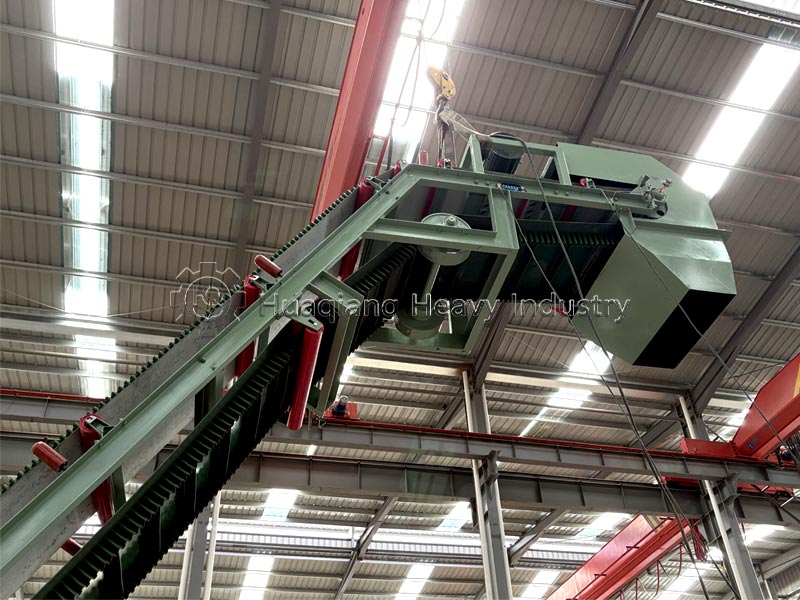
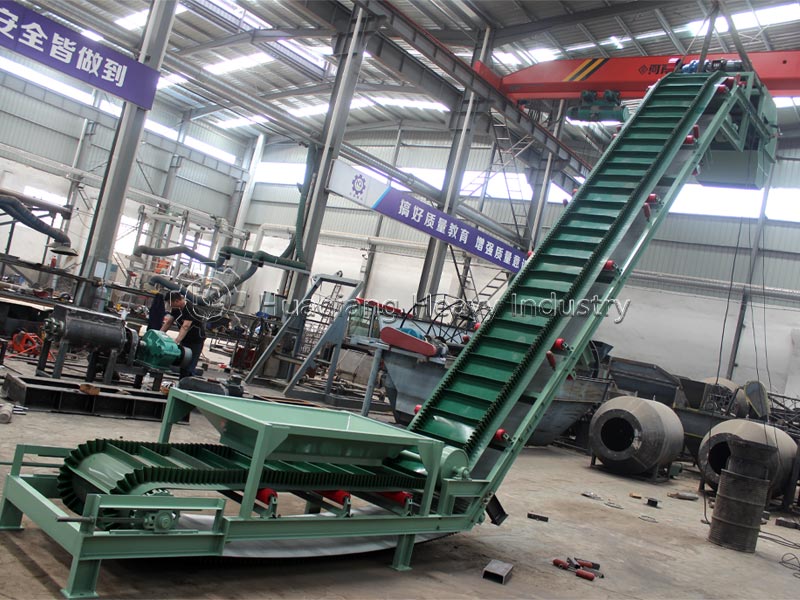
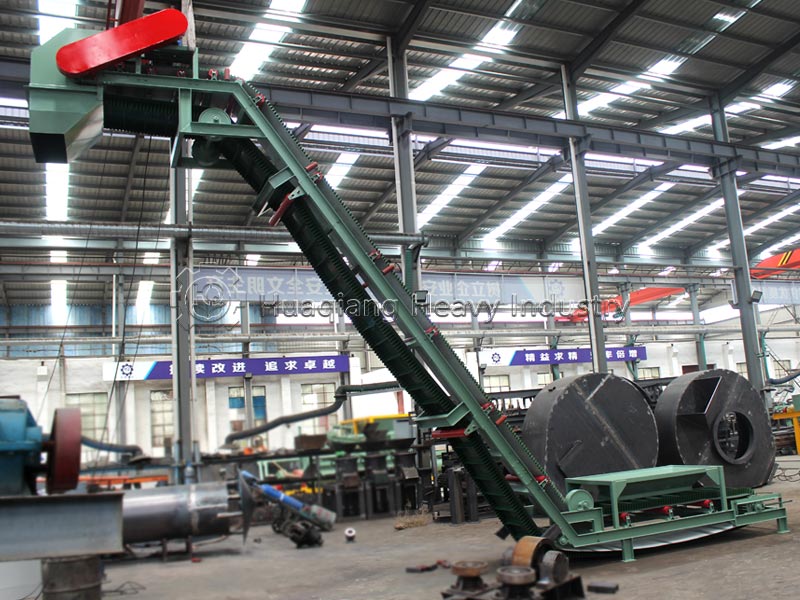
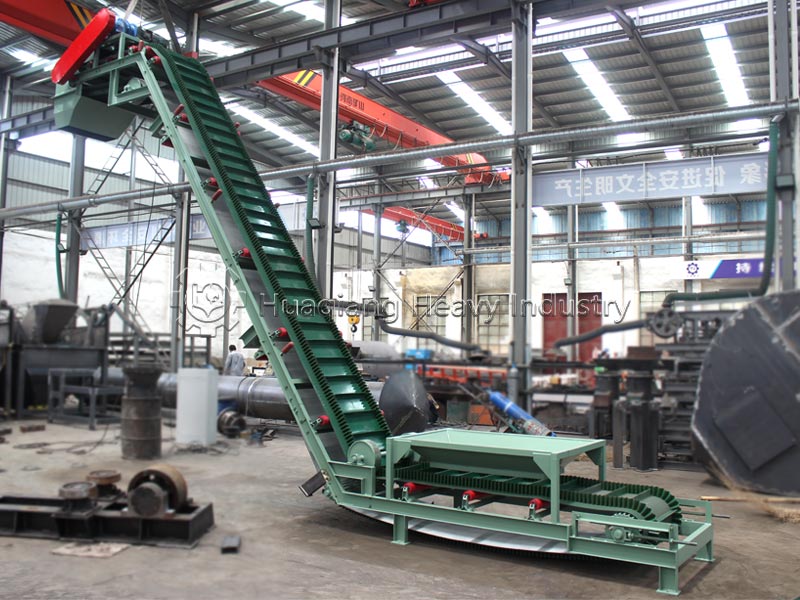
The large-angle belt conveyor, also known as a corrugated sidewall belt conveyor or DJ-type large-angle belt conveyor, is a continuous conveying device based on a conventional belt conveyor, employing a special conveyor belt structure. Its core feature is the replacement of the ordinary flat belt with a corrugated sidewall conveyor belt, significantly expanding the conveying angle from the conventional belt conveyor’s 18° or less to 30°–90°, and even enabling vertical lifting.
This equipment combines the advantages of general belt conveyors—simple structure, reliable operation, and convenient maintenance—with the outstanding characteristics of large-angle conveying, compact structure, and small footprint. It can replace the traditional “belt conveyor + bucket elevator” combined layout, directly achieving continuous horizontal-inclined-vertical conveying, resulting in significant overall economic benefits.
Equipment Structure Composition
The entire machine is divided into five main modules: dedicated conveyor belt, segmented frame system, drive tensioning unit, anti-deviation belt pressure assembly, and cleaning and safety accessories.
- Core Corrugated Sidewall Conveyor Belt (Dedicated Component): Composed of a base belt, two corrugated rubber sidewalls, and transverse partitions, integrally vulcanized. The partitions and sidewalls form an independent compartment. For fertilizer applications, three types of base belts can be customized: wear-resistant, acid and alkali-resistant, and heat-resistant. Sidewall heights range from 40 to 240 mm, selectable as needed.
- Segmented Welded Frame
- Lower Horizontal Feed Section: Buffer rollers and a centrally located guide chute reduce material impact.
- Concave Arc Transition Section: Equipped with pressure rollers to press the sidewalls and prevent them from flipping out of the chute (core leak-proof structure).
- Inclined Main Conveying Section: Bearing rollers + double-sided anti-deviation vertical rollers.
- Convex Arc Discharge Section: Gentle arc for smooth material removal from the belt.
- Upper Horizontal Discharge Section: Discharge chute and head cleaning device.
- Drive and Tensioning Assembly: Head-mounted rubber-coated drive roller, motor + frequency converter reducer; tail-mounted spiral/counterweight tensioning mechanism to maintain belt tension throughout; standard backstop to prevent material backflow during machine stop.
- Dedicated Anti-Belt Deviation Assembly: Concave arc belt pressure pulley set, double-sided limiting vertical rollers, self-aligning idler rollers to solve the problems of belt deviation on one side and side scraping of the frame under large inclination angles.
- Cleaning and Safety Features: Head spring sweeper, bottom beater wheel (to shake off adhering wet fertilizer clumps); emergency stop rope, belt deviation alarm switch, grounding protection, fully enclosed dust cover (optional).
Working Principle
- Closed-loop transmission: The motor drives the head rubber-coated roller, relying on the friction between the roller and the base belt to continuously circulate the entire sidewall belt.
- Bucket loading: Material falls from the tail guide chute into the sidewalls and partitions to form an independent bucket. The wavy sidewalls prevent material from scattering laterally.
- Stable lifting at large angles: The belt is constrained by the concave arc pressure pulley, preventing it from folding outwards. The partitions mechanically support and counteract the downward force of gravity, ensuring no backflow or spillage at angles of 30°~90°.
- Head unloading: The belt passes around the head arc-shaped roller, and the material is discharged from the unloading chute by gravity and centrifugal force, and sent to the next equipment.
- Return self-cleaning: When the empty belt descends, the bottom beater vibrates, and the spring cleaner scrapes away any clumps of fertilizer adhering to the belt surface, preventing material accumulation and blockage on the return trip.
Applicable Raw Materials
- Main Materials for the Fertilizer Industry
1) High-moisture organic raw materials: fermented chicken manure, cow manure, pig manure, wet straw, mushroom residue, distiller’s grains, kitchen sludge (moisture content 20%~45%);
2) Granular fertilizers: disc/drum granulated organic fertilizer, compound fertilizer, BB fertilizer, cooled coated finished granules;
3) Powdered materials: humic acid, bentonite, talc coating powder, chemical fertilizer powder;
4) Small-lump raw materials: crushed cake fertilizer, fermented compost fragments.
- Materials for Cross-Industry Application
Grains, feed pellets, chemical powders, sand, gravel, coal slag, with a bulk density of 0.5~2.5t/m³ and a particle size ≤180mm, can all be transported.
- Materials Prohibited from Transport
Sharp hard stones with a particle size >180mm, highly corrosive liquid materials, flammable and explosive ultrafine dust (explosion-proof customized models required), high-viscosity slurry.
Applications
With its core advantages of “small footprint, flexible layout, and enclosed environmental protection,” the steeply inclined belt conveyor is widely used in the following industries:
| Industry Field | Typical Application Scenarios |
|---|---|
| Coal & Mining | Vertical or large‑angle lifting of coal and ore in underground tunnels, open‑pit mines and coal preparation plants; replace bucket elevators to reduce floor occupation |
| Iron & Steel Metallurgy | High‑temperature and heavy‑load large‑angle conveying for blast furnace coke, sinter ore and pellet ore; closed conveying reduces dust pollution |
| Building Materials & Cement | Vertical feeding of limestone, clinker and finished cement from stockyard to vertical mill / rotary kiln; shorten conveying route length |
| Chemical & Power Industry | Stacking and transferring of chemical fertilizer, coal and fly ash; special acid‑alkali resistant sidewall belts are adopted for corrosive materials |
| Grain & Agriculture | Vertical lifting and loading‑unloading of bulk grain (corn, wheat, soybean) for storage; food‑grade PU sidewall belts meet sanitary requirements |
| Port & Wharf | Loading and unloading of bulk cargo ships and barges; cooperate with stackers and reclaimers to form compact port conveying system |
Core Value: Compared to the traditional combination of “horizontal belt conveyor + bucket elevator,” the steeply inclined belt conveyor can save more than 30% on civil engineering investment and eliminates the risks of “slippage, bucket drop, and chain breakage” common in bucket elevators, achieving reliability close to that of general-purpose belt conveyors.
Common Faults, Causes, and Standardized Solutions
| Fault Phenomenon | Root Cause | Professional Solutions |
|---|---|---|
| Material slipping & spilling at large inclination angle | 1. Insufficient baffle height; 2. Excessive belt speed; 3. Cracked corrugated sidewall; 4. Lack of pressing rollers, outward‑tilted sidewall | 1. Increase baffle height; 2. Reduce operating speed; 3. Cold‑bond repair for cracked sidewall belt; 4. Add pressing rollers to constrain sidewall |
| Belt one‑sided deviation, sidewall rubbing frame | 1. Non‑parallel head & tail pulleys; 2. Off‑center feeding; 3. No anti‑deviation vertical rollers on return side; 4. Skewed belt joint | 1. Adjust frame tension to correct horizontal level; 2. Extend central feeding chute; 3. Install bilateral anti‑deviation vertical rollers; 4. Re‑cut and correct belt joint |
| Sidewall cracking & tearing | 1. Hard‑object impact and scratch; 2. Excessive pressure from pressing rollers; 3. Aging under long‑term high‑temperature baking | 1. Install pre‑screening for foreign‑object removal; 2. Reduce pressure of pressing rollers; 3. Replace heat‑resistant belt, clean high‑temp materials during shutdown |
| Belt slipping, idling of driving pulley | 1. Insufficient belt tension; 2. Pulley stuck with wet fertilizer lumps; 3. Instant over‑feeding overload | 1. Adjust tension screw to increase belt tension; 2. Stop machine and clear accumulated material on pulley; 3. Lower feeding rate for uniform feeding |
| Material accumulation at head section, severe belt sticking | Worn‑out scraper cleaner, non‑rotating tapping roller | Replace scraper blade, inspect tapping‑roller drive; low‑pressure water‑spray cleaning is optional for wet fertilizer (forbidden for dry materials) |
| Belt reverse‑rotation after shutdown, material back‑flow | Failure of back‑stop friction disc | Replace back‑stop friction disc during shutdown, add lubricant periodically |
Equipment Application Process in Fertilizer Production Line
Complete Fertilizer Production Line Supporting Chain
Raw Material Stockpile → Inclined Belt Conveyor → Crusher → Batching and Mixing Machine → Granulator → Inclined Belt Conveyor → Rotary Drum Dryer → Cooler → Inclined Belt Conveyor → Coating Machine → Screening Machine → Finished Product Silo → Packaging Machine
Section Supporting Logic
- Raw Material Feeding Section: Due to limited workshop height, wet manure is lifted at a large angle to the crusher in one go, eliminating the need for concrete ramps and saving on construction costs.
- Drying and Transfer Section: Wet granulated particles are directly fed into the high-level feed inlet of the dryer at a large angle, eliminating the need for two-stage ordinary belt conveyors and reducing dust leakage.
- Finished Product Refining Section: After cooling, high-temperature particles are lifted in a sealed manner to the coating machine and high-level screening silo.
- Fine Powder Circulation Section: Screened fine powder is returned to the mixer via an inclined belt conveyor for re-granulation, eliminating raw material waste.
The steep-angle belt conveyor is a specialized conveying equipment that breaks through the inclination angle limitations of traditional belt conveyors. Its core innovation lies in the box-shaped bucket structure with corrugated sidewalls and transverse partitions, enabling stable material conveying without spillage even at extreme inclination angles of 30°–90°. With its significant advantages of low footprint, low investment, high reliability, and good environmental performance, this equipment has become the mainstream choice to replace bucket elevators and traditional combined conveying solutions in large-scale vertical lifting scenarios in industries such as mining, metallurgy, building materials, ports, and grain. When selecting and using this equipment, key considerations should be given to the quality of the sidewall belt, backstop protection, feed uniformity, and regular maintenance to ensure stable operation under long-term heavy-load conditions.
Have Any Problem? Please, Contact
Integrity
Adhere to honesty and trustworthiness, be responsible to customers, employees, partners, and society, and establish long-term trust relationships.
Win win
Establish win-win relationships with all stakeholders such as customers, suppliers, and employees to share the fruits of enterprise development.