


Equipment Overview
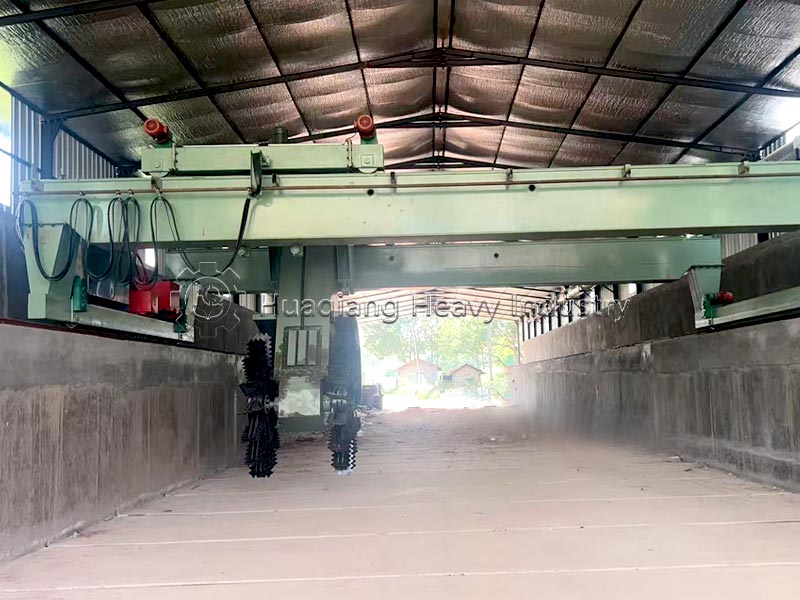
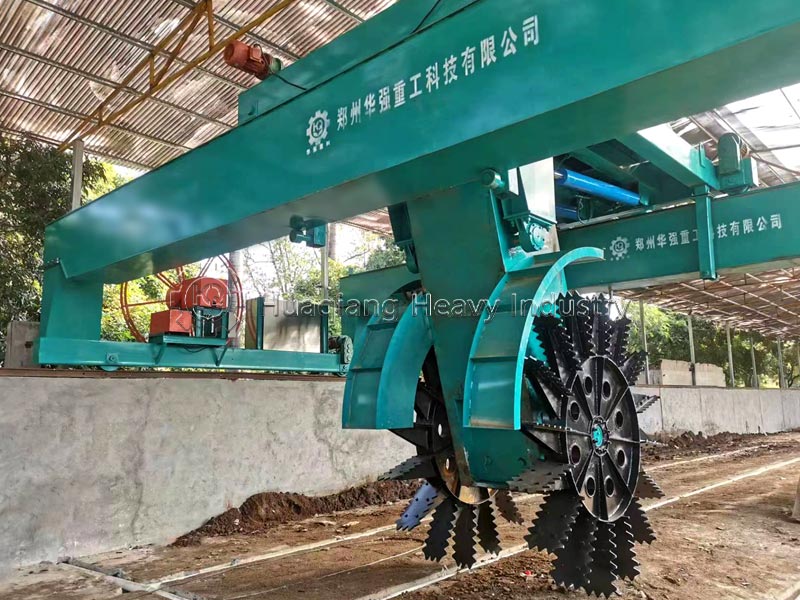
The large wheel compost turner (also known as a wheel-type compost turner or large wheel compost turning machine) is a large-scale compost turning device developed for large-span, high-depth fermentation tanks. It adopts a disc-type rotating turning structure, offering a wide turning area, sufficient penetration depth, and high operating efficiency. It is suitable for the large-scale fermentation needs of large organic fertilizer processing plants and centralized manure treatment bases, and is a core piece of equipment for modern organic fertilizer mass production.
This equipment differs from traditional spiral and drum-type compost turners. It relies on a large-diameter rotating disc combined with multiple sets of high-strength throwing blades for operation, resulting in a wider turning coverage and stronger material layer penetration in a single pass. It can thoroughly turn thick piles of material in one go, completely solving the industry problem of surface turning and bottom aeration. The equipment is suitable for trench-type fermentation and is a core piece of equipment for the industrialized harmless treatment of livestock farming, municipal waste, and municipal sewage sludge.
This equipment features a reasonable design structure, high efficiency, low energy consumption, high automation, and ease of use, making it a highly efficient model that is very popular with users.
Equipment Structure and Composition
The large wheel compost turner mainly consists of the following systems:
| System Name | Main Components | Function Description |
|---|---|---|
| Power Transmission Device | Main motor, reducer, bearing seat, main shaft, embedded hard tooth surface curved multi-stage gear set | Provides power for turning wheel disc; the motor drives wheel disc rotation via reducer |
| Traveling Device | Beam traveling motor, transmission gear, traveling wheel, track system | The whole machine moves longitudinally along tracks on both sides of fermentation tank, traveling speed 1–15m/min |
| Compost Turning Device | Large-diameter turning wheel disc, manganese steel tooth-type turning plate, wheel disc frame, mixing rake teeth | Core working component; high-speed rotation cuts, lifts and conveys materials |
| Hydraulic Lifting Device | Hydraulic pump station, electromagnetic valve body, hydraulic oil pipe, hydraulic cylinder column | Controls lifting height of turning wheel disc to adapt to different stacking depths |
| Horizontal Shifting Device | Compost trolley motor, speed-regulating shifting trolley | Realizes left-right movement of wheel disc along tank width for dead-angle-free turning |
| Electric Control System | Control cabinet, soft starter, limit travel switch, automatic electrical control system | Centralized control, supports manual / automatic operation, equipped with safety limit protection |
| Main Frame Body | Main frame, lifting frame, baffle plate | Supports overall machine structure, arranged across fermentation tank |
Key Structural Features:
1. The disc is equipped with a double-stage, four-layer spatial three-dimensional structure blade, enabling stepped progressive cutting and long-distance throwing (3-5 meters), ensuring full contact between the material and air.
2. The transmission and speed change system is fully enclosed, using direct transmission via shafts and gear sets, providing strong resistance to impact loads.
3. Four-stage spatial curved surface cutting and turning teeth, with replaceable wear-resistant blades, resulting in low operating costs.
4. Longitudinal and lateral displacement coordination ensures no dead angles in turning, eliminating the need for a return path within the fermentation tank.
Raw Materials for the Equipment
1. Typical Raw Materials that Can Be Processed
Livestock and poultry manure; sludge and waste; sugar mill filter mud; lees and cake; straw sawdust and other fibrous/solid organic matter
2. Key Points for Raw Material Adaptation (Professional Summary)
Large disc compost turners are particularly suitable for the following combinations of characteristics:
Materials with high solids content requiring turning and aeration;
Materials with fibrous/agglomerating tendencies: achieved by the disc turning plates;
The stage requiring “uniform mixing + sufficient aeration” in fermentation tank aerobic processes.
The core design and operation principle is: maintaining the disc at a suitable height above the ground through hydraulic lifting to prevent the blades/turning components from hitting the ground, while ensuring contact with the material at the bottom of the tank to complete the “lifting + turning”.
Equipment Applications
The large wheel compost turner has a wide range of applications, suitable for aerobic fermentation treatment of various organic wastes:
1. Organic Fertilizer Production:
Fermentation and turning of livestock and poultry manure (pig manure, cow manure, chicken manure, sheep manure, etc.)
Fermentation and composting operations in organic fertilizer plants and compound fertilizer plants
2. Agricultural Waste Treatment:
Fermentation treatment of crop straw and straw sawdust
Industrial organic waste such as sugar factory filter mud, lees, and cake residue
Mushroom residue, distiller’s grains, garden dead branches and leaves, agricultural waste residue, etc.
3. Urban Organic Solid Waste Treatment:
Aerobic composting of urban sludge and sludge waste
Fermentation treatment of domestic waste
4. Other Fields:
Fermentation, composting, and moisture removal operations in horticultural farms and button mushroom cultivation plants
Bioremediation of contaminated soil
This equipment is suitable for aerobic fermentation and can be used in conjunction with solar fermentation chambers, fermentation tanks, and transfer machines. When used with a transfer machine, it can achieve multi-tank functionality.
Working Principle of the Equipment
The large wheel compost turner operates on the basis of aerobic fermentation technology. The core mechanism is as follows:
I. Power Transmission Principle: The electric motor directly transmits power to the reducer, which is connected to the main shaft of the compost turner. The disc is fixed by coupling flanges at both ends of the shaft. The transmission system consists of the motor, main shaft, and embedded hardened gear sets with variable-direction arc gears, providing strong power to the compost turner.
II. Turning and Turning Operation Principle
1. Longitudinal Movement: The entire machine moves longitudinally along the tracks on both sides of the fermentation tank, with an adjustable speed (1–15 m/min).
2. Lateral Movement: The turning trolley drives the wheel to move left and right in the width of the tank, achieving full coverage and no dead angles during turning and turning.
3. Wheel Cutting: The wheel rotates at high speed (20–40 r/min), and the equipped double-stage 4-layer spatial three-dimensional structure blades perform stepped progressive cutting of the material.
4. Lifting and Throwing: The material in the fermentation tank is lifted from the bottom of the tank to the surface of the pile, and then turned, stirred, and moved to a position 3–5 meters away.
5. Aeration and Oxygen Supply: During the turning and turning process, the material has full and large-area contact with air, quickly replenishing the oxygen inside the pile.
III. Aerobic Fermentation Principle
Through regular turning and turning, the pile temperature rises rapidly to 50–65℃. Under this high-temperature condition:
1. Pathogens, insect eggs, and weed seeds are effectively killed.
2. Microorganisms fully decompose organic matter.
3. The fermentation cycle is shortened.
4. 5. Maintain the oxygen content of the compost pile within the ideal range.
Avoid problems such as odor and seedling burn caused by anaerobic fermentation.
Operating Procedures and Maintenance Methods
I. Operating Procedures:
1. Pre-run Inspection: Check the reducer and lubrication points for oil level, power supply voltage (rated 380V, fluctuation range ±10%), wiring reliability, bolt tightness, and material accumulation height.
2. Start-up Sequence: Start power → Move the trolley to the designated position → Lower the wheel disc → Start the main motor (wheel disc rotates) → Move the trolley into operation.
3. Shutdown Sequence: Stop the trolley → Stop the trolley → Stop the main motor → Hydraulically lift the wheel disc → Disconnect the power.
II. Maintenance Methods:
1. Post-shift Maintenance: Clean residue, add lubricating oil, and disconnect the power.
2. Weekly/Regular Maintenance: Check the gearbox gear oil (replace after the first 200 hours, then annually thereafter), bearing wear, and the integrity of the electrical control cabinet contactors.
Common equipment problems (symptoms → causes)
| Common Faults | Possible Cause Analysis | Treatment Suggestions |
|---|---|---|
| Short compost turning distance | Severe deformation of rake teeth & shaft or winding of foreign matter | Repair rake teeth or shaft; remove foreign matter |
| Foreign matter jammed on transmission gear or gear damage | Clear foreign matter or replace gears | |
| Unstable traveling | Noise or overheating of reducer | Clear foreign matter; inspect or replace key components |
| Foreign matter inside traveling gear or transmission device | Clear foreign matter | |
| Lack of lubricating oil | Add lubricating oil | |
| Excessive wear or damage of bearing | Replace bearings | |
| Difficult or failed motor startup (with buzzing noise) | Deformation and bending of reduction shaft | Calibrate or replace the shaft |
| Too low or too high voltage | Restart after voltage returns to normal |
Application of the Equipment in the Production Line
The large wheel compost turner is the core equipment in the fermentation section of an organic fertilizer production line, located at the source of the entire production line.
1. Typical Organic Fertilizer Production Line Process Flow:
Raw material pretreatment → Fermentation tank composting → Disc compost turner fermentation → Composted material → Crushing → Batching and mixing → Granulation → Drying → Cooling → Screening → Coating → Packaging
2. Specific Positioning of the Large Disc Compost Turner in the Production Line:
Location: Fermentation section, trough-type fermentation tank
Function: Turning, crushing, oxygenating, and composting materials in the trough
Connection: Connects to the raw material batching and feeding system at the front end, and prepares the composted material for entry into the granulation section at the rear end.
3. Production Line Adaptability:
Suitable for aerobic fermentation, can be used with solar fermentation chambers, fermentation tanks, and transfer machines.
When used with a transfer machine, it can achieve multi-tank functionality.
The fermentation tanks it is paired with can discharge continuously or in batches.
High efficiency, stable operation, robust and durable, uniform turning and composting.
Fermentation Process of the Equipment
The large wheel compost turning machine serves the aerobic composting fermentation process, its core function being to provide sufficient oxygen for aerobic microorganisms.
1. Aerobic Fermentation Principle
Composting fermentation is a microbial-dominated exothermic process. The disc turner, through turning and tossing, ensures full contact between the material and air, providing oxygen for aerobic microorganisms and promoting the decomposition of organic matter. The turner also has a crushing function, significantly saving time and labor, and significantly improving production efficiency and product quality.
2. Fermentation Temperature Control
Temperature control is crucial in the fermentation process:
Suitable Temperature Range: 55–65℃ is the critical temperature for killing pathogens and weed seeds.
Excessively High Temperature (above 70℃): Beneficial microorganisms’ activity decreases or even die, resulting in “compost burning.”
Excessively Low Temperature: It is difficult to maintain the high-temperature period, prolonging the harmless treatment time.
Control Methods: Controlling the heat dissipation rate of the compost pile by adjusting the turning frequency and depth.
3. Fermentation Cycle
With continuous turning and oxygen supply from the disc turner, the compost pile temperature is balanced and stable, maintaining a stable sterilization temperature of 55–70℃. The entire fermentation and maturation cycle typically takes 20-25 days to complete harmless maturation, thoroughly killing insect eggs and pathogens, and meeting the standards for organic fertilizer raw materials. In some high-efficiency scenarios, the fermentation cycle can be shortened to 7-10 days.
4. Turning Frequency
The turning frequency needs precise control:
Too low a frequency: Heat accumulates inside the pile, with local temperatures exceeding 70℃, leading to “piling fire.”
Too high a frequency: The pile temperature drops frequently, making it difficult to maintain a high temperature period.
Intelligent Control: Modern rotary turners integrate sensors and a PLC control system, which can automatically adjust the turning frequency and depth.
Equipment Parameters
| Model | Main Motor | Small Car Travel Motor | Big Car Travel Motor | Hydraulic Pump Motor |
|---|---|---|---|---|
| LP-10m | 55KW | 1.5KW×4 | 1.5KW×2(4) | 4KW |
| LP-12m | ||||
| LP-15m | ||||
| LP-20m |
Target Users of the Equipment:
1. Organic Fertilizer/Compound Fertilizer Production Enterprises: Requires automated aerobic fermentation and turning for uniform composting.
2. Livestock Farms (with supporting treatment): Harmless treatment and resource utilization of livestock and poultry manure.
3. Wastewater Treatment and Sludge Disposal Enterprises: Core equipment for industrialized harmless treatment.
4. Sugar Mills and Related By-product Resource Utilization Enterprises: Treatment of filter mud, lees, and cake residue.
5. Horticulture and Button Mushroom Cultivation Enterprises: Substrate/fermentation composting and stable supply.
6. Industrial Parks/Agricultural Complexes: Reuse of organic waste such as straw and sawdust.
Advantages and Features of the Equipment
I. Advantages Compared to Traditional Trench Compost Turners
| Comparison Item | Large Wheel Compost Turner | Traditional Trough Compost Turner |
|---|---|---|
| Turning Depth | 1.5–3 meters | Normally 0.8–1.5 meters |
| Turning Width | 12–30 meters | Normally 3–6 meters |
| Space Utilization | Large span, saving civil engineering costs | Small span, requires multiple fermentation troughs |
| Automation Level | Fully automatic, no on-site staff required | Semi-automatic or manual operation |
| Energy Consumption | Energy saving by 30%–70% | High energy consumption |
| Dead-angle-free Turning | Symmetrical wheel disc turning + shifting trolley | Dead angles may exist |
| Crushing Capacity | Manganese steel tooth-type turning plates, excellent crushing performance | Average crushing capacity |
II. Core Competitive Advantages
1. Large Turning Depth: Up to 1.5–3 meters, suitable for high-pile operations
2. Large Turning Span: Up to 30 meters wide, saving floor space
3. No Dead Angles in Turning: Symmetrical turning with rotating discs, and adjustable trolley for left and right movement
4. Low Energy Consumption: Unique energy-saving transmission mechanism, significantly more energy-efficient than traditional equipment for the same workload
5. High Degree of Automation: Fully automated electrical control, no manual operation required during operation
6. Crushing and Mixing Function: Provides crushing and mixing capabilities for materials
7. Smooth Operation: Fully enclosed transmission system with strong resistance to impact loads
8. Low Maintenance Costs: Replaceable wear-resistant toothed cutters for long service life
9. Limit Safety Protection: Equipped with a soft starter and limit switches for safety and limiting functions.
Safe Operating Procedures
1. Operators must not operate the compost turner after drinking alcohol, or when feeling unwell or unwell.
2. All tracks of the compost turner must be grounded to ensure safety.
3. Power must be disconnected when replacing cable trays or cables.
4. No one may pass in front of or behind the compost turner during production. Warnings should be given before starting the machine, and personnel must stay away from it.
5. No maintenance or lubrication should be performed during production.
6. The machine must travel at the specified speed during turning; exceeding the speed limit is prohibited.
7. Unauthorized operators are prohibited from operating the machine.
8. The traveling and lateral tracks must be parallel. Limit switches must be moisture-proof and sealed to withstand the high temperature and humidity fermentation environment.
9. Daily maintenance requires close monitoring of chain tension, hydraulic station oil quality, and wheel bearing temperature.
As a core piece of equipment in the fermentation section of large and medium-sized organic fertilizer production lines, the large wheel compost turner, with its advantages of large span, deep depth, high automation, and low energy consumption, has become the preferred fermentation equipment for large-scale organic fertilizer plants, large-scale livestock farms, and sludge treatment centers. Its ground-trough aerobic fermentation technology can convert organic raw materials such as livestock manure and agricultural waste into high-quality organic fertilizer within 15-30 days, achieving the dual goals of resource utilization and environmental protection.
During selection and use, users should choose the appropriate model based on the actual fermentation tank size, raw material quantity, site conditions, and budget, and strictly adhere to operating procedures and maintenance requirements to ensure safe, efficient, and long-term stable operation of the equipment. The large-disc compost turner features a reasonable design structure, high efficiency, low energy consumption, high degree of automation, ease of use, low cost, and wide application, making it a highly efficient machine that is popular among users.
Whether you are building a new organic fertilizer/compound fertilizer/feed production line and need a complete equipment solution, upgrading an existing production line and need equipment selection advice, or encountering difficulties in granulation of high-moisture, sticky, or coarse-fiber materials and need technical support—we are always ready to provide you with professional and sincere service.
Have Any Problem? Please, Contact
Integrity
Adhere to honesty and trustworthiness, be responsible to customers, employees, partners, and society, and establish long-term trust relationships.
Win win
Establish win-win relationships with all stakeholders such as customers, suppliers, and employees to share the fruits of enterprise development.