
Equipment Overview
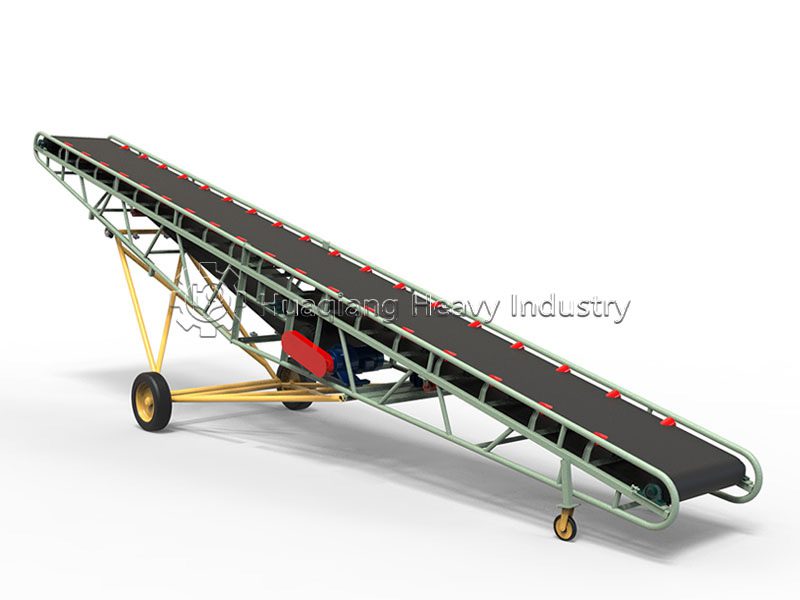
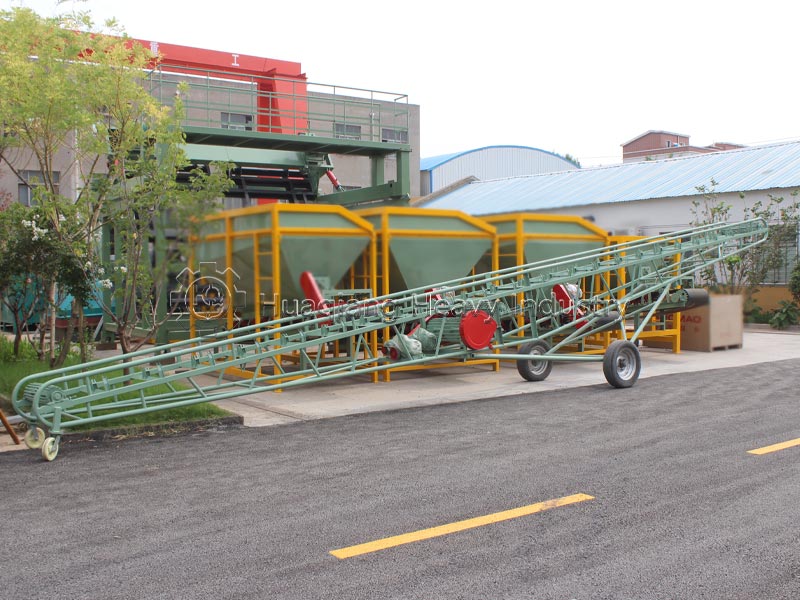
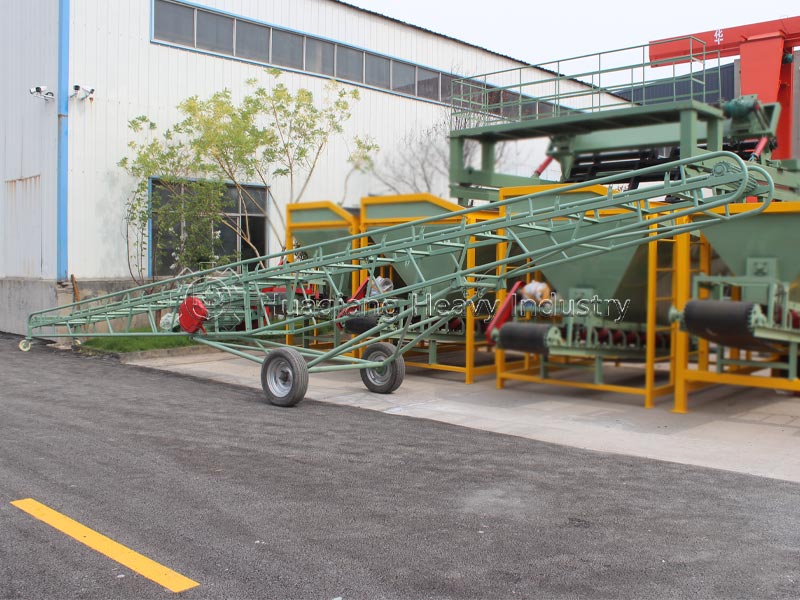
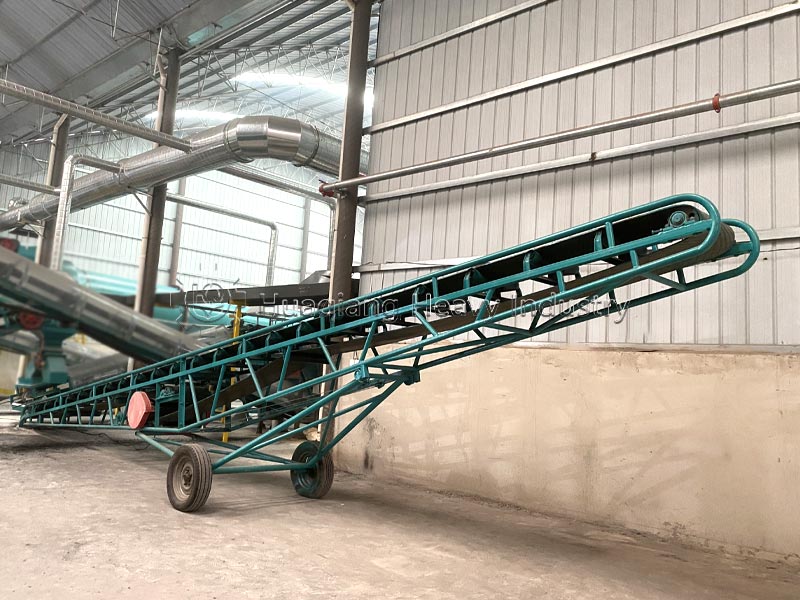
A mobile belt conveyor is a specialized conveying device that adds a traveling mechanism and lifting adjustment function to a fixed belt conveyor. It retains the core advantages of belt conveyors—continuous conveying, large capacity, and low energy consumption—while achieving mobility through casters or a tire chassis, eliminating the need for foundation fixing and allowing for rapid relocation. It is hailed as a “walking conveyor artery.”
Compared to fixed belt conveyors, the core value of a mobile belt conveyor lies in its flexible deployment—it can move quickly between different work sites such as warehouses, docks, construction sites, and grain depots. With the help of hydraulic or manual lifting systems to adjust the conveying height, it can flexibly connect with trucks, silos, and storage yards.
Equipment Structure Composition
The complete machine is divided into four main modules: a standard belt conveyor unit, a moving and walking unit, a lifting and adjusting unit, and safety auxiliary accessories:
- Basic Belt Conveyor Unit (Universal with Fixed Belts)
1) Conveyor Belt: Fertilizer plants use three types: ordinary trough rubber belt (dry granules), herringbone anti-slip sidewall belt (high-moisture organic fertilizer, steep incline), and acid and alkali resistant rubber belt (high-salt compound fertilizer);
2) Idler System: trough-type load-bearing idlers, return flat idlers, feed buffer idlers, and self-aligning idlers (to prevent deviation);
3) Roller Assembly: head drive roller and tail redirecting roller; the drive roller surface is coated with rubber to increase friction;
4) Drive Unit: motor + reducer, mostly using a central drive layout, lowering the center of gravity of the whole machine, preventing tipping during movement and lifting;
5) Tensioning Device: manual tensioning at the tail screw, adjusting belt tension to prevent slippage;
6) Sweeper, guide chute, and side baffles to prevent powder spillage and dust.
- Dedicated Mobile Walking Unit
1) Walking Wheel Set: Front swivel casters, rear solid load-bearing rubber wheels; pneumatic tires are optional for heavy-duty models;
2) Brake Locking Device: Each wheel is equipped with a foot brake, locking during operation to prevent the machine from sliding;
3) Towing Hook: Forklift/tractor towing for long-distance transport within the factory area.
- Lifting and Adjustment Unit (Core Feature Structure)
1) Light-duty models (≤10m): Manual screw lifting bracket, hand-crank adjustment of discharge height;
2) Medium and large-duty models (≥10m): Hydraulic lifting cylinder, electric one-button lifting, discharge height adjustable from 1.5–8m;
3) Diagonal Brake Stabilizing Legs: After lifting to the correct position, the auxiliary legs are lowered, ensuring no shaking of the machine during operation.
- Safety Accessories
Emergency stop switch, deviation protection, backstop (to prevent material backflow during shutdown), dust baffle, grounding protection cable.
Applicable Raw Materials
- Materials Suitable for the Fertilizer Industry (Core Applications)
1) Bulk Raw Materials: Fermented chicken/cow manure, straw, mushroom residue, humic acid, powdered organic fertilizer, compound fertilizer granules, cooled and coated finished fertilizer;
2) Bagged Materials: 10–50kg woven bags of finished organic fertilizer, compound fertilizer, BB fertilizer;
3) Lump Materials: Crushed cake fertilizer, fermented compost lumps;
- Materials for Cross-Industry Expansion
Grains, feed pellets, sand and gravel, chemical dry powder, bagged feed;
- Materials Prohibited from Transportation
Hard stones with a particle size > 50mm, high-viscosity slurry, flammable and explosive ultrafine dust (explosion-proof models required), liquid corrosive materials.
Working Principle
- Conveying and Transmission Logic: The motor drives the central rubber-coated drive roller, which in turn drives the annular belt in a closed-loop circulation due to friction. Material falls from the tail guide chute onto the belt, where trough-shaped idlers lift it to form a trough, conveying it at a uniform speed to the head for unloading. The principle is the same as that of a fixed belt conveyor.
- Movement and Adjustment Logic: Releasing the wheel brakes allows the machine to be pushed to any point in the yard, truck, or equipment feed inlet. Locking the brakes secures the machine.
- Height and Inclination Adjustment: A hand-cranked screw/hydraulic cylinder raises/lowers the machine head, changing the conveying inclination angle and discharge height to match different equipment and truck height differences. The anti-slip side belt prevents fertilizer particles from sliding down at large inclination angles, achieving stable conveying at high heights.
Target Customers:
- Small and medium-sized organic fertilizer, compound fertilizer, and bio-fertilizer production plants with limited storage space and frequently changing transfer points;
- Large-scale livestock and poultry breeding groups and fruit and vegetable planting cooperatives with self-built simple fertilizer production workshops;
- Enterprises engaged in the resource-based and environmentally friendly disposal of sludge and kitchen waste, requiring temporary transfer of outdoor composting raw materials;
- Agricultural input storage and fertilizer trading distribution centers, with frequent loading and unloading of bagged fertilizer trucks;
- Fertilizer complete equipment suppliers, providing flexible feeding equipment for small production lines;
- Grain, feed, and small-scale chemical powder processing plants.
Standard Operation and Full-Cycle Maintenance Methods
(I) Standard Start-up and Shutdown Procedures
Start-up Sequence
- Push the equipment to the work position, depress all wheel brakes, and lower the outriggers; adjust the lifting cylinder to the appropriate discharge height;
- Pre-start checks: belt tension, idler roller rotation, emergency stop switch, grounding line, and cleaning of material adhering to the scraper;
- Start the conveyor belt under no-load, run it for 3 minutes to observe for any deviation or abnormal noise, then feed material evenly. Do not feed heavy material at once.
Shutdown Sequence
- Stop feeding and wait for all material to be discharged from the belt;
- Turn off the main motor, release the brakes, retract the lifting outriggers, and push the equipment to an unused area for storage.
(II) Strict Safety Operating Procedures
- Do not cross the belt or reach to clean the rollers and idlers during operation; power must be disconnected and a sign posted before maintenance.
- Empty the material from the belt before moving the equipment; do not push the machine with material on to prevent tipping.
- Wear insulated gloves during circuit maintenance; do not start the machine without a reliable grounding wire.
- When conveying wet fertilizer at a large angle, use a non-slip side belt to prevent material from slipping and causing injury.
(III) Graded Lubrication and Maintenance Procedures
- Daily Inspection: Clean fertilizer clumps from the belt surface and remove accumulated material from the sweeper; check for leaks in the wheel brakes and lifting cylinders.
- Weekly Lubrication: Add grease to the head and tail roller bearings and self-aligning idlers; apply anti-rust grease to the traveling wheel shafts.
- Quarterly Maintenance: Check the gear oil level in the reducer and replace it with new gear oil every 4 months; perform anti-rust maintenance on the lifting screw/hydraulic cylinder.
- Annual Overhaul: Check for belt wear and joint cracks; replace jammed idlers; and level the entire machine frame. (iv) List of vulnerable parts: rubber conveyor belt, herringbone anti-slip side guards, idlers, roller bearings, scraper blades, wheel tires, hydraulic oil seals, and screw tensioning rods.
Summary table of common faults and solutions for mobile belt conveyors
| Fault Classification | Fault Phenomenon | Main Cause | Solution |
|---|---|---|---|
| Belt System Faults | Belt deviation | Uneven frame level, mis‑installed rollers and idlers, offset feeding position | Lower outrigger and re‑calibrate the whole machine; adjust positions of head‑tail pulleys and idlers; ensure material feeding at belt center |
| Belt slipping | Insufficient tension, water on driving pulley, overload operation | Adjust tension device; clean water and dirt on pulley surface; control feeding capacity; forbid overload startup | |
| Belt wear & tear | Sharp foreign objects stuck into belt, belt not replaced after long‑time service, poor quality of belt joint / bonding | Remove foreign objects inside equipment timely; regularly inspect belt joint condition; replace worn, aged and damaged belt immediately | |
| Idler stuck by foreign matters | Lack of lubricating grease for idler bearing, seal failure with dust ingress causing idler abrasion | Inject lubricating grease for idler bearing periodically; clear dust accumulation; repair or directly replace damaged idlers | |
| Moving & Lifting Mechanism Faults | Lifting failure | Insufficient hydraulic oil volume, hydraulic system fault, corrosion and jamming of manual lifting lead‑screw | Refill hydraulic oil to standard level; inspect and repair hydraulic pump fault; clean corroded part of lead‑screw and fully lubricate |
| Difficult travelling | Insufficient tire inflation pressure, steering bearing jamming, uneven ground at working site | Check and supplement tire pressure; lubricate or replace jammed steering bearing; give priority to operating on flat ground | |
| Frame shaking during operation | Outriggers not fully lowered and locked, loose and uneven ground at working site | Ensure all outriggers land and lock firmly; compact loose ground; lay steel plates for leveling to stabilize equipment |
Application Technology of Mobile Belt Conveyor in Fertilizer Production Line
Production Line Connection Logic: Complete Fertilizer Main Line: Raw Material Warehouse → Fixed Belt Conveyor → Crusher → Mixer → Granulator → Dryer → Cooler → Coating Machine → Screening → Finished Product Warehouse
Mobile Belt Conveyor Connection Points:
1) Raw Material Stockpile → Mobile Belt Conveyor → Crusher Inlet (Temporary feeding for outdoor composting, can be moved at any time);
2) Screening Fine Powder Outlet → Mobile Belt Conveyor → Front-end Mixer (Fine powder is recycled for re-granulation, temporary setup without civil engineering);
3) Packaging Machine Outlet → Mobile Belt Conveyor → Truck Cargo Box (Flexible loading of bagged fertilizer, adaptable to different vehicle types and parking locations).
Summary of Equipment’s Comprehensive Technical Features:
- High Mobility: Equipped with wheels, requiring no civil engineering support, it can quickly switch between storage yards, workshops, and truck loading/unloading points, achieving a utilization rate far exceeding that of fixed conveyor belts;
- Flexible Adjustable Inclination Angle and Height: Manual/hydraulic dual lifting modes adaptable to various equipment and vehicles with varying heights;
- Wide Material Compatibility: Available with both standard and anti-slip sidewall conveyor belts, capable of conveying dry, wet, powdery, granular, and bagged fertilizers;
- Low Investment Cost: Simple structure, requiring no civil engineering foundation, a single unit can handle multiple workstations, reducing the investment in multiple fixed conveyor belts;
- Low Operational Threshold: Can be moved, lifted, and operated by a single person, with frequency conversion speed regulation adapting to different material conveying needs;
- Suitable for Small and Medium-Sized Sites: Lightweight and compact, it can be stored in a corner when not in use, suitable for small fertilizer processing plants and livestock cooperatives with limited space.
Have Any Problem? Please, Contact
Integrity
Adhere to honesty and trustworthiness, be responsible to customers, employees, partners, and society, and establish long-term trust relationships.
Win win
Establish win-win relationships with all stakeholders such as customers, suppliers, and employees to share the fruits of enterprise development.