
Organic Fertilizer Production Process: Overcoming the Challenges of High Moisture and Odor in Chicken Manure
In today’s global advocacy for circular agriculture and environmental protection, chicken manure, a traditional waste from animal husbandry, is gradually being transformed into a high-value resource. Converting it into organic fertilizer not only alleviates the environmental pressure on farms but also provides high-quality nutrients for farmland, opening up new avenues for income generation. However, the high moisture content, easy odor, and difficulty in granulation of chicken manure itself are key hurdles to successfully realizing resource utilization. This article will clearly break down a complete process and guide you on how to select the right equipment to achieve a low-cost, high-yield green transformation.
The entire conversion process can be summarized into five core steps, each requiring precisely matched equipment to overcome challenges.
Step 1: Solid-Liquid Separation, Laying the Foundation for Fermentation
Fresh chicken manure typically has a moisture content as high as 70%-80%. Direct fermentation is not only time-consuming but also produces a large amount of foul odor. Therefore, the first step is crucial: using a screw extrusion solid-liquid separator for dehydration. This quickly removes moisture from the chicken manure, reducing the moisture content of the solid portion to 50%-60%. This not only significantly reduces the burden of subsequent fermentation, but the separated liquid can also enter a biogas digester or undergo further treatment, maximizing resource utilization.
Step Two: Efficient Fermentation, Solving the Odor Problem
Fermentation is the core step determining the quality of organic fertilizer. The core task is to utilize microorganisms to rapidly decompose organic matter under aerobic conditions, killing insect eggs and weed seeds. For different scales, there are two main options:
For small family farms, cost-effectiveness is the primary consideration. In this case, a flexible and economical mobile compost turner is ideal. It can operate along windrow composting lines, requiring minimal investment and being easy to operate.
For large-scale farms or professional organic fertilizer plants, efficiency and environmental control are more critical. A trough-type compost turner or a highly automated, fully enclosed fermentation tank is recommended. The compost turner operates back and forth in a cement trough, processing a large volume; the fermentation tank integrates heating, stirring, and oxygen supply systems, completing a rapid, odorless fermentation process within 7-10 days, minimizing the composting time.
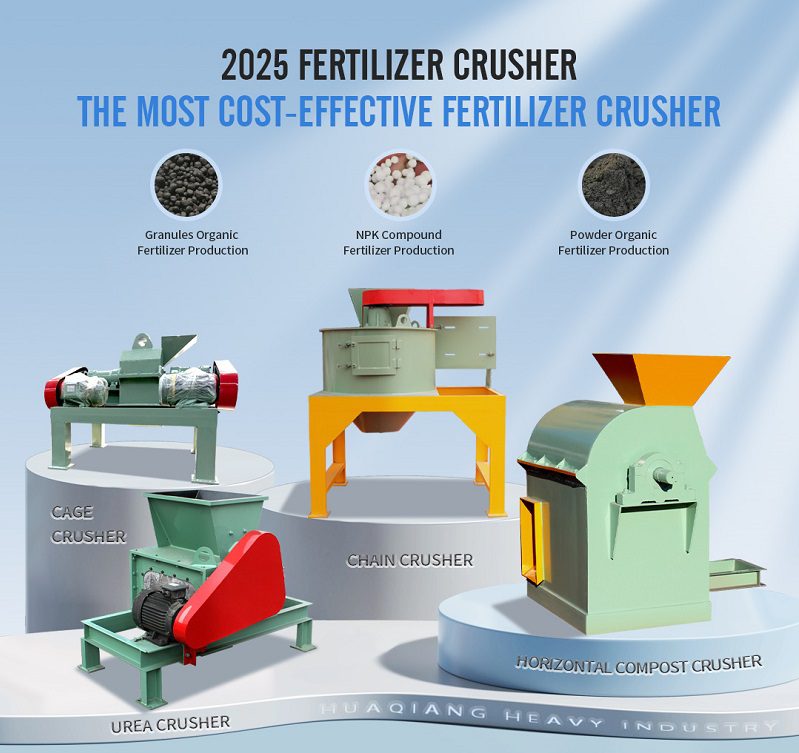
Step 3: Crushing and Refining to Ensure Uniform Particles
Although the fermented chicken manure is stable, it often clumps together. Crushing is necessary for subsequent granulation and to ensure uniform fertilizer release. This requires a semi-wet material crusher specifically designed for high-moisture materials. It can easily handle fermented chicken manure with a moisture content of 25%-55%, using high-speed rotating blades to break up clumps, providing fine and uniform raw materials for granulation.
Step 4: Innovative Granulation to Enhance Product Value
Powdered organic fertilizer has low added value and is inconvenient to transport and use. Granulating it is a key step in achieving added value. Given the high viscosity and fiber content of fermented chicken manure, a disc granulator or a dedicated chicken manure granulator is recommended. The biggest technological advantage of this type of equipment is that it utilizes the material’s inherent viscosity and intermolecular forces to agglomerate it. No clay or other binders need to be added during the granulation process, ensuring a nearly 100% pure organic matter content in the finished product, resulting in a better appearance and purer fertilizer effect.
Step 5: Drying, Cooling, and Packaging Freshly formed granules are hot and have slightly excessive moisture content, making them prone to mold and spoilage during storage. Therefore, they need to pass through a rotary dryer to remove excess moisture, then a cooler to room temperature, and finally be bagged and stored via an automated packaging line, becoming ready-to-sell organic fertilizer.
Through these five steps, a clear and efficient production line is established. Whether you process 5 tons, 20 tons, or 40 tons of chicken manure per day, you can achieve your goals through flexible equipment combinations. The key is that every step, from dehydration and fermentation to granulation, is based on the principle of “low cost, high return,” using the most suitable technology to solve the most challenging problems.
In short, the resource utilization of chicken manure is not difficult; it requires a clear approach and a matching combination of equipment. Through scientific process design, farmers can not only completely solve their environmental burden but also transform their “waste” into a stable source of income.
Following the crucial organic fertilizer fermentation process, the composted chicken manure requires careful preparation for granulation. The half-wet material crusher machine is the ideal choice for this stage, efficiently breaking down the fermented, clumpy material with moisture content up to 25%-55% without clogging. For different material characteristics, the organic fertilizer granulator series offers alternatives: a chain crusher for harder lumps and a cage crusher for achieving a finer, more uniform powder. Once crushed, the material enters the shaping stage. A complete organic fertilizer disc granulation production line utilizes a disc pan to roll the powder into premium, uniform spherical granules. As a space-saving and efficient alternative, a new type two in one organic fertilizer granulator combines the final crushing and initial granulation steps, offering a compact solution ideal for medium-scale operations seeking to maximize value from chicken manure while minimizing equipment footprint.