

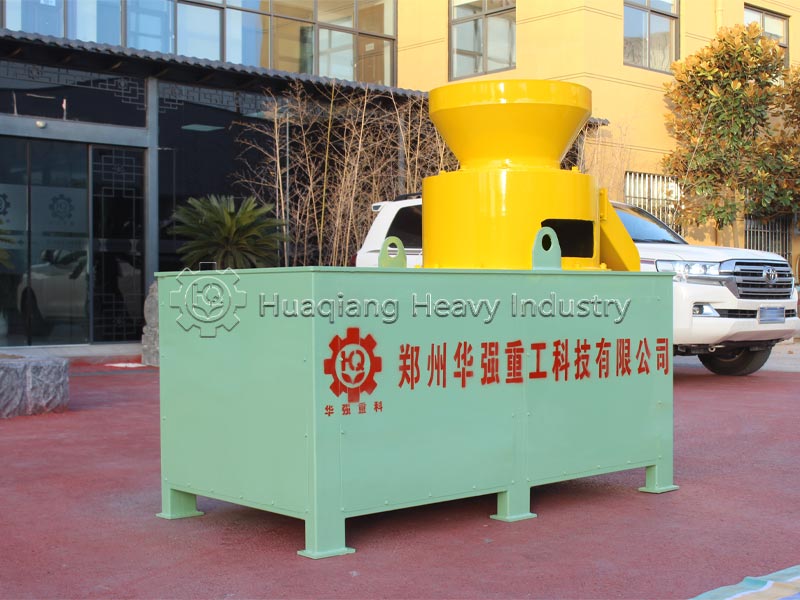


Ring Die Pelleting Machine
Equipment Overview
The dual-die pelleting machine (also known as a ring die pelleting machine) is one of the core pieces of equipment in the field of organic fertilizer, compound fertilizer, and livestock feed pelleting. It integrates the high-pressure molding performance of the traditional ring die pelleting machine with the strong adaptability of the flat die granulator to coarse fibrous materials, representing a deep integration and innovation of fertilizer pelleting technology.
Core Positioning:
1. Primarily used for pelleting (biological) organic fertilizer, compound fertilizer, and livestock feed.
2. Integrates a feeder, mixer, and granulator into one unit.
3. The main unit integrates a ring die and a flat die, equivalent to two granulators working simultaneously.
4. Excellent technology, simple operation, and various models are available.
Technological Evolution: Ring die pelleting technology can be traced back to the 1920s, when the world’s first ring die pellet mill was invented. Research on ring die pellet mills in China began in the 1960s, with the first pellet mill imported from UMT in the UK. The first domestically produced ring die pellet mill was developed in the 1970s. Today, the dual-die granulator integrates traditional ring die and flat die technologies, representing a new generation of development direction for granulation equipment.
Equipment Working Principle
1. Ring Die Pelleting Machine Principle
Driven by a motor, the ring die assembly rotates, and the pressure roller, as the driven wheel, follows suit. Material between the die rollers is forced out of the die holes under pressure and cut into granules by the granulator cutter. The material volume within the extrusion zone is gradually compressed during the roller rotation, finally overcoming the friction between the material and the die hole wall to extrude it from the ring die.
Three-Zone Theory: Based on the state of the powdered material under die roller extrusion, it can be divided into three working zones:
Feeding Zone: Material enters the gap between the die rollers and is initially distributed.
Deformation and Compression Zone: Material is gradually compressed, reducing its volume.
Extrusion Forming Zone: Material overcomes the friction with the die hole wall and is extruded into shape.
2. Flat Die Pelleting Machine Principle
Material enters from the feed hopper and is driven by the main motor, which rotates the flat die disc via a reducer and transmission mechanism. The pressure roller mounted on the drive shaft works in opposite directions with the flat die disc. Under pressure, the material is pressed into the die holes on the flat die disc and compacted into shape. The formed granules are cut and scraped out from the bottom of the die hole by a scraper, achieving continuous granulation.
3. Dual-Die Synergistic Working Principle
The dual-die granulator integrates the pressing functions of a ring die and a flat die:
Ring Die Section: Utilizes centrifugal force for forced feeding, suitable for large-volume, high-capacity production.
Flat Die Section: Utilizes gravity for vertical feeding, suitable for coarse fiber and high-viscosity materials.
Synergistic Effect: One machine simultaneously leverages the advantages of both modes, adapting to different raw material characteristics; its capacity is equivalent to two single-machine units.
Equipment Structure and Components
The ring die pelleting machine boasts a scientifically designed and multifunctional structure, primarily comprising the following components:
1. Feeding Device: Equipped with a frequency converter, allowing precise adjustment of the feeding speed based on the raw material’s moisture content.
2. Mixing Device: Features a built-in secondary mixing function to ensure uniform material distribution and prevent clogging.
3. Ring Die and Flat Die System: Innovatively integrates ring and flat dies to adapt to production requirements of different particle diameters.
4. Pressure Roller System: Equipped with corrosion-resistant, high-strength pressure rollers to ensure stable pressing effects and extend service life.
5. Power System: Driven by a main motor and supplemented by gear transmission, ensuring smooth operation.
6. Adjustment System: Includes a die gap adjustment device for easy control of particle forming effects and to meet the needs of different materials.
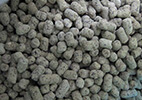
Raw material requirements for the equipment:
1. Raw material pretreatment standards
| Parameter | Required Range | Explanation |
|---|---|---|
| Moisture Content | 15%-25% | Excess moisture causes die blockage; too low moisture leads to poor forming effect |
| Crushing Fineness | 3-4mm | Flat die has low fineness requirement, while ring die requires finer powder |
| Fiber Length | <30mm | Overlong fibers easily wind around shafts and block the machine |
| Impurity Control | No stones, iron blocks or metal foreign objects | Hard foreign objects will scratch and damage the dies |
| Fermentation Degree | Fully decomposed (for organic fertilizer) | Undecayed raw materials will degrade finished pellet quality |
| Temperature | Ambient temperature | High-temperature materials must be cooled before granulation |
2. Recommended Proportions for Different Raw Materials
Livestock and Poultry Manure Organic Fertilizer: Manure: Straw = 3:1 ~ 4:1
Pure Organic Fertilizer: Direct granulation of fermented and decomposed materials
Compound Fertilizer: Mixing and granulating multiple raw materials according to the formula
Biomass Pellets: Moisture content of sawdust/straw controlled at 12-15%
Application Scope of the Equipment
1. Main Application Areas
| Application Field | Specific Materials | Final Product Form |
|---|---|---|
| Bio-organic Fertilizer | Chicken manure, pig manure, cow manure, sheep manure and other livestock & poultry manure | Cylindrical / spherical organic fertilizer pellets |
| Compound Fertilizer | NPK compound fertilizer, blended fertilizer | Cylindrical compound fertilizer pellets |
| Aquaculture & Livestock Feed | Livestock & poultry feed, aquatic feed, grass meal feed | Feed pellets |
| Biomass Energy | Sawdust, crop straw, rice husk, cotton stalk | Biomass fuel pellets |
| Special Functional Fertilizer | Humic acid fertilizer, amino acid fertilizer, bacterial fertilizer | Special functional fertilizer pellets |
| Industrial Pellets | Snow melting agent, industrial coal briquette, activated carbon | Industrial molded pellets |
2. Applicable Raw Material Characteristics
High Moisture Materials: Livestock and poultry manure with a moisture content of 20-40% (pre-treatment required)
Coarse Fiber Materials: Straw, sawdust, rice husks, peanut shells, etc.
Muddy Materials: Fermented organic materials, peat, etc.
Powdered Materials: Various fertilizer raw materials and additives
Mixed Materials: Mixtures of multiple raw materials in various proportions
Fermentation and Granulation Process of the Equipment
In the actual production line, the granulator is not isolated; it is closely integrated with the fermentation process:
Fermentation Process: Typically, trough-type turning or windrow fermentation is used. The material needs to be thoroughly deodorized and sterilized through aerobic fermentation to achieve the standard carbon-to-nitrogen ratio (C/N).
Pre-granulation Treatment: The moisture content of the fermented material is usually above 40%, requiring drying or the addition of dry powder to adjust the moisture content entering the granulator to between 20% and 25%.
Granulation Process: “Cold granulation” technology is used, with a particle temperature rise of less than 30℃. This is crucial for bio-organic fertilizers containing functional microorganisms (such as Bacillus subtilis), ensuring a microbial survival rate of over 90%.
Granulation Process:
In the entire production line, the ring die pelleting machine is the core component:
1. Fermentation Section: The material moisture content needs to be controlled at around 20%-30%.
2. Crushing Section: The material is processed to 40-60 mesh using a crusher.
3. Mixing Section: Add functional bacteria and trace elements.
4. Granulation Section: Forced feeding and venting are performed using a dual-mold granulator.
5. Cooling and Packaging: After the granules are cooled and the moisture content is reduced, they enter a quantitative packaging scale.
Application of Equipment in Production Lines
Dual-die pelleting machines/ring die pelleting machines are typically used as core granulation equipment in organic fertilizer/compound fertilizer production lines, located after fermentation, crushing, and mixing processes, and before drying, cooling, and screening processes.
1. Typical Flow of an Organic Fertilizer Production Line
Raw material selection (animal manure, etc.) → Ingredient mixing → High-temperature microbial composting and fermentation → Semi-finished product screening and crushing → Dual-die/ring-die granulation → Drying → Cooling and screening → Metering and sealing → Finished product warehousing
2. Composition of Complete Equipment Sets
Complete production lines mainly consist of a fermentation system, a granulation system, a drying and cooling system, a deodorization and dust removal system, and a finished product packaging system. The fermentation system includes a feeding conveyor, a mixer, a dedicated turning machine, an oxygen supply system, and an automatic control system.
3. Unique Advantages of Dual-die Granulators
In the production line, dual-die granulators integrate feeding, mixing, and granulation, reducing intermediate equipment. The dual-die modules can operate independently, switching as needed to avoid energy waste. The equipment supports continuous feeding and discharging, requiring no dedicated personnel; 1-2 people can complete the entire operation and maintenance process.
4. Construction Scale The construction scale of an organic fertilizer production line is generally 10,000-50,000 tons per year.
Equipment Parameters
Organic Fertilizer Double Die Pellet Machine
| Model | HP-450 | HP-650 |
|---|---|---|
| Capacity (t/h) | 2-5 | 4-8 |
| Pelleting Rate (%) | >95% | >95% |
| Motor Power (Kw) | 30+1.5 | 55+3 |
| Overall Dimension (mm) | 2150*1350*2200 | 2500*1350*2535 |
Equipment Operation Method
1. Pre-start Preparation
I. Lubrication Check
– Gearbox: Add 40# or 50# machine oil; replace with 70# or 90# gear oil in low-temperature environments.
– Pressure Roller Bearing: Regularly add No. 3 calcium-based grease every two weeks, controlling the filling amount to 1/3~1/2; during the first week of equipment use, grease should be added to the pressure roller every shift.
II. Installation and Debugging
– Place the pellet mill stably and securely, and check if the equipment’s rotation direction meets the standard after powering on.
– Thoroughly check all connecting screws on the equipment to ensure there are no loose or missing bolts.
– Precisely adjust the gap between the pressure roller and the die; the standard gap is 0.1-0.3 mm.
– Confirm that the equipment is in a no-load standby state, without any obstructions.
III. Die Grinding (Special Step for First Use of a New Machine)
– Discard normal production materials and select special grinding materials with a high oil content.
– Slowly and evenly feed in the oily grinding material, repeatedly extruding, granulating, rolling, and grinding.
– Only after the mold orifice is lubricated and the material discharge is smooth can the normal mixed material be replaced and put into production.
2. Start-up Sequence
Standard Start-up Procedure (Strictly follow the sequence):
① Start the granulator main unit → ② Start the feeder → ③ Feed in the material, and simultaneously adjust the feeder speed to the appropriate operating condition.
3. Adjustments During Operation
– Feeding Speed: Adjust the feed rate in real time according to the dryness and wetness of the material to maintain uniform and stable feeding, and prevent the main unit from jamming and stopping due to excessive load.
– Moisture Adjustment: When the material has a high coarse fiber content, about 5% water can be added; when the proportion of coarse fiber in the mixed material is low, reduce the proportion of water added accordingly.
– Current Monitoring: When the equipment is operating at full load, the operating current must be stable within the rated current range of the motor; overcurrent operation is strictly prohibited.
– Temperature Monitoring: During equipment operation, the temperature rise of the discharged granules must be controlled below 30°C.
4. Shutdown Sequence
Standard Shutdown Procedure (Strictly follow the sequence):
① Stop feeding → ② Turn off the feeder → ③ Turn off the granulator main unit
Important Notes: Before shutting down, ensure the feeder is running under no-load and empty any residual material from the main unit. Only after the equipment’s operating current has dropped to its minimum value should the machines be shut down sequentially to avoid material accumulation and equipment stalling.
Common Equipment Problems and Solutions
1. Common Equipment Problems
Based on industry experience, common problems with dual-die pelleting machines/ring die pelleting machines mainly fall into the following categories:
Die orifice blockage during startup, resulting in no granules:Commonly seen with new machines or after restarting.
Excessive powder content in granules or inability to form granules:Low granule formation rate.
Gradually decreasing output: Continuously declining capacity.
Pellets becoming hard and shiny: Excessively hard granules.
Soft edges, cracked and pasty surface: Poor granule appearance quality.
Sudden stalling of the granulator: Sudden shutdown during operation.
Rough granule surface: Insufficient smoothness.
Die orifice blockage: Material blockage.
2. Troubleshooting
| Common Faults | Possible Causes | Solutions |
|---|---|---|
| No pellets discharged due to blocked die holes at startup | Corroded & rough die holes; excessive gap between die and roller | Clean residual pellets inside die holes; grind with high-oil powder; adjust gap to 0.1-0.3mm |
| Excessive powder content or failure to form pellets | Too low or too high material moisture; excessive crude fiber | Adjust moisture content; add viscous powder materials |
| Gradually declining output capacity | Oversized die-roller gap; low moisture; clogged die holes; abnormal feeder rotation speed | Adjust gap; increase water content; clean dies; inspect the feeding machine |
| Hard & glossy pellets | Insufficient material moisture | Raise the moisture of raw powder |
| Soft pellet edges with surface cracking & pasting | Improper moisture ratio; rough new die plate | Adjust water content; grind by extruding oily powder materials |
| Sudden machine stall | Large hard foreign objects or metal entering between die and roller | Remove foreign matters; reduce feeding volume |
| Die hole blockage | Uneven & fast feeding; oversized material particles; low voltage; excessive compression ratio | Feed evenly; re-crush raw materials; improve power distribution room; replace die with proper compression ratio |
| Rough pellet surface | Rough new die | Carry out circulating extrusion running-in with oily materials |
The dual-die pelleting machine/ring die pelleting machine boasts a scientifically designed structure (three-in-one design), simple operation and maintenance (operable by ordinary workers), and a wide production capacity ranging from 0.5 tons/hour to over 8 tons/hour. With its core advantages such as ring die rotary extrusion molding technology, flexible switching between dual dies, direct granulation of high-moisture materials, and low-temperature processing to preserve nutrients, it has become a key granulation equipment in multiple fields including organic fertilizer, compound fertilizer, feed, and biomass fuel.
Whether you are building a new organic fertilizer/compound fertilizer/feed production line and need a complete equipment solution, upgrading an existing production line and need equipment selection advice, or encountering difficulties in granulating high-moisture, sticky, or coarse-fiber materials and need technical support—we are always ready to provide you with professional and sincere service.
Have Any Problem? Please, Contact
Integrity
Adhere to honesty and trustworthiness, be responsible to customers, employees, partners, and society, and establish long-term trust relationships.
Win win
Establish win-win relationships with all stakeholders such as customers, suppliers, and employees to share the fruits of enterprise development.