
Equipment Introduction
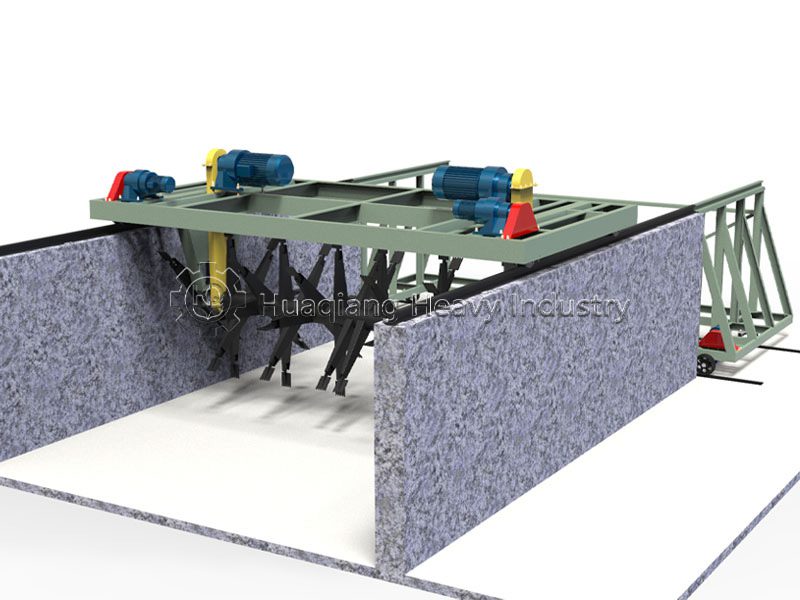
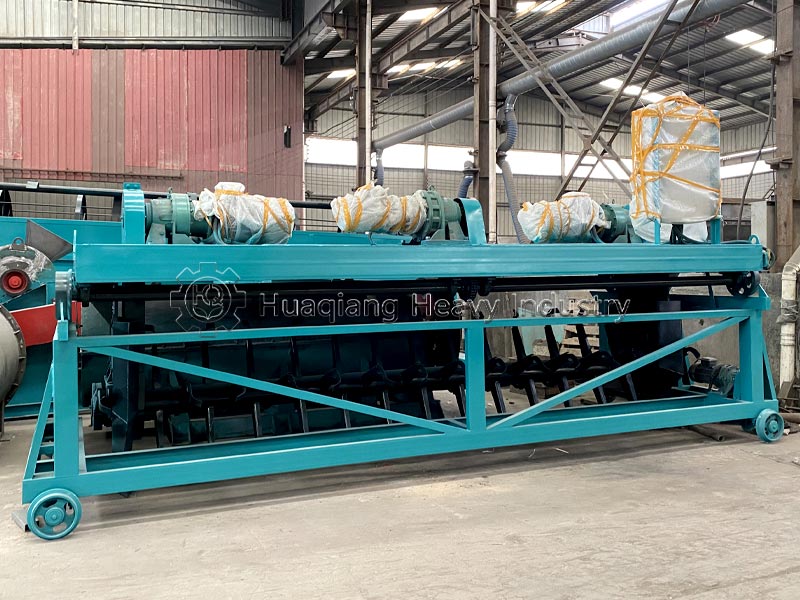
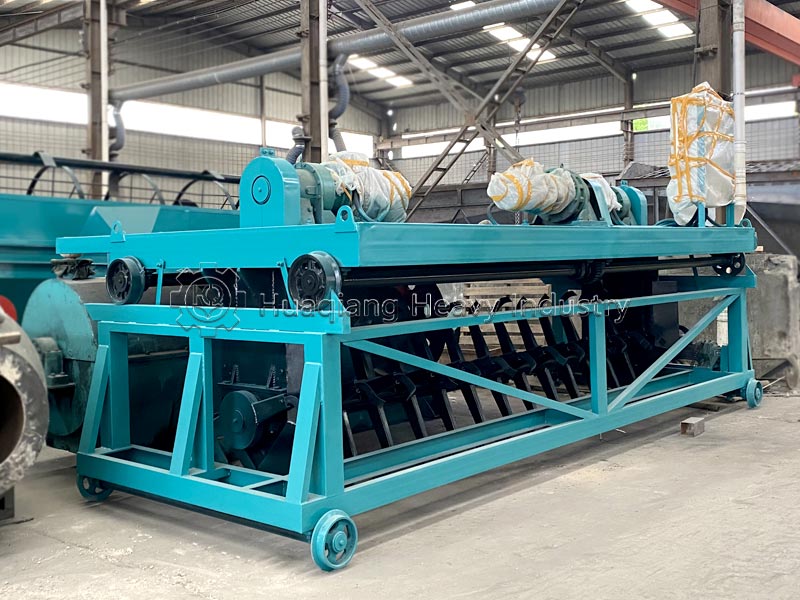
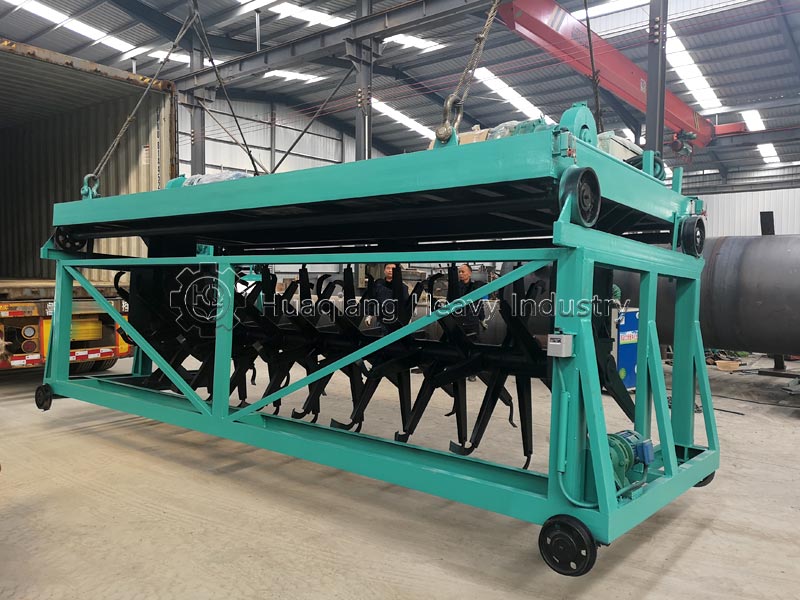
The trough-type compost turner (also known as a trough-type compost turner, track-mounted compost turner, or ground trough compost turner) is a large-scale, stationary compost turning device specifically designed for ground trough aerobic fermentation. The entire machine spans the fermentation trough and moves back and forth along tracks on both sides of the trough via wheels. It is equipped with a high-power motor drive system and a lifting/hydraulic lifting system. The turning width can reach 3–6 meters, the turning depth can reach 0.6–1.5 meters, and the processing capacity is 150–450 cubic meters per hour. It is a core fermentation equipment in medium to large-scale organic fertilizer production lines. Its core function is to turn, oxygenate, crush, and mix the materials in the trough during the organic material fermentation process, achieving efficient aerobic fermentation.
Equipment Structure
The trough-type compost turner mainly consists of the following major systems:
| System Name | Main Components | Function Description |
|---|---|---|
| Power Transmission Device | Main motor, pendulum pin gear reducer, sprocket, bearing housing, main shaft | Provides power for the compost turning roller; the motor drives the sprocket through the reducer for power transmission |
| Traveling Device | Traveling motor, transmission gear, transmission shaft, traveling sprocket / traveling wheel | Moves the whole machine longitudinally along the tracks on both sides of the fermentation trough |
| Lifting Device | Winch, coupling, transmission shaft, bearing housing (FDT type) | Controls the lifting height of the compost turning roller to adapt to different stacking depths |
| Hydraulic Lifting Device | Hydraulic pump station, electromagnetic valve body, hydraulic oil pipe, hydraulic cylinder column (FPY type) | Hydraulically controls the lifting of the compost turning roller with more precise adjustment |
| Compost Turning Device | Sprocket, support arm, compost turning roller, mixing blades | Core working component; high-speed rotation realizes material compost turning |
| Transfer Cart (Shifting Cart) | Traveling motor, transmission gear, transmission shaft, traveling wheel | Temporary transport tool for the compost turner to switch troughs, realizing one machine serving multiple troughs |
| Electric Control System | Control cabinet, soft starter, limit travel switch | Centralized control, supports manual or automatic operation |
Key Structural Features:
1. The electric motor directly transmits power to the cycloidal pinwheel reducer, then via a sprocket to the turning drum.
2. The stirring blades on the drum are spirally distributed, capable of turning and moving the material in the fermentation trough to a distance of 0.2–1 meter.
3. The bearing seats of the turning device are fixed to the turning machine frame, and the two main shafts are fixed in the bearing seats.
4. Several turning shafts arranged at a certain distance and staggered at a certain angle are welded onto each main shaft, and each turning shaft is welded with a turning plate.
5. The turning device is connected to the traveling device via a pin shaft.
6. Equipped with a soft starter, resulting in low impact load during startup.
7. Limit switches provide safety and limit functions.
Applicable Raw Materials:
This equipment can process all high-organic-matter industrial, agricultural, livestock, and municipal organic waste:
1. Livestock manure: chicken manure, cow manure, pig manure, sheep manure;
2. Agricultural and forestry waste: straw, sawdust, wood chips, peanut shells, rice husks;
3. Industrial organic waste residue: sugar mill filter mud, distiller’s grains, vinegar residue, traditional Chinese medicine residue, oilseed cake;
4. Municipal solid waste: dewatered sludge from sewage treatment plants, pre-treated organic slurry from kitchen waste, fallen leaves and branches from gardens;
5. Edible fungi waste: waste mushroom sticks, mushroom substrate.
Process Requirements: Raw materials must be pre-mixed to a moisture content of 50%~60% and a carbon-to-nitrogen ratio of 20~30:1 before being placed in the fermentation tank.
Working Principle of the Equipment
The working principle of the trough-type compost turner is based on the organic combination of mechanical transmission and aerobic fermentation.
I. The working process is as follows: The electric motor directly transmits power to the cycloidal pinwheel reducer, which then drives the turning drum to rotate via a sprocket drive. The turning blades (tooth-like prongs) distributed in rows or spirals on the drum cut into the material during rotation, turning, stirring, and moving the material in the fermentation trough from the bottom. The material can typically be pushed a distance of 0.2–1 meter.
This process achieves three core functions:
1. Turning and Oxygenation: The material comes into full contact with air, providing ample oxygen for aerobic microorganisms.
2. Crushing and Mixing: The turning and threshing wings break the material into small clumps, making the viscous, dense raw material pile loose and elastic.
3. Moisture Regulation: Forced water vapor release during the turning process helps reduce the moisture content of the material.
II. Temperature Regulation Mechanism: During the operation of the turning machine, the raw material clumps come into full contact with and mix with air. The pile can retain a large amount of fresh air, which helps aerobic microorganisms to actively generate fermentation heat and raise the pile temperature. When the temperature is too high, the replenishment of fresh air can lower the pile temperature, forming an alternating state of medium-high temperature-medium-high temperature, where various beneficial microorganisms can grow and reproduce rapidly within their suitable temperature range.
Equipment Parameters
| Model | Main Motor | Walking Motor | Lifting Motor | Mobile Car Motor |
|---|---|---|---|---|
| FD3 | 7.5kw*2 | 1.5kw | / | 1.5Kw |
| FD4 | 11kw*2 | 1.5kw | / | 1.5Kw |
| FD5 | 15kw*2 | 2.2kw | 0.75kw | 1.5Kw |
| FDT3 | 7.5kw*2 | 1.5kw | 0.75kw | 1.5Kw |
| FDT4 | 11kw*2 | 1.5kw | 0.75kw | 1.5Kw |
| FDT5 | 15kw*2 | 2.2kw | 0.75kw | 1.5Kw |
Operating Procedures and Precautions
2) Key Precautions:
1. No-load test run: Check the rotation direction of the drum (adjust phase if reversing), listen for abnormal noises from the reducer, and check if the blades are rubbing against the ground.
2. Loaded operation: Start the lifting device to slowly lower the drum to the bottom of the trough. If the ground flatness error is within 15mm, the blade clearance should be controlled at 30-50mm; if uneven, it should be controlled at around 50mm.
3. Shutdown prevention: Before shutting down, check for any accumulated material in front of the drum and raise the drum to its highest point to prevent excessive starting load.
Common Equipment Problems and Solutions
| Fault Type | Fault Inducement | Standard Treatment Scheme |
|---|---|---|
| Difficult Compost Turning, Roller Overload & Blockage | Material accumulation thickness in fermentation trough exceeds standard | Manually shovel redundant fertilizer layer to reduce material height |
| Roller cutters and main shaft deformed; foreign matter wrapped by materials | Disassemble, inspect and calibrate cutters / main shaft; thoroughly clear wrapped straw, ropes and other foreign objects | |
| Foreign matter stuck between transmission gears or gear tooth surface damaged | Clean foreign matter between gears; directly replace transmission gears if damaged | |
| Unstable Traveling, Reducer Abnormal Noise, Machine Body Overheating | Foreign materials accumulated inside traveling sprockets and traveling wheels | Shut down the machine and clean accumulated materials in traveling mechanism |
| Traveling transmission shaft bent and deformed | Disassemble and calibrate transmission shaft; replace it directly if severely deformed | |
| Reducer and bearings lack lubricating oil | Inject special lubricating oil and grease into corresponding lubrication points | |
| Difficult or Failed Motor Startup with Buzzing Noise | Internal motor bearings severely worn or damaged | Disassemble motor and install brand-new bearings |
| Reduction shaft inside reducer bent and deformed | Disassemble reducer, calibrate or replace reduction shaft | |
| Factory power supply voltage too low, excessive voltage fluctuation | Suspend equipment operation; restart only after power voltage recovers to rated 380V standard |
Equipment Application in Production Line
I. Location in Organic Fertilizer Production Line
The trough-type compost turner is mainly used in the fermentation section of the organic fertilizer production line. It is a core and crucial piece of equipment in the entire production line, directly determining the fermentation and maturation effect of the materials and the quality of the finished organic fertilizer. The equipment is fully integrated into the standardized organic fertilizer production process, handling the upstream feeding process and providing qualified matured raw materials for downstream deep processing.
The complete production process flow is as follows:
Raw material pretreatment → Batching and mixing → Feeding into the fermentation tank → Turning and fermentation by the trough-type compost turner → Discharge → Crushing → Screening → Granulation → Drying → Cooling → Secondary screening → Finished product packaging. The trough-type compost turner adopts a ground-level fermentation mode, continuously turning, aerating, and stirring the materials to complete the high-temperature maturation and fermentation of the organic fertilizer raw materials. This is the core link in achieving the harmless and resource-oriented maturation treatment of the materials.
II. Production Line Supporting Equipment The trough-type compost turner needs to be used in conjunction with a complete set of organic fertilizer production equipment. Each supporting piece of equipment has a clearly defined function, working together to complete the entire production process of organic fertilizer from raw material processing to finished product packaging. The functions of each supporting piece of equipment are as follows:
1. Loader/Forklift: Primarily used for the initial stacking and transfer of raw materials and the feeding of materials into the fermentation tanks, ensuring a continuous supply of raw materials for the fermentation stage and guaranteeing continuous operation of the production line.
2. Batching System: Precisely proportions the main ingredients and various auxiliary materials according to production process standards, adjusting key indicators such as the carbon-nitrogen ratio and moisture content of the materials to provide a qualified material base for subsequent fermentation operations.
3. Transfer Machine: Used in conjunction with the trough-type compost turner, enabling a single turner to operate across multiple fermentation tanks, completing the turning and composting work in multiple fermentation tanks, effectively improving equipment utilization, reducing equipment investment costs, and realizing a one-machine-multiple-tank production mode.
4. Crusher: Used for the fine crushing of materials after fermentation and composting. The trough-type compost turner has a built-in material crushing function, which can initially break up lumps of material, effectively simplifying subsequent crushing processes and reducing the workload of the crusher.
4. Screening machine: Screens the fermented and crushed material, effectively removing large pieces of incompletely fermented material and impurities, ensuring uniform particle size to meet the requirements of subsequent granulation processes.
5. Granulator: Processes the screened, well-rotted powdery material into regular granular organic fertilizer, improving the appearance, fertility stability, and ease of application of the organic fertilizer.
6. Dryer/Cooler: Drys, dehumidifies, and cools the granulated fertilizer, precisely regulating the moisture and temperature of the finished fertilizer to ensure that it does not clump or mold during storage.
7. Packaging machine: Automatically packages the dried and cooled qualified finished organic fertilizer in quantitative quantities, completing the final product process and facilitating warehousing, transportation, and market sales.
Fermentation Process of the Equipment
The trough-type compost turner serves the trough-type aerobic composting fermentation process.
1. Aerobic Fermentation Principle
Trough composting is a composting process in which materials are placed in a fermentation trough, and then turned, stirred, and crushed by a trough-type compost turner, allowing the materials to ferment, mature, and degrade. When the turner’s drum rotates at high speed, the blades crush and mix the materials, while simultaneously turning and loosening them by the drum.
2. Fermentation Tank Structure
A fermentation trough is formed by building two walls on flat ground, creating one or more fermentation troughs. The trough-type compost turner moves along a track on the fermentation trough. The turner is moved from one fermentation trough to another using a transfer vehicle.
3. Feeding and Discharging Methods
Batch Feeding: A batch of material is fed into the fermentation tank at one end, and then moved to the other end through turning and tossing. Feeding is then repeated at the beginning, continuing until the fermentation cycle ends, at which point the finished product is discharged from the other end.
Bulk Feeding: The entire fermentation tank is filled with material at once, and discharged all at once at the end of the fermentation cycle.
4. Core Functions of Fermentation Process
Stirring and Conditioning: Adjusts the carbon-nitrogen ratio, pH, and moisture content of the raw materials.
Temperature Control: Creates alternating medium and high temperatures to promote the growth of beneficial microorganisms.
Improved Permeability: Transforms viscous, dense materials into loose clumps.
Moisture Adjustment: Forces moisture evaporation, reducing the moisture content from approximately 55% initially to below 20% in the finished product.
5. Fermentation Cycle
The fermentation cycle of the trough-type compost turner is typically around 15 days. Utilizing special aerobic fermentation technology, organic waste can be rapidly decomposed, dehydrated, sterilized, and deodorized, achieving the goals of harmlessness, resource recovery, and volume reduction.
6. Fermentation effect: Compared with static composting, the fermentation tank mode is easier to obtain stable product properties, has a better odor control effect, a higher degree of overall automation, and saves space.
Target Customers for the Equipment
The main target customers for trough-type compost turners include:
1. Large-scale Livestock Farms
Large-scale pig farms, chicken farms, cattle farms, sheep farms, etc., need to process large quantities of livestock and poultry manure. Trough-type compost turners can effectively process pig manure, chicken manure, etc., achieving harmless treatment and resource utilization of manure. The national standard “Trough-type Compost Turner for Manure Utilization in Large-scale Pig Farms” is specifically designed for this application scenario.
2. Organic Fertilizer Production Enterprises
Organic fertilizer plants are the core user group for trough-type compost turners. From small plants with an annual output of 10,000 tons to large plants with an annual output of over 200,000 tons, different specifications of trough-type compost turners can be selected according to capacity requirements.
3. Compound Fertilizer Plants
Compound fertilizer production enterprises that require organic raw material fermentation treatment.
4. Sludge Treatment Plants/Wastewater Treatment Plants
Environmental protection enterprises that need to harmlessly treat and utilize municipal sludge.
5. Sugar Mills/Food Processing Plants: Production enterprises that need to process industrial organic waste such as sugar mill filter mud and distiller’s grains.
6. Horticultural Farms/Landscape Companies: Horticultural enterprises that need to process greening waste such as fallen leaves and branches.
7. Button Mushroom Cultivation Farms: Edible fungi cultivation enterprises that need to ferment and prepare mushroom culture media.
8. Environmental Engineering Companies/EPC General Contractors: Engineering companies and general contractors that undertake organic solid waste treatment projects.
9. Agricultural Cooperatives/Modern Agricultural Parks: Large-scale agricultural operators engaged in circular agriculture and ecological agriculture.
Safety Operating Procedures
1. Operators must not operate the compost turner after drinking alcohol, or when feeling unwell or unwell.
2. For safety, all tracks of the compost turner must be grounded.
3. Power must be disconnected when replacing cable trays or cables.
4. Always observe the hoist during lifting and lowering to prevent the drum from being lowered too low and damaging the blades, and to prevent over-lifting and damaging the hoist shaft and bearing housing.
5. Replace the hoist wire rope immediately if it has fuzz or more than 7 broken strands.
6. No one is allowed to pass in front of or behind the compost turner during production. Warnings should be given before starting the machine, and personnel must stay away from it.
7. No maintenance or lubrication should be performed during production.
8. The machine must be moved at the specified speed during turning; exceeding the speed limit is prohibited.
9. No one other than the designated operator may operate the machine.
The trough type compost turner has the characteristics of high efficiency, smooth operation, durability and uniform turning. Its control cabinet can realize manual or automatic control and adapt to the needs of different automation levels. For users who want to achieve industrialized harmless treatment and improve the quality of organic fertilizer, it is currently a mainstream and cost-effective choice.
Whether you need a fermentation compost turning machine or planning an entire fertilizer production line – from fermentation compost turning, crushing and mixing, to granulation, drying and cooling, screening and packaging, we can provide you with a one-stop solution.
Have Any Problem? Please, Contact
Integrity
Adhere to honesty and trustworthiness, be responsible to customers, employees, partners, and society, and establish long-term trust relationships.
Win win
Establish win-win relationships with all stakeholders such as customers, suppliers, and employees to share the fruits of enterprise development.