
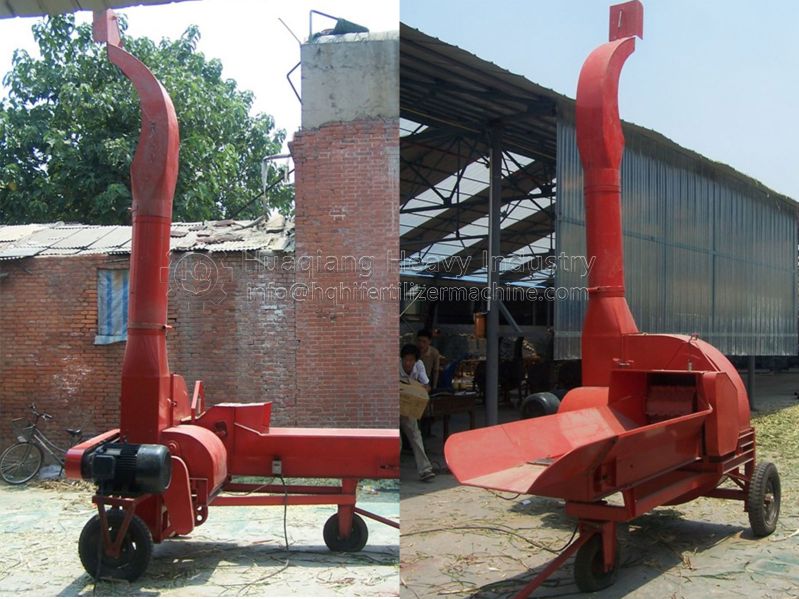
Equipment Introduction
A straw crusher is an agricultural processing machine used to crush crop straw and other biomass materials. This equipment can crush corn stalks, straw, peanut shells, bean stalks, and other agricultural waste stalks, transforming agricultural waste that might otherwise be burned into reusable resources, protecting the environment and effectively developing renewable energy.
Straw crushers can be equipped with electric motors, diesel engines, or 30-50 horsepower tractors. They feature a reasonable structure, easy mobility, automatic feeding, and reliable safety. This reliable and simple-to-operate equipment is an important tool for agricultural production and waste resource utilization.
In terms of crushing methods, straw crushers are mainly divided into two categories: hammer mill crushers and blade crushers. Hammer mill crushers can achieve a crushing ratio of 10-25 or even 50, suitable for users who require a high crushing ratio and uniform particle size; blade crushers are more suitable for scenarios requiring rapid and large-scale straw processing.
Equipment Structure
The straw crusher mainly consists of the following five systems:
| System | Components | Function Description |
|---|---|---|
| Feeding System | Feed hopper, upper/lower rollers, fixed blades, moving blades, feeding belt | Feeds material evenly into the crushing chamber; includes gravity feeding, belt feeding and forced feeding modes |
| Crushing & Conveying System | Motors, knives, screw conveyors, hammers, blades | Crushes material step by step and conveys it to the next working unit |
| Screening System | Sieves, vibrating screens, drum screens, mesh plates | Screens materials within the required particle size range and removes impurities and over‑size particles |
| Power Transmission System | V‑belts, pulleys, chains, sprockets, couplings | Transmits power from the motor to each working unit; drives rollers, knives and conveyor components |
| Auxiliary System | Travel wheels, guards, frames, fans, dust collectors | Supports movement, safety protection, dust removal and stable operation of the equipment |
Key Component Descriptions:
Hammer/Blade: Made of high-quality alloy steel (e.g., 65Mn), quenched to a surface hardness of HRC48–56 and a core hardness of HRC33–40. Double-sided blades with a lifespan of 500–1000 hours, and can be repeatedly re-grinded.
Screen: Located at the bottom of the crushing chamber, controlling the output particle size. The aperture can be changed as needed (commonly 1–50mm).
Fan and Centrifugal Discharger: The fan generates negative pressure to suck away the crushed material, which is then collected and discharged via a cyclone separator.
Working Principle of the Equipment
The straw crusher adopts a composite crushing mechanism of “cutting + hammering + grinding.” The working process is as follows:
- Feeding: Straw enters the crushing chamber through the feed inlet (or automatic conveyor chain). The feeding speed and continuity directly affect the production capacity.
- Cutting: Long strips of straw are first cut into short segments by a combination of fixed and moving blades.
- Hammering: High-speed rotating hammers (typically 1800–3540 r/min) strongly impact, tear, and rub the material.
- Screening and Discharge: The crushed material passes through a screen under centrifugal force. Qualified fine powder is sucked away by the negative pressure of the fan and discharged through the centrifugal discharger; unqualified coarse material continues to circulate and crush within the chamber.
5. Collection and Conveying: The crushed material is transferred to subsequent processes or a collection bin via a conveying device. Special model principle: Disc cutter + hammer blade combination type (such as 9FQM1000 model): coarse branches are first cut into 6mm thin slices by the disc cutter, and then enter the crushing chamber where they are crushed into 5-25mm fragments by the hammer blades, realizing dual-channel processing of coarse and fine materials.
The equipment’s raw materials mainly cover all agricultural crop residues:
- Cereal straw: Corn stalks, rice straw, wheat straw.
- Cash crop straw: Cotton stalks, tobacco stalks, soybean stalks, chili seedlings.
- Forestry waste: Branches, bark, weeds, etc.
Common Equipment Problems and Solutions
| Common Problems | Cause Analysis | Solutions |
|---|---|---|
| Reduced Output | Dull hammer blades / cutter blades or blocked sieve holes | Grind cutting edges, replace hammer blades or clean sieve holes |
| Severe Machine Vibration | Rotor unbalance, damaged bearings, loose anchor bolts | Replace damaged parts, re‑balance rotor, fasten anchor bolts |
| Discharge Outlet Blockage | Excessively high material moisture or insufficient fan air volume | Dry raw materials, clean pipelines, increase fan rotating speed |
Equipment Operation and Maintenance Methods
- No-load Start: After starting, observe whether the rotation direction is correct. Feeding can only begin after the speed stabilizes.
- Uniform Feeding: Feeding hard objects such as iron blocks, stones, and wood blocks is strictly prohibited to prevent damage to the blades or penetration of the machine casing.
- Lubrication and Maintenance: Add grease to the bearings every 8-10 hours of operation; regularly check the belt tension.
- Wear Inspection: Regularly check the wear condition of the hammer blades. If one end is worn, it can be turned around for use. If severely worn, the entire set should be replaced to prevent vibration.
Applications of the Equipment in Production Lines
In biomass pellet production lines, straw crushers are typically used in the “coarse crushing” stage. The process is: straw baler → straw crusher → dryer → fine crusher → pelletizer.
- Application in Organic Fertilizer Production Lines
Straw crushers are the core front-end equipment in straw organic fertilizer production lines. Straw organic fertilizer production lines are customized to address the characteristics of straw: high fiber content, difficulty in composting, and easy agglomeration.
Complete Processing Flow:
Straw and other agricultural waste → Straw crusher for fine processing → High-temperature sterilization → Constant-temperature fermentation → Room-temperature maturation → Organic fertilizer production
In organic fertilizer production lines, straw crushers serve as supporting equipment for fermentation. By finely crushing raw materials such as straw, they effectively shorten the fermentation time. The crushed agricultural plant debris has a uniform texture, is fluffy and delicate, and is easy to mix with livestock and poultry manure and other materials for fermentation.
- Application in Feed Processing
Straw crushers can be used in feed production to make silage, ammonified feed, micro-silage, or pelleted feed. The processed forage has good palatability, solving the problem of excessive energy expenditure for ruminants such as cattle and sheep during grazing.
- Application in Biomass Energy
The crushed straw can be processed into pellet fuel for power plants using a briquetting machine, and can also be used in straw power generation, ethanol refining, and other fields.
- Production Line Capacity
Straw organic fertilizer production lines can be customized with solutions for annual production of 10,000-50,000 tons, suitable for straw recycling companies and small and medium-sized organic fertilizer plants.
Analysis of the advantages and disadvantages of the equipment
| Category | Item | Description |
|---|---|---|
| Advantages | Wide Raw‑material Adaptability | Crushes dozens of biomass materials such as corn stalks, wheat straw, hay, branches, bark and peanut vines |
| Process Both Wet & Dry Materials | Suitable for crushing all kinds of dry and wet crop straw | |
| Flexible Power Options | Supported by electric motor, diesel engine or 30‑50 HP tractor | |
| Compact Structure & Easy Operation | Can be operated by one single person | |
| Wide Application Range | Widely used in feed, fertilizer, energy, building materials, chemical industry and other fields | |
| Adjustable Output Particle Size | Control finished particle size by replacing sieve screens with different aperture sizes | |
| Easy Mobility | Some models are equipped with traveling mechanism for field operation | |
| Disadvantages | Easy Blocking for High‑moisture Materials | Material tends to stick and block when straw moisture exceeds 15% |
| Fast Wear of Hammer Blades | Hammer blades are wearing parts which need regular inspection and replacement | |
| Risk of Damage from Hard Impurities | Hard objects like metal and stones in feed will damage equipment | |
| Noise & Dust Generation | Certain noise and dust will be produced during operation | |
| High Power Requirement | Large‑size machines need high‑power driving sources |
Target Users of the Equipment
The main target users of straw crushers include:
- Feed processing enterprises: to crush straw and process it into roughage or compound feed for cattle and sheep;
- Livestock farms/farmers: for self-production and self-use, reducing feed costs;
- Organic fertilizer production enterprises: as front-end crushing equipment in organic fertilizer production lines;
- Biomass energy enterprises: to provide raw materials for biomass pellet mills and briquetting machines;
- Edible mushroom cultivation bases: to prepare raw materials for edible mushroom culture media;
- Wood-based panel/paper mills: to provide wood fiber raw materials;
- Landscaping/municipal departments: to handle garden pruning waste;
- Rural cooperatives/family farms: for comprehensive utilization such as straw return to the field and straw charcoal processing.
Have Any Problem? Please, Contact
Integrity
Adhere to honesty and trustworthiness, be responsible to customers, employees, partners, and society, and establish long-term trust relationships.
Win win
Establish win-win relationships with all stakeholders such as customers, suppliers, and employees to share the fruits of enterprise development.