
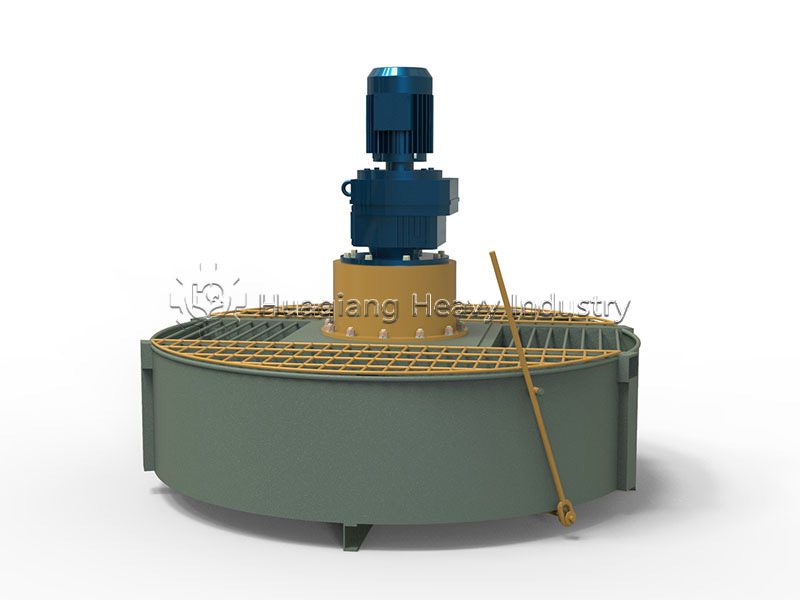


Equipment introduction
- Basic definition
The vertical disc mixer is a vertical structure, disc-type special mixing equipment for forced mixing of powder/semi-wet materials. The core uses a cycloidal pinwheel reducer to drive the main shaft mixing teeth. It relies on three-dimensional turbulence to achieve rapid and homogeneous mixing of materials. It is the core pretreatment mixing equipment for organic fertilizer, compound fertilizer, building materials, and feed production lines.
- Core advantages
1) It occupies an extremely small area: the same production capacity only occupies 1/3 of a horizontal mixer, which is suitable for small factories;
2) Anti-stick and wear-resistant: The disc is lined with polypropylene plate/stainless steel plate, which is highly wear-resistant and not easy to stick to materials;
3) High mixing uniformity: mixing coefficient of variation CV≤5%, uniformity ≥95%;
4) Energy saving and low noise: the cycloid reducer has low transmission loss and saves 10%~20% of energy compared with horizontal equipment of the same specification;
5) No dead corners and easy to clean: there are no dead corners for material accumulation at the bottom of the disc, and bottom unloading, disassembly, assembly and maintenance are simple;
6) Continuous operation: 24-hour uninterrupted production is possible, the start-stop process is standardized, and it is adapted to automated assembly lines;
7) Low vibration: The whole machine has strong structural rigidity, does not require heavy concrete foundation, and has low civil construction costs.
Equipment Structure
The vertical disc mixer can be divided into three main parts: the frame, the transmission connection, and the mixing section.
- Frame: All working parts are mounted and fixed on the frame. The frame is constructed from high-quality carbon steel plates and channel steel, and has passed strict product certification and specific process requirements.
- Mixing Container (Mixing Disc/Disc): The mixing disc is the main container of the equipment, shaped like a disc. It contains a cylinder with a cylindrical cover. The disc is lined with polypropylene or stainless steel, making it less prone to material adhesion and wear-resistant. For organic fertilizer raw materials with high fiber content and large moisture content fluctuations, the inner wall of the disc can also be lined with high-molecular-weight polyethylene and equipped with an automatic scraping device.
- Mixing Section: The transmission wheel transmits power to the main shaft via a pin coupling. The main shaft has fixed mixing teeth (mixing arms), which drive the mixing teeth to thoroughly mix the material. The mixing arms are arranged in multiple layers in a staggered pattern, effectively shearing and dispersing the material. 4. Transmission Connection Section
The main shaft is driven by a cycloidal pinwheel reducer. The main working part uses nylon pins as transmission connectors for easy assembly and maintenance.
- Feeding/Discharging and Auxiliary Sections
Feed Inlet: Located at the top of the equipment; material enters from the top.
Discharge Inlet: Located at the bottom of the equipment; top feeding and bottom discharge structure is rationally designed.
Unloading Gate: Equipped with a manual or pneumatic unloading gate for fast unloading speed.
Liquid Addition Device: An atomizing nozzle can be installed at the top to achieve uniform addition of liquid additives.
Application scope of equipment
| Application Industry | Specific Application Scenarios |
|---|---|
| Organic & Bio‑organic Fertilizer Production (Core Application) | Core pre‑mixing equipment before fermentation for organic fertilizer, bio‑organic fertilizer and organic‑inorganic compound fertilizer production lines. It can accurately and evenly mix composted livestock manure powder, chemical fertilizer powder, medium‑trace elements and conditioners according to formula. Suitable for small‑and‑medium organic fertilizer plants with annual output of 3000‑20000 tons. |
| Compound & Blended Fertilizer Production | Supporting equipment for compound and blended fertilizer production lines. It can process high‑humidity organic powder and mix NPK granular raw materials. Gentle stirring without crushing granular materials to guarantee the integrity of finished granules. |
| Feed Processing | Used for mixing complete feed, concentrated feed and premix for livestock and poultry. Realize uniform proportion mixing of trace raw materials such as vitamins, minerals and feed carriers with main materials. |
| Chemical & Building Material Industry | Suitable for mixing chemical powder additives, refractory materials and ceramic raw materials. It can mix dry‑mix mortar and dry powder building materials, as well as dust‑removal materials from thermal power plants. |
| Other Industries | Widely applied in mixing processes of powder and granular materials in chemical metallurgy, mining, light industry and other fields. Strong universality for diverse scenarios. |
Applicable Raw Materials for the Equipment
The vertical disc mixer has extremely high adaptability to raw materials:
- Organic Fertilizer Raw Materials
Composted livestock and poultry manure (chicken manure, pig manure, cow manure, sheep manure composting powder, etc.)
Straw powder, mushroom residue, peat moss
Urban sludge, biogas residue, kitchen waste, and other organic waste
- Chemical Fertilizer Raw Materials
Nitrogen, phosphorus, and potassium fertilizer powder (urea, potassium chloride, monoammonium phosphate, etc.)
Compound fertilizer granules, blended fertilizer raw materials
Micronutrient powder and conditioners
- Other Materials
Powdered, granular, and other dry powder materials
Dry materials to viscous materials with a moisture content of 30% are all acceptable
Especially suitable for processing organic fertilizer raw materials with a moisture content of 30%–40%
- Raw material adaptability boundary:
The initial moisture content of the material should be highly adaptable (from dry material to viscous material with 30% moisture content). However, coarse fibrous materials with a length >5cm should be crushed first. It is not advisable to mix materials with a large density difference (such as steel balls and light rice husks) or extremely sticky materials (such as pure manure slurry with a moisture content >40%) to avoid serious stratification or sticking to the wall.
Equipment Working Principle
- Feeding Stage: Multiple materials, metered by the batching system, fall into the disc mixing chamber through the top feed inlet;
- Centrifugal Circulation: The motor-driven reducer rotates the main shaft and mixing teeth at low speed, causing the materials to rise upwards along the disc wall under centrifugal force;
- Three-Dimensional Forced Mixing: Multi-layered staggered mixing teeth exert shearing, convection, and diffusion effects on the materials, causing them to simultaneously undergo circumferential motion and radial tumbling, forming a three-dimensional turbulent flow; clumps of material are broken up by the mixing teeth, and materials of varying weights, textures, and moisture are fully mixed and blended;
- Homogenization Completion: A single mixing cycle achieves nutrient homogeneity in just 30-90 seconds, with a mixing variation coefficient ≤5%;
- Discharge: After mixing meets the standards, the bottom discharge door is opened, and the materials are completely discharged by their own weight, leaving extremely low residue in the disc and preventing cross-contamination.
Equipment Classification and Maintenance Methods
- Daily Maintenance (During Production Breaks)
1) Clean the inner wall of the disc, agitator teeth, and any clumps of material from the discharge port;
2) Check the agitator teeth for deformation or loosening;
3) Check the main shaft seal for powder leakage and the discharge gate seal for material leakage;
4) Check the motor and reducer for abnormal temperature rise or unusual noises.
- Weekly Maintenance
1) Add lithium-based grease to the bearing housings;
2) Tighten all loose bolts;
3) Clean debris from the feed grating and check the iron removal device.
- Regular Maintenance Every 500 Hours/Six Months
1) Drain the reducer oil and replace with dedicated gear oil; replace immediately if the oil is emulsified or contains metal shavings;
2) Thoroughly inspect the wear of the mixing gears; replace the entire set when worn to 2/3 of their original size;
3) Inspect the inner liner for wear; repair or replace any damaged parts;
4) Disassemble the coupling and replace aged nylon pins;
5) Calibrate the unloading gate limit switch to ensure smooth opening and closing and sealing.
- Annual Overhaul
Disassemble the main shaft, bearings, and sealing components; replace all vulnerable parts; correct the main shaft coaxiality; perform rust removal and repainting on the entire machine.
Equipment Applications in Production Lines
- Core Position in Organic Fertilizer and Compound Fertilizer Production Lines
The vertical disc mixer is typically located after crushing and screening and before the granulator in the entire organic fertilizer production line, serving as the core mixing hub for ingredients.
Complete Processing Flow: Livestock and poultry manure and other raw materials → Crushing and screening → Mixing and batching in a vertical disc mixer → Granulation → Drying → Screening → Packaging
- Specific Role in the Production Line
Coarse Mixing/Pre-wetting: Particularly suitable for the initial blending of organic fertilizer raw materials with a moisture content of 30%–40% after fermentation with backfill material.
Precise Batching: Allows for the mixing of crushed and screened organic fertilizer powder, nitrogen, phosphorus, and potassium fertilizer powder, trace element powder, and conditioner according to the formula ratio.
Quality Control: The open structure facilitates observation of the material’s state; any uncrushed impurities or large crusts can be removed at any time.
- Impact on Subsequent Processes
Materials uniformly mixed by the vertical disc mixer result in higher pellet formation and more consistent particle strength after entering the granulator. Nutrients are released evenly after application to the soil, avoiding the risk of root and seedling burn due to excessively high local concentrations.
- Automated Configuration
The equipment can be equipped with a variable frequency speed control system, allowing for free adjustment of the mixing speed and operating time based on material moisture, form, and production capacity. It can be connected to conveyors, batching machines, and granulators to form a fully automated production line.
Common Equipment Faults and Solutions
| Fault Phenomenon | Possible Causes | Solutions |
|---|---|---|
| Uneven Mixing | Improper disc tilt angle; abnormal rotating speed; over‑feeding; worn mixing blades | Adjust tilt angle to 45°‑55°; restore rated speed; control feeding ≤80% of rated capacity; replace worn blades |
| Abnormal Noise & Vibration | Hard impurities entering; loose & deformed blades; damaged bearings / gears; loose anchor bolts | Stop machine immediately to clear impurities; fasten or replace blades; refill or replace lubricant; tighten anchor bolts and re‑level the unit |
| Material Sticking to Wall | Excessively high moisture content; no anti‑stick liner; untimely cleaning | Control moisture content at 20%‑30%; install or replace polypropylene / polyurethane liner; thoroughly clean after each shift |
| Motor Overload | Excessive feeding; material jamming; unstable voltage; transmission stuck | Reduce feeding rate; clear jammed material; check circuit voltage; overhaul gearbox and bearings |
| Oil Leakage | Aged sealing parts; excessive oil level; housing cracks | Replace oil seal / gasket; maintain oil level at standard scale; repair or replace housing |
| Disc Wobbling | Loose liner; large foreign objects trapped; damaged main shaft bearing; poor levelness | Tighten liner plates; remove foreign objects; replace main shaft bearing; re‑calibrate levelness (tolerance ≤0.5/1000) |
| Material Blockage | Too small discharge port angle; foreign‑object blockage; compacted material | Adjust discharge port angle; remove blockages; install vibratory discharge device for auxiliary unloading |
Target Customers for the Equipment:
- Small and Medium-Sized Organic Fertilizer Production Enterprises: Vertical disc mixers are a core requirement in the fertilizer industry, particularly suitable for small and medium-sized organic fertilizer plants with an annual production capacity of 3,000 to 20,000 tons. They are especially suitable for processing high-moisture, high-viscosity fermented organic fertilizer raw materials.
- Compound Fertilizer and Compound Mixture Production Enterprises: Enterprises requiring precise mixing of various powdered raw materials, especially suitable for processing raw materials with high moisture content.
- Feed Processing Enterprises: Suitable for small and medium-sized feed processing plants that need to formulate complete compound feeds and premixes for livestock and poultry.
- Chemical and Building Materials Enterprises: Production enterprises that need to mix powdered additives, refractory materials, ceramic raw materials, dry mortar, etc.
- Start-up Fertilizer Plants and Contract Manufacturing Sites: Vertical disc mixers, with their low investment threshold (only half the cost of horizontal machines with the same capacity), simple operation, and convenient maintenance, are an ideal choice for verifying the feasibility of formulations. 6. Selection Recommendations
Small users: Choose a Φ1.2–1.5 meter model, suitable for production lines with an annual output of less than 10,000 tons.
Medium users: Choose a Φ1.8–2.2 meter model, suitable for production lines with an annual output of 30,000–50,000 tons.
Large users: Choose a heavy-duty model with a Φ2.5 meter or larger, suitable for large-scale continuous production lines.
High-moisture materials: Prioritize models with anti-stick trays lined with stainless steel or polypropylene plates.
Multi-product switching: Prioritize models with variable frequency speed control.
Equipment Parameters
| Model | Disc Diameter (mm) | Wall Height (mm) | Speed (r/min) | Power (kW) | Capacity (t/h) | Overall Dimension (mm) | Weight (kg) |
|---|---|---|---|---|---|---|---|
| PJ1600 | 1600 | 400 | 12 | 5.5 | 3‑5 | 1700×1700×1368 | 1200 |
| PJ1800 | 1800 | 400 | 11 | 11 | 4‑6 | 1900×1900×1600 | 1400 |
| PJ2200 | 2200 | 500 | 11 | 15 | 6‑10 | 2300×2300×1650 | 1668 |
| PJ2500 | 2500 | 550 | 11 | 15 | 10‑16 | 2600×2600×1750 | 2050 |
Vertical disc mixers, with their simple structure, small footprint, low energy consumption, convenient maintenance, and low investment threshold, have become a practical core piece of equipment in small and medium-sized fertilizer production lines and the mixing of powdered materials in various industries. A proper understanding of their working principles, strict adherence to operating procedures, and standardized maintenance can effectively reduce failure rates, extend equipment lifespan (up to 8-10 years with proper maintenance), and ensure the stability of finished product quality. For production enterprises with limited budgets, compact spaces, and moderate requirements for mixing uniformity, vertical disc mixers are an ideal alternative to manual mixing or expensive horizontal equipment.
Have Any Problem? Please, Contact
Integrity
Adhere to honesty and trustworthiness, be responsible to customers, employees, partners, and society, and establish long-term trust relationships.
Win win
Establish win-win relationships with all stakeholders such as customers, suppliers, and employees to share the fruits of enterprise development.