

Equipment Introduction
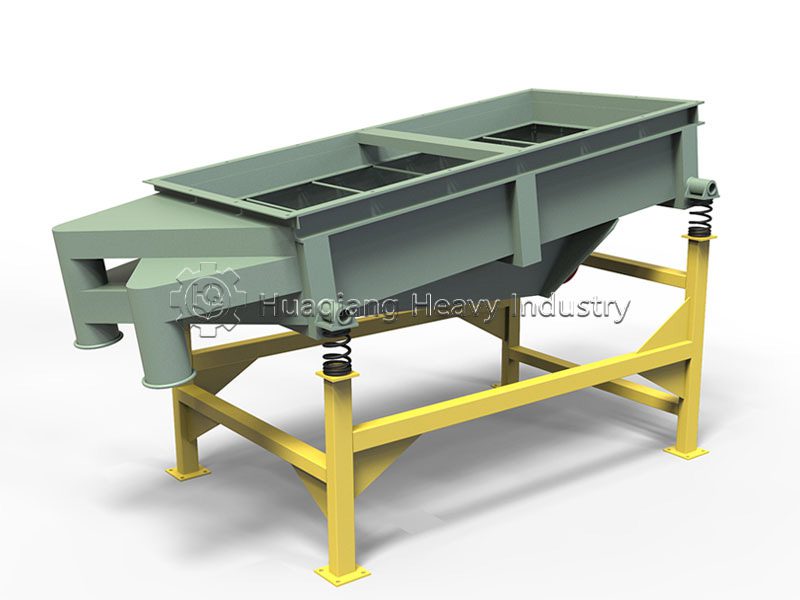
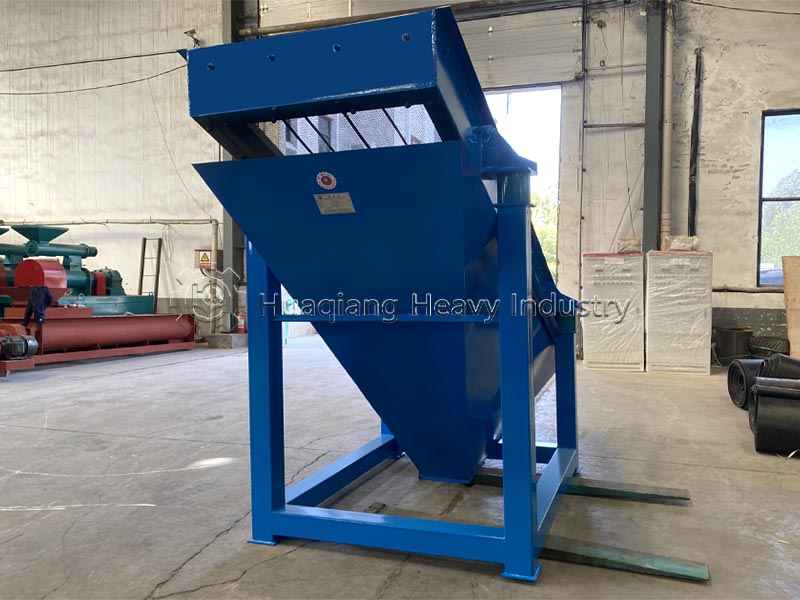
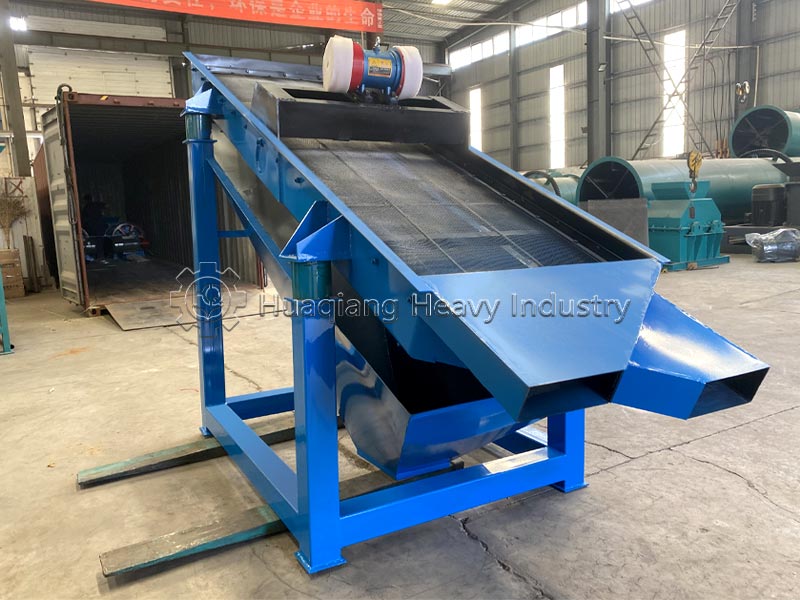
A vibrating screen is a specialized piece of equipment that uses high-frequency vibration generated by a vibrating motor or exciter to precisely classify and screen powdery and granular materials. In organic fertilizer and compound fertilizer production lines, it acts like a precise “ruler,” responsible for strictly separating materials according to particle size.
Unlike drum screens, which rely on gravity tumbling for screening, vibrating screens utilize the reciprocating vibration generated by the exciter, giving materials strong penetrating power. They are particularly adept at handling materials with high viscosity, high moisture content, or those requiring high-precision classification. Their screening accuracy typically reaches over 95%, making them a core piece of equipment connecting crushing, granulation, and packaging processes to ensure uniform particle size in the finished fertilizer product.
Vibrating screens are characterized by low energy consumption, high output, simple structure, and easy maintenance, and are widely used in industries such as fertilizers, abrasives, chemicals, pharmaceuticals, building materials, and food.
Working Principle of the Equipment
The working principle of the vibrating screen is based on the synergistic mechanism of “vibration throwing” and “probabilistic screening”:
- Vibration Generation
Power is transmitted from the motor to the vibrator via a V-belt. The vibrator generates excitation force, causing the screen box to vibrate in an approximately circular or linear trajectory. Linear vibrating screens use two motors rotating in opposite directions to generate linear excitation force, causing the material to jump linearly on the screen surface; circular vibrating screens generate circular motion through a single-axis eccentric block.
- Material Throwing and Segregation
After the material enters the screen surface evenly from the feed inlet, it is thrown up and propelled forward in a jumping motion under the action of high-frequency vibration. The material layer is loosened during vibration, resulting in stratification of particles of different sizes.
- Sieving and Grading
Particles smaller than the screen openings quickly pass through the screen and fall down, becoming undersize material; materials larger than the screen openings flow along the screen surface towards the discharge port. Through the superposition of multiple screens, materials can be separated into multiple particle size grades in one pass. 4. Rapid screening features: Some fertilizer-specific screens utilize the principle of probability, with screening time only half that of ordinary screens, and a processing capacity per unit screen area twice that of ordinary screens.
Summary table of applications and applicable raw materials for vibrating screens
| Classification | Application Field / Material Type | Specific Application & Description |
|---|---|---|
| Application Scope | Organic Fertilizer / Bio‑organic Fertilizer Production (Core) | ① Used as grading sieve after granulation: separate finished particles and return fines; ② Used as inspection sieve before packaging: guarantee finished product purity and remove unqualified particles; ③ Fine screening for fermented, granulated and dried materials to remove unformed and over‑size impurities and improve finished product appearance. |
| Compound Fertilizer / Complex Fertilizer Production | Specially designed for compound fertilizer screening conditions, suitable for accurate grading and impurity removal of granular compound fertilizer, powdery chemical fertilizer and powdery chemical materials, matching standardized process of fertilizer production line. | |
| Other General Industries | Widely used in mining, metallurgy, chemical industry, building materials, grain, food, pharmaceutical, carbon and other industries. It can complete screening, grading and impurity‑removal procedures for various raw materials and finished materials with strong universality. | |
| Applicable Raw Materials | Conventional Adaptable Materials | Various powdery and granular materials: organic fertilizer granules, compound fertilizer granules, complex fertilizer granules, powdery fertilizer, chemical fertilizer raw materials, grain, feed, chemical raw materials, building‑material raw materials, etc. |
| Advantaged Adaptable Materials | Good at treating organic materials with high viscosity and high moisture content; suitable for high‑precision grading scenarios for fine screening of powdery and small‑granule materials with small particle‑size difference. Sieve aperture can be customized to meet diversified production requirements. |
Equipment Capacity Range
- Linear Vibrating Screen (Mainstream Fine Processing Screening)
| Model | Screen Size (mm) | Number of Layers | Capacity (t/h) | Matching Motor Power (kw) |
|---|---|---|---|---|
| DZSF515 | 500×1500 | 1‑3 | 1‑8 | 2×0.37 |
| DZSF1030 | 1000×3000 | 2‑4 | 10‑25 | 2×1.5 |
| DZSF1540 | 1500×4000 | 3‑5 | 25‑50 | 2×3.0 |
- Circular Vibrating Screen (Raw Material Coarse Screening) Hourly processing capacity 5~40t, single-layer large-aperture screen, mostly used for pre-treatment of impurities in fermentation raw materials.
Application of Equipment in Production Line
- Core Position in Organic Fertilizer Production Line
The vibrating screen plays a crucial role as a “precision filter” in the organic fertilizer production line. It is typically installed after granulation and before packaging, serving as the final checkpoint to ensure the quality of the finished product.
Complete Processing Flow:
Raw Material Pretreatment → Fermentation and Composting → Crushing → Batching and Mixing → Granulation → Drying → Cooling → Vibrating Screening → Coating → Packaging
- Specific Functions in Production Line
(1) Separation of Finished Product and Return Material
After drying and cooling, the granulated particles enter the vibrating screen. Finished products meeting specifications pass through the screen to the next process, while unqualified oversized particles or fine powder are returned to the production line for reprocessing.
(2) Multi-level Grading
Through double or multiple layers of screens, materials are separated into various particle size grades (such as large lumps, finished products, and fine powder) in one pass.
(3) Final Quality Control
Installed before the packaging machine, it performs a final inspection of the products before they enter the warehouse, ensuring that no impurities are discharged. 3. Advantages Compared to Rotary Drum Screens
| Comparison Item | Vibrating Screener | Rotary Screener |
|---|---|---|
| Screening Method | Vibration throwing | Gravity rolling |
| Screening Accuracy | High (up to 95% and above) | Medium |
| Floor Space | Small | Large |
| Start‑Stop Operation | Fast | Relatively slow |
| Multi‑layer Classification | Available | Available |
| Suitable Materials | Viscous, high‑moisture, high‑precision classification materials | Materials prone to screen hole blockage |
The application of vibrating screens directly determines the level of refinement of the final product. Fertilizers screened by vibrating screens not only have uniform particle size but also a smooth surface, greatly enhancing the product’s marketability.
Target Audience and Selection Recommendations
- Main Target Audience
1) Chemical and Fertilizer Enterprises: Raw material impurity removal, finished product grading, and return material recycling.
2) Mining and Sand & Gravel Enterprises: Aggregate grading, manufactured sand screening, and coal washing demediuming.
3) Food and Pharmaceutical Enterprises: Powder filtration, particle grading, and foreign matter removal.
4) Metallurgical and Energy Enterprises: Coke screening, sinter grading, and coal washing.
5) Environmental Protection and Renewable Resources Enterprises: Construction waste recycling, municipal solid waste pretreatment, and biomass fuel screening.
- Core Selection Principles
1) Selection based on material characteristics: For dry and fine powders, choose a rotary vibrating screen or ultrasonic vibrating screen; for high-volume coarse screening, choose a linear vibrating screen or mining vibrating screen; for easily clogged or irregular materials, choose a swing screen.
2) Selection based on particle size range: The screen aperture size is usually 1.2-1.5 times the grading particle size; for ultrafine powders (<100 mesh), an ultrasonic screen cleaning system is recommended.
3) Select based on capacity requirements: Calculate the required screen area based on the target throughput, with a 20% margin.
4) Select based on operating environment: Use stainless steel screens and frames for corrosive materials; use explosion-proof vibrating motors for explosion-proof environments; use rubber springs and fully enclosed structures for high-noise environments.
Analysis of the advantages and disadvantages of vibrating screens
| Category | Performance Features | Detailed Description |
|---|---|---|
| Advantages | High Screening Accuracy | Screening accuracy can reach over 95%, with precise classification effect. Especially suitable for production scenarios requiring fine classification of powdery and small‑granule materials. |
| Strong Processing Capacity | Large material throughput per unit screen area. Working efficiency far exceeds ordinary screening equipment, showing remarkable output advantages under the same working conditions. | |
| Fast Screening Speed | Short material retention time during screening. Screening time is only 1/2 of ordinary screening machines, suitable for continuous high‑yield production. | |
| Good Material Adaptability | Wide range of applicable working conditions. Can stably handle materials with high viscosity, high moisture content and small particle‑size difference, with strong practicality. | |
| Small Floor Space | Compact and small‑size structure. It greatly saves installation site compared with rotary screeners, ideal for factories with limited space. | |
| Support Multi‑layer Classification | Multi‑layer screens with different apertures can be configured to complete multi‑grade separation in one pass and simplify production processes. | |
| Low Energy Consumption & Low Noise | Low operating energy consumption, stable vibration and low noise. Low operation cost and friendly working environment. | |
| Simple Structure & Convenient Maintenance | Compact integral structure with fewer components. Easy disassembly‑assembly, simple daily inspection and part replacement, low maintenance cost. | |
| Disadvantages | Screen Mesh Is Wearing Part | The screen mesh bears continuous material impact and vibration abrasion. It is a quick‑wear component requiring regular inspection and timely replacement. |
| High Requirement for Uniform Feeding | Strict feeding condition requirement. Uneven feeding or local material accumulation will directly reduce screening accuracy and final product quality. | |
| Anti‑blocking Measures Needed for High‑moisture Material | For extremely high‑moisture materials, screen clogging risk still exists. Special screen‑cleaning and anti‑blocking devices shall be equipped during production. | |
| Requirements for Installation Foundation | The machine works with vibration and generates vibration load. Shock‑absorbing accessories are required, and certain flatness standard for foundation and ground must be met. | |
| High Precision Requirement for Screen Mesh Tension | Screen mesh shall keep standard tension. Too loose causes uneven screening and accelerated wear; too tight may tear the mesh, adversely affecting screening performance and service life. |
Have Any Problem? Please, Contact
Integrity
Adhere to honesty and trustworthiness, be responsible to customers, employees, partners, and society, and establish long-term trust relationships.
Win win
Establish win-win relationships with all stakeholders such as customers, suppliers, and employees to share the fruits of enterprise development.