
The Complete Picture: Building a Bio-Organic Fertilizer Production Line from the Ground Up
There’s something almost magical about the transformation. On one end of the facility, raw waste pours in—chicken manure that would make your eyes water, cow dung mixed with straw, crop residues left over from harvest, mushroom substrate that’s already served its purpose. It smells. It attracts flies. It’s a problem begging for a solution.
And on the other end of the facility, beautiful bags roll off the line—uniform, professional, filled with dark, nutrient-rich organic fertilizer that farmers are eager to buy. The smell is gone. The pathogens are dead. The weed seeds are sterilized. What was once a liability has become a profit center.
That transformation doesn’t happen by accident. It happens because somewhere in between, a well-designed bio-organic fertilizer production line is doing its job.
Why Go Bio-Organic?
Before we dive into the machinery, let’s talk about why anyone would invest in this kind of operation. The answer is simple: the world is hungry for organic.
Conventional farming has depleted soils across the globe, leaving them lifeless and dependent on chemical inputs. Farmers are waking up to the reality that healthy soil needs organic matter—needs the humus, the beneficial microbes, the slow-release nutrients that only bio-organic fertilizer can provide. At the same time, livestock operations are under increasing pressure to manage waste responsibly. Neighbors won’t tolerate the smell anymore. Regulators won’t ignore the runoff.
The Big Picture: How a Production Line Flows
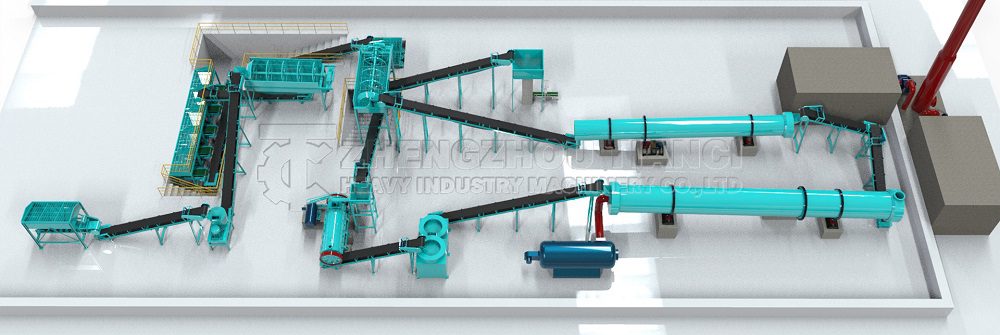
Think of a bio-organic fertilizer production line as a river. Raw materials enter at the source, and they flow through a series of transformations until they emerge at the mouth as finished product. Each piece of equipment is a point on that river, doing specific work to move the material closer to its final form.
The line divides naturally into four main phases: pre-treatment, fermentation, fine processing, and granulation/packaging. Let’s walk through each one.
Phase One: Pre-Treatment
Raw organic waste rarely arrives in perfect condition for composting. Chicken manure might be too wet. Cow dung might be mixed with long straw that needs breaking down. There might be rocks, metal fragments, or other contaminants that don’t belong in fertilizer.
The pre-treatment phase addresses issues.
A solid-liquid separator is often the first stop for wet materials like fresh manure. It presses out excess moisture, producing stackable solids that will compost properly and liquids that can be treated separately or used as irrigation.
A crusher follows, breaking down large clumps and reducing particle size. For materials with long fibers—crop straw, for example—a specialized shredder might be needed to chop everything into manageable pieces.
Some operations also include a mixer at this stage, blending different feedstocks to achieve the ideal carbon-to-nitrogen ratio before composting begins. Others prefer to mix during or after fermentation. Phase Two: Fermentation—The Heart of the Line
This is where the real magic happens. And this is also where you have choices to make, because different operations call for different fermentation equipment.
For open-air operations with plenty of space, a windrow compost turner might be your best bet. These machines straddle long piles of material, turning and aerating as they go. They’re simple, reliable, and capable of handling enormous volumes. The large wheel design is particularly popular for big operations, with massive drums that chew through windrows ten feet wide and six feet high.
For operations with space constraints or indoor facilities, trough fermentation makes more sense. Here, the chain compost turner comes into its own. Running on rails along narrow, deep troughs, it reaches down two meters or more to lift material from the very bottom and cascade it to the top. No anaerobic pockets survive this treatment. And with a transfer car system, one chain turner can serve multiple troughs, stretching your investment further.
For the toughest materials—dense, heavy, fibrous—the double screws compost turner is the weapon of choice. Its twin rotors work in opposing directions, creating a folding action that shatters clumps and obliterates anaerobic zones. Material from the left screw meets material from the right screw, mingling and merging in a chaotic dance that leaves nothing untouched.
Whichever turner you choose, the goal is the same: oxygenate the pile, heat it up, and keep it hot long enough to kill pathogens and weed seeds while beneficial microbes multiply and do their work.