
Organic Fertilizer Granulation: A Step-by-Step Process for Beginners and Factories
In organic fertilizer production, granulation is a crucial link between fermentation and commercial sales. Ungranulated powdered organic fertilizer is inconvenient to store and transport, and its application is prone to dust and uneven distribution. Scientifically granulated organic fertilizer produces round, well-formed granules with moderate strength, facilitating mechanized fertilization and allowing for controlled nutrient release. This article will break down the entire organic fertilizer granulation process, analyzing the key technologies and optimization techniques at each stage.
The granulation process transforms loose, easily dispersed fermented materials into regular granules, achieving three core benefits: improved storability—increased granule volume density allows for more product in the same package; ease of application—compatible with mechanical fertilizer spreaders, enabling precise control of application rate; and uniform nutrient distribution—each granule contains complete nutrients, avoiding localized over- or under-fertilization.
Organic fertilizer granulation is not an isolated step, but rather an integral part of the entire process chain from raw materials to finished product. The standard process includes: raw material pretreatment → fermentation and maturation → ingredient mixing → granulation → drying and cooling → screening and polishing. Raw material pretreatment is the starting point for quality. Livestock manure, straw, and other raw materials need to be processed by a high-moisture material crusher to a particle size ≤5mm, and impurities such as stones and nails should be removed by screening to create favorable conditions for subsequent fermentation and granulation.
Fermentation and maturation are the core factors determining fertilizer efficiency. Under regular operation of a compost turner, the material undergoes 15-30 days of aerobic fermentation. The standard for complete maturation is: the pile temperature drops to ambient temperature, the C/N ratio stabilizes at 20-25:1, and there is no odor, only a fresh earthy aroma. Insufficiently fermented material will easily pulverize and crack during the granulation stage.
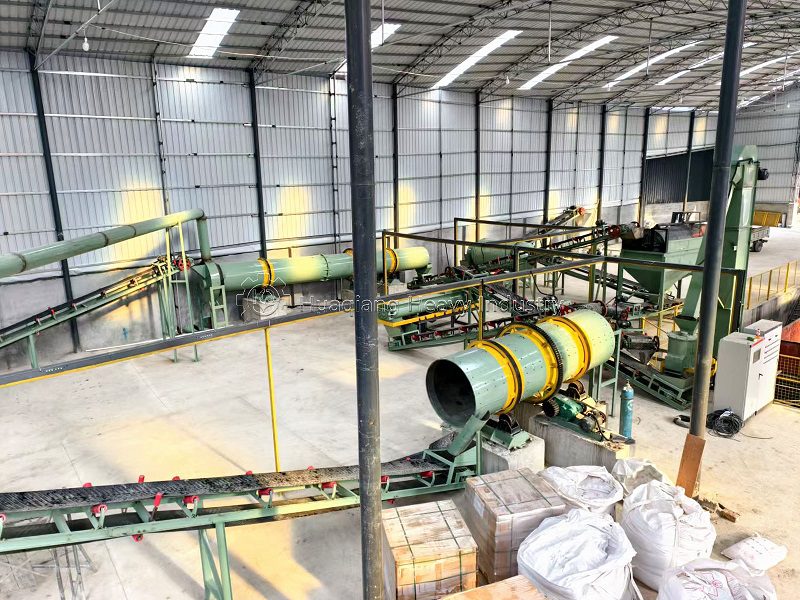
The ingredient mixing stage adjusts the formula according to the product positioning. Pure organic fertilizer requires no additional additives, while organic-inorganic compound fertilizer requires the mixing of nitrogen, phosphorus, potassium, and trace elements in proportion, for 3-5 minutes, until the material is uniform in color and free of lumps.
Granulation and molding are the core of the process. Different equipment can be selected based on the material characteristics and production capacity requirements. Disc granulators use a rotating inclined disc to agglomerate materials into spheres, suitable for small to medium scale operations with material moisture content of 20%-25%. Roller extrusion granulators use a dry forming process, suitable for dry powder materials with a moisture content ≤8%, producing high-strength granules without the need for drying. Drum granulators use steam conditioning to roll materials into spheres, suitable for large-scale continuous production, producing high granulation rates and round granules.
Moisture control is crucial in the granulation process. Disc granulators require a material moisture content of 20%-30%, resulting in a granule-like consistency that “clumps together when squeezed but crumbles when dropped.” Roller extrusion requires a dry powder state of ≤5%. Drum granulation achieves dynamic moisture control through steam conditioning.
The drying and cooling process protects the activity of beneficial microorganisms. Low-temperature, high-volume drying (hot air temperature ≤60℃, material temperature ≤50℃) reduces the granule moisture content to ≤15%, while avoiding high-temperature sterilization of functional bacteria. After cooling to ambient temperature, the granules proceed to the screening process.
Screening and polishing determine the appearance of the finished product. Vibrating screens or drum screens separate qualified granules (2-4mm or 3-6mm) from fine powder and coarse particles. Fine powder is returned to the granulator for reprocessing, while coarse particles are crushed and reused. For products requiring improved surface finish, a polishing machine can be added to further enhance granule roundness.
Small to medium-sized production lines (10,000-30,000 tons/year) can employ a simplified process of “semi-wet material crushing → disc granulation → low-temperature drying → screening,” offering low investment and flexible operation. Large-scale production lines (over 50,000 tons/year) require a continuous system of “automatic batching → rotary drum granulation → continuous drying and cooling → automatic packaging,” centrally controlled by a DCS to achieve 24-hour uninterrupted operation.
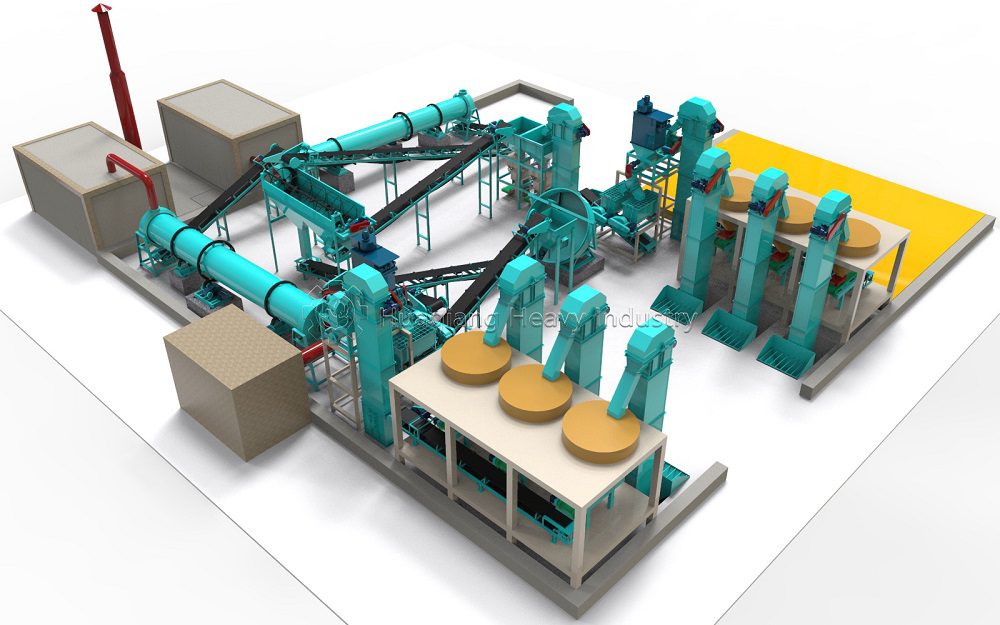
Our granulation equipment seamlessly integrates with raw material processing, fermentation and turning, screening, and packaging equipment, forming a complete production line capability. The granulator inlet is equipped with a standard interface for the mixer outlet to ensure smooth material flow; the dryer and granulator capacities are matched at a 1:1.2 ratio, with buffer space provided; all equipment supports centralized PLC control, allowing for full-line parameter setting and monitoring from the central control room.
From viscous manure to uniform granules, every step in organic fertilizer granulation requires precise control. Understanding the entire process logic is fundamental to selecting the right equipment and managing production effectively.
The granulation process described is the culmination of a well-designed organic fertilizer production equipment system. It begins with robust organic fertilizer raw material processing equipment, like the half-wet material crusher machine, which prepares the fermented material to the ideal particle size. This finely prepared feedstock is then perfectly suited for the chosen organic fertilizer production granulation technology. Within the organic fertilizer granulator series, several options exist. For producing premium spherical granules, a dedicated organic fertilizer disc granulation production line is a classic and effective choice, with its adjustable parameters for disc angle and speed. For operations seeking a compact, versatile solution, an innovative new type two in one organic fertilizer granulator can combine the final stages of conditioning and initial granulation. The selection of the granulator must be based on the material’s characteristics—its moisture content, texture, and desired final product form. Whether using a disc granulator for its gentle tumbling action or a more robust extrusion method, the goal is the same: to transform the uniform, finely ground, and perfectly conditioned feedstock from the upstream organic fertilizer raw material processing equipment into the high-value, consistent granules that define a premium organic fertilizer product.