
Simple Compost Turner: A Fork or a Revolution?
When you hear “compost turner,” you might picture a massive machine with wheels taller than a person, teeth like a dragon, and enough horsepower to move a mountain. But not every compost pile needs a monster. Sometimes, a simple compost turner does the job just fine quietly, cheaply, and without the drama.
Walk behind a small farm or a boutique organic fertilizer plant, and you will find it: a compact, three point hitch turner hitched to a 50 horsepower tractor. It looks like a rotating drum with steel paddles, barely two meters wide. The tractor driver drops the turner into a windrow of chicken manure and rice hulls, engages the PTO, and crawls forward at a walking pace. The paddles dip into the pile, lift the dark, steaming material, and toss it backward into a fluffy, aerated row. No hydraulics, no computer, no laser guidance. Just steel, grease, and a farmer who knows his microbes.
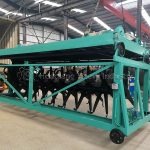
Compared to a large wheel compost turner or a double screws compost turner machine, this simple version seems almost primitive. But watch it work for an hour, and you will change your mind. It turns a pile as thoroughly as any giant – just slower, and with more passes. And that slowness is sometimes a blessing. Gentle turning means less dust, less noise, and less damage to the fungal networks that help break down tough fibers like straw and corn stalks.
The rest of the fertilizer line waits nearby. A chain crusher stands ready to shred oversized clumps after composting. A vibrating screen will later separate fine humus from coarse particles. And at the far end, a disc granulator spins slowly, turning mature compost into uniform pellets for bagging. But none of those machines can do their job if the compost comes out uneven. The simple compost turner ensures that every shovelful of material gets the same dose of oxygen, the same chance to heat up and cool down.
Installation if you can call it that – takes an afternoon. The turner arrives on a flatbed trailer, still wrapped in shipping plastic. A tractor backs up to it, and a worker pins the three point hitch arms. The PTO shaft clicks into place. The operator greases the bearings, checks the oil level in the gearbox, and spins the rotor by hand to feel for binding. “That is it,” he says. “No foundation, no concrete, no laser alignment. Just hook it up and go.”
The first test run reveals the turner’s personality. The tractor engine lugs slightly as the paddles bite into the dense, wet windrow. Steam erupts behind the machine, carrying the earthy smell of decomposition. Temperature probes stuck into the pile show a drop from 65 to 55 degrees Celsius within minutes – fresh oxygen flooding the core. The operator glances at a digital thermometer mounted on the tractor fender. “Perfect,” he mutters. “The bacteria are breathing again.”
A simple compost turner does not have automatic depth control. The driver raises or lowers the three point hitch by feel, watching the discharge pattern in a rearview mirror. If the material flies too far, he lifts the turner a little. If it barely moves, he lowers it. This manual dance takes practice, but after a few windrows, the driver develops a rhythm. “It is like mowing grass,” he says. “You learn to read the pile.”
After two weeks of turning every three days, the windrow transforms. What started as sticky, smelly manure becomes dark brown, crumbly, and sweet smelling.