
Flat Die Pelleting Machine: The Robust Shaper for Small-Scale Fertilizer Production
In the world of organic fertilizer and feed pelleting, where production scale and cost-effectiveness require fine balancing, the Flat Die Pelleting Machine stands out as a reliable “Pellet Sculptor” in the minds of small-to-medium producers and specialized farmers, thanks to its rugged durability, simple operation, and economic value. It does not chase extreme industrial scale but focuses on efficiently transforming various powdered raw materials—from organic waste to mixed feed—into high-density, uniform pellets. It is the ideal choice for distributed production and specific formulation granulation.
Core Advantage: Simple, Direct, Reliable Pressure Forming
The heart of the flat die pelleting machine is its horizontally positioned ring-shaped die (flat die) and vertically operating press rollers. Material is fed from above onto the flat die, forcibly compressed through the precision holes in the die by the rotating rollers, and then cut into uniform pellets by external knives. This direct working principle grants it three outstanding advantages:
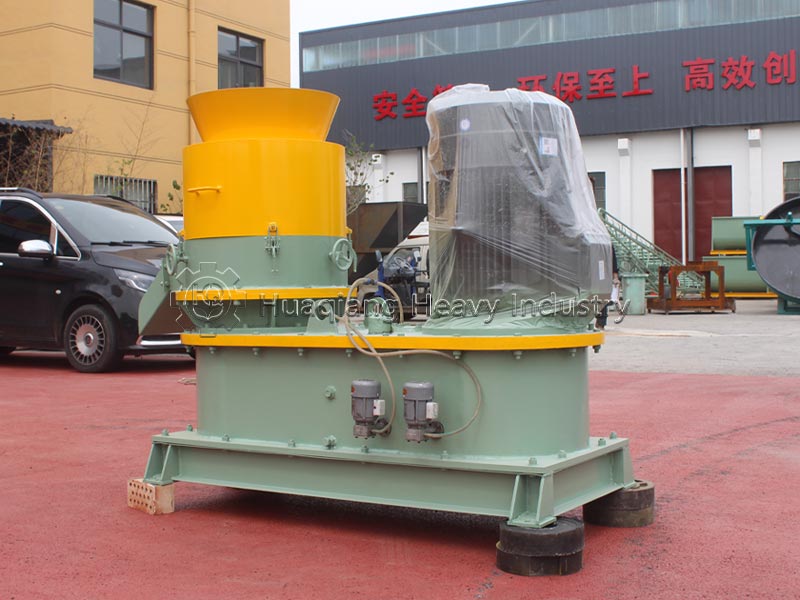
Excellent Fiber Processing Capability: Particularly adept at handling raw materials with high cellulose content and low viscosity, such as sawdust, straw powder, and alfalfa meal. Its performance with the vast agricultural waste used in organic fertilizer production far surpasses other granulation methods that rely more heavily on binders.
Simple Structure, Easy Maintenance: The overall structure is compact, and the main wear parts (the flat die and press rollers) are extremely easy to disassemble and replace, requiring no complex tools. This significantly lowers the maintenance threshold and downtime, making it suitable for production environments with limited technical support.
Low Moisture Requirement & Energy Consumption: Materials typically only need a low initial moisture content (approx. 15-20%) to form, reducing dependence on pre-drying processes and thereby lowering overall energy consumption and production complexity.
Unique Positioning Within the Fertilizer Equipment Family
The flat die pelleting machine is not a “one-size-fits-all” device but excels in a specific niche:
Compared to Ring Die Pelleting Machines: Ring die machines (with a vertical ring-shaped die) are the absolute workhorses for large-scale continuous feed and compound fertilizer production, offering high capacity and automation but also higher investment and maintenance costs. The flat die machine represents small-to-medium capacity and flexible production, with a lower investment threshold, making it better suited for organic fertilizer or specialty feed scenarios with variable raw materials and batch production.
Compared to double roller press granulators: Both belong to dry-forming methods. The double roller machine compresses material into sheets between two intermeshing rollers before breaking them into granules, suitable for high-hardness mineral materials. The flat die machine extrudes directly through the die, offering greater adaptability to organic and fibrous materials and producing more uniform pellets in appearance.
Role in the Production Line: It is often positioned after the mixing stage, receiving uniformly mixed materials from a double shaft mixer or vertical mixer and transforming them into a commercial pellet form, facilitating subsequent packaging, storage, transportation, and application.
Key Technology: The Art of the Die and Rollers
The core of forming quality lies in the matching and adjustment of the die (hole diameter, thickness, open area) and the press rollers. Different dies can produce cylindrical pellets ranging from 2 to 12 mm in diameter. High-quality equipment is equipped with hydraulic or spring pressure systems, allowing flexible adjustment of the pressure between the rollers and the flat die to adapt to different raw material characteristics, ensuring pellet hardness and formation rate.
Application Value: Empowering Distributed Agriculture and the Circular Economy
The true power of the flat die pelleting machine lies in its accessibility and practicality. It enables:
Small organic fertilizer plants to utilize local livestock manure and straw to produce commercial pellet fertilizer, increasing product added value
Ecological farms to achieve self-production and processing of feed, controlling formulation and quality.
Biomass fuel production sites to convert agricultural and forestry waste into standardized solid fuel pellets.
It is not just a production tool but a vital technological node promoting the on-site resource recovery of agricultural waste and shortening supply chains.
Conclusion: Achieving Great Value at a Smaller Scale
Amidst the industrial trend pursuing large-scale, fully automated production, the flat die pelleting machine proves that focus, reliability, and cost-effectiveness are themselves powerful forms of competitiveness. Through the most intuitive mechanical principles, it provides small-to-medium-scale producers with the autonomous capability to transform powdered raw materials into high-value commodities. Choosing a stable-performing flat die pelleting machine means opting for a more autonomous, flexible, and locally-responsive sustainable development path, allowing value to solidify firmly within every appropriately scaled production endeavor.