
Organic Fertilizer Production Process: Seamless Integration from Raw Material Processing to Disc Granulation
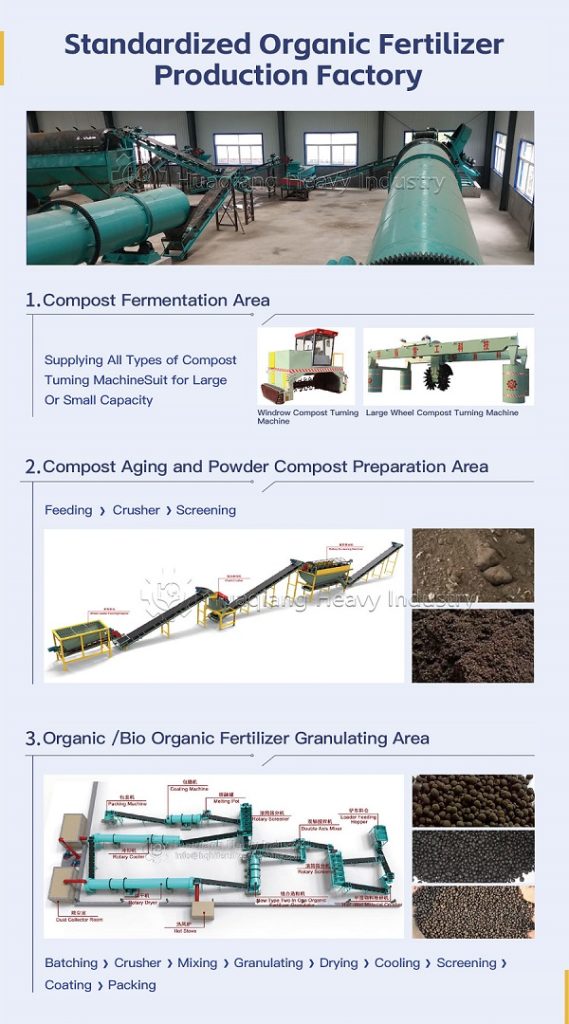
Organic fertilizer production is a complex, interconnected system. From raw material receiving and pretreatment to fermentation, granulation, drying, screening, and packaging, the seamless integration of each step directly determines the overall efficiency and product quality of the production line. Among these, raw material pretreatment, as the initial stage, is crucial in its integration with the core granulation stage of the disc granulation production line.
Raw Material Pretreatment: Laying the Foundation for Granulation
Raw material pretreatment is the cornerstone of the entire process. Using equipment such as half-wet material crushers, chain crushers, and cage crushers, the raw materials are specifically refined based on their moisture content, hardness, and fiber content. This stage requires strict control of the particle size of the crushed raw material within the range of 1-3 mm and a stable moisture content of 30%-40%. These two indicators are key to ensuring a smooth integration with the subsequent granulation stage—excessively large particle size leads to low granulation formation rate, excessively high moisture content causes granules to clump together, and excessively low moisture content requires the addition of binders, increasing production costs.
The pre-treated raw materials need to be smoothly conveyed to the mixing stage before granulation via conveying equipment. During conveying, material accumulation and adhesion to the walls must be avoided. For sticky raw materials, screw conveyors are preferred, while belt conveyors are suitable for dry and loose raw materials.
Mixing Stage: The Transition Bridge Between Pre-treatment and Granulation
The mixing stage serves as a “transition bridge” connecting raw material pre-treatment and disc granulation. Its task is to thoroughly mix the pulverized raw materials with fermentation agents, binders, trace elements, etc., achieving a mixing uniformity of over 95%. Otherwise, uneven nutrient distribution in the granulated particles will affect the quality of the organic fertilizer product.
The mixed raw materials need to be continuously and evenly conveyed to the disc granulator. The feeding speed must be precisely matched to the processing capacity of the disc granulator—feeding too quickly will overload the granulator, while feeding too slowly will reduce production efficiency.
III. Granulation and Post-Production Stages: Ensuring Timeliness
The wet organic fertilizer granules produced by the disc granulator need to be promptly conveyed to the drying equipment to prevent the wet granules from accumulating and clumping. The temperature of the drying equipment needs to be precisely controlled between 60-70℃. This temperature range ensures that the moisture content of the granules is reduced to below 15% while preventing high temperatures from damaging the activity of beneficial microorganisms in the organic fertilizer.
The dried granules need to quickly enter the screening equipment to return unqualified large and small granules to the crushing and granulation stages, achieving a circular production process. Qualified granules then proceed to the cooling and packaging stages, completing the entire production process.
Equipment Interconnection and Parameter Adjustment
Equipment interconnection and parameter adjustment at each stage are core techniques for process integration. Medium and large-scale production lines can use a PLC control system to achieve interconnected adjustment of the rotation speed and feed rate of the raw material pretreatment equipment, mixing equipment, and granulation equipment, adjusting the front-end raw material processing parameters in real time based on the granulation effect.
Simultaneously, material detection points need to be set up at each stage to monitor raw material particle size, moisture content, mixing uniformity, and other indicators in real time, promptly identifying and resolving problems in process integration.
Layout Design: Ensuring Process Integration
The layout design of the production line should also follow the principle of “material flow in the forward direction, without backflow,” reducing material conveying distance and lowering energy consumption and material loss. A well-planned layout ensures that raw materials flow along the shortest path from the factory entrance to the finished product exit, avoiding unnecessary transfers and waiting times.
From the first step of raw material pretreatment to the final step of finished product packaging, the precise connection of each link constitutes an efficient, stable, and continuous organic fertilizer production line. When raw materials flow smoothly through each piece of equipment, and when granules pour out evenly from the granulator, you will understand that every detail of the process connection silently contributes to the final product quality.
Seamless Integration in Organic Fertilizer Production
The seamless integration of each production stage, from raw material intake to finished product packaging, is the hallmark of an efficient operation. This is particularly true when connecting the critical stages of raw material pretreatment and granulation. The output from organic fertilizer raw material processing equipment like a half-wet material crusher machine or chain crusher—with its precisely controlled particle size and moisture—must be perfectly matched to the input requirements of the subsequent granulation phase. For many operations, this leads to the heart of the plant: an organic fertilizer disc granulation production line. This classic setup, centered on a disc granulator machine from the broader organic fertilizer granulator series, excels at transforming well-prepared feedstock into high-quality spherical pellets. For facilities seeking a more streamlined workflow, an innovative alternative like a new type two in one organic fertilizer granulator can be integrated, effectively combining the final stages of conditioning and initial organic fertilizer production granulation into a single, efficient unit. Whether using a dedicated disc line or a combined machine, the key to successful organic fertilizer production granulation lies in the flawless integration of the chosen organic fertilizer production equipment. Precise control over feed rate, moisture, and particle size at every upstream step ensures that the granulator receives a consistent, ideal feedstock, resulting in a uniform, high-value final product.