
Horizontal Mixer – What Makes It the “Dough Master”?
Have you ever seen a machine that can take several different powders varying in color, moisture, and particle size and blend them more evenly than cake batter in just a minute or two? That’s the horizontal mixer the “dough master” of any fertilizer production line. Today, let’s walk into its installation site and see how this low key yet indispensable giant teams up with its brothers to “knead” all kinds of raw materials into one tight bundle.
The first thing that catches your eye on site is the long horizontal drum. It lies like a steel whale, resting quietly on a reinforced base. Workers are using a spirit level to check the drum’s levelness front to back and side to side height differences must stay within two millimeters, otherwise the machine will twist and “dance” during operation, and the bearings will fail within months. An old hand squats at one end of the drum, running his finger along the weld at the flange: “Every set of paddles inside this drum has to be at the exact angle. One degree off, and the material won’t tumble it’ll just roll in place.”
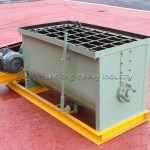
Inside the drum runs a full length mixing shaft, on which several sets of spiral or paddle shaped arms are welded. The arrangement and tilt angles of these paddles determine how the material flows through the drum some push it forward, others pull it backward, creating a combined “convection + shear” movement. Installing the shaft is the most painstaking step: workers have to crawl into the narrow access door, crouch, and tighten the paddles one by one, then use a laser alignment tool to calibrate the coaxiality between the shaft and the gearbox. “Even 0.1 mm off is unacceptable,” shouts the quality inspector, looking at the display. “Add a shim to the left!”
Of course, the horizontal mixer never works alone. Upstream is a hammer crusher capable of turning clumped urea, phosphate, or fermented organic material into flying powder. Downstream, a bucket elevator and a disc or rotary drum granulator wait. Some production lines also equip the mixer with a liquid addition device, which atomizes water, steam, or binders through nozzles evenly over the tumbling powder. While installing these nozzles, technicians run multiple spray tests to ensure no dead zones exist otherwise, wet material will stick to the drum wall and form hard crusts.
Besides these neighbors, you’ll also see belt conveyors, a dust collector, and an electrical control panel on site. The conveyors feed crushed material steadily into the mixer’s inlet; the dust collector sucks up airborne powder at the feeding port, so workers don’t have to hold their noses; and the VFD in the control panel adjusts the mixing shaft’s speed – slow for thorough blending, fast for breaking up clumps depending on the formula.
On trial run day, workers pour several bags of colored powder into the drum, close the access door, and press the start button. The motor hums softly, the shaft turns slowly, and a soft “shushing” sound comes from inside like waves lapping a sandy shore. After one minute, they open the discharge door. The previously layered powder has become a single uniform color. Grab a handful no clumps, no segregation as even as blended paint. Someone grins and pats the drum: “This feels more uniform than a baker’s dough!”
So never underestimate the horizontal mixer. It does the most unglamorous job stirring yet it determines the quality starting point of the entire production line. Without it, even the finest powder is just scattered sand. With it, nitrogen, phosphorus, potassium, and organics hold tightly together, becoming those uniform, plump fertilizers that the soil loves. Isn’t that what a behind the scenes hero looks like?