
Applying Organic Fertilizer to Fruit Trees: Key Techniques for Increasing Yield and Quality
Apples not sweet, citrus not tart, grapes bland… these quality problems often stem not from the variety, but from the soil. More and more fruit growers are discovering that the scientific application of organic fertilizer can help fruit trees regain their memorable flavor. This article details the timing and methods for applying organic fertilizer to fruit trees.
Why Can’t Fruit Trees Do Without Organic Fertilizer?
Fruit trees are perennial crops, permanently planted in the same location, and their soil requirements are far higher than those of annual vegetables. Soil compaction, acidification, and a decline in organic matter directly affect the root system’s absorption capacity and the formation of fruit quality.
This is precisely where organic fertilizer comes in. It improves soil structure, restoring looseness and aeration to compacted soil, allowing roots to grow deep and widely. The humic acid in organic fertilizer can chelate micronutrients in the soil, promoting the absorption of nutrients such as calcium, iron, and zinc, and reducing physiological diseases. More importantly, organic fertilizer is rich in amino acids, sugars, and other active substances, which can promote the accumulation of sugars and the formation of flavor compounds in the fruit. Fruit growers’ experience is straightforward: orchards using organic fertilizer produce sweeter, better-colored fruit that stores well, fetches a higher price per kilogram (0.3-0.5 yuan more).
Base Fertilizer: Autumn Application is Key. There’s an old saying about base fertilizer application for fruit trees: “Autumn application is gold, winter application is silver, spring application is scrap metal.” Autumn is the peak growth period for fruit tree roots. Applying organic fertilizer at this time allows the roots to quickly absorb and store nutrients, laying a solid foundation for flowering and fruit setting the following year.
The optimal time for base fertilizer application is after fruit harvest and before leaf fall. In northern regions, this is generally from late September to late October, while in southern regions, citrus trees can be fertilized immediately after harvest. The amount depends on the tree’s age and yield: for mature trees in their peak fruiting period, apply 30-50 kg of fully decomposed organic fertilizer per tree; for young trees, apply 10-20 kg per tree. Application methods include radial or circular trenching. Dig trenches 30-40 cm deep within the canopy projection area, mix the organic fertilizer with topsoil, backfill, and finally water thoroughly. The benefits of trench application include guiding root development in depth and enhancing the tree’s drought and cold resistance.
Topdressing: Supplementing at Key Nodes
Topdressing replenishes nutrients during critical growth periods of fruit trees. Pre-flowering fertilizer is applied 10-15 days before bud break, primarily using fast-acting organic fertilizer, at 10-15 kg per tree, to promote spring shoot growth and flower bud development. Fruit-enlarging fertilizer is applied during the rapid fruit enlargement period (July-August for apples, August-September for citrus), at 15-20 kg per tree, combined with high-potassium compound fertilizer, to promote fruit enlargement and sugar accumulation. Post-harvest fertilizer is applied after fruit harvest, at 10-15 kg per tree, to help the tree recover its vigor and accumulate nutrients for the following year.
Topdressing methods should be chosen flexibly according to the season. In spring, during the active root period, it can be combined with shallow cultivation and watering; in summer, liquid organic fertilizer can be applied with irrigation water, which is fast-acting and well-absorbed; in autumn, basal fertilizer must be applied deeply in trenches.
Solving the Problem of Low Fruit Sweetness and Poor Taste
Many fruit growers report, “We’ve used plenty of chemical fertilizers, but the fruit just isn’t sweet.” The problem lies in nutrient imbalance. Chemical fertilizers only provide nitrogen, phosphorus, and potassium, while the sweetness and flavor of fruit require sufficient organic matter and trace elements.
One Fuji apple orchard had been using chemical fertilizers for many years, resulting in decreased fruit firmness and a sugar content of only around 12 degrees Brix. The growers adjusted their approach: in autumn, they applied 40 kg of well-rotted cow manure per tree, along with superphosphate and potassium sulfate, deep in trenches. The following year, the fruit sugar content increased to over 14 degrees Brix, the fruit surface was evenly colored, and the purchase price was 0.6 yuan higher per kilogram. Another Kyoho apple orchard applied well-rotted soybean meal organic fertilizer during the fruit expansion period, along with reduced nitrogen fertilizer. At maturity, the fruit was firm, with a thick bloom, and the sugar content reached 18 degrees Brix, with a significantly better taste than surrounding orchards.
Four Key Points for Applying Organic Fertilizer to Fruit Trees
First, it must be fully decomposed. Applying uncomposted organic fertilizer leads to secondary fermentation, generating heat and organic acids that can directly burn the roots, potentially causing the entire tree to die. Secondly, layered application yields better results. Mixing organic fertilizer with topsoil and applying it to the bottom of the trench, then covering it with soil, encourages root growth towards the fertile layer. Thirdly, it should be scientifically combined with chemical fertilizers. Organic fertilizer provides long-lasting nutrition, while chemical fertilizers meet the rapid needs during critical periods; only by combining the two can high yields and quality be achieved. Fourthly, the effects of organic fertilizer are noticeable year by year. The effects of organic fertilizer are not immediate; consistent application for 2-3 years will significantly increase soil organic matter content, leading to a qualitative leap in fruit quality.
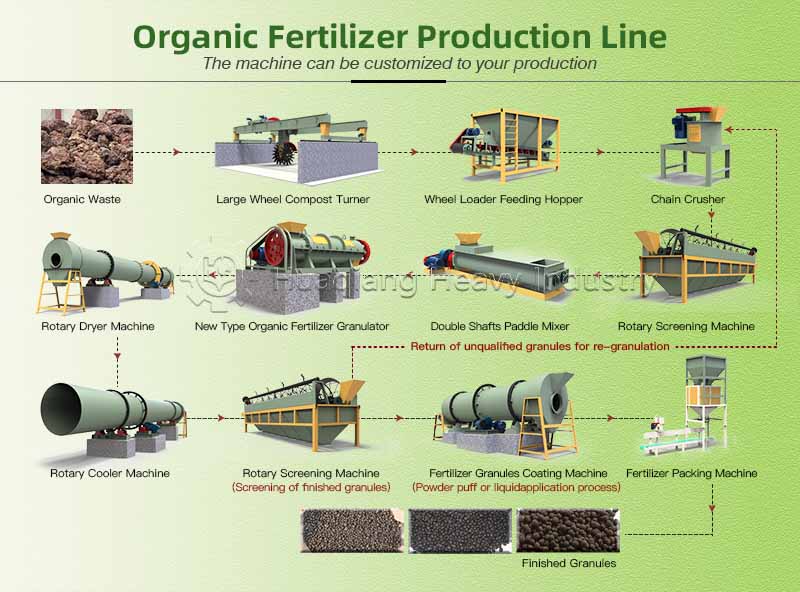
The benefits of organic fertilizer for fruit quality—sweeter fruit, better color, and improved storage—begin with a proper production process. The organic fertilizer fermentation process transforms raw materials into a stable, mature product. This material is then prepared for granulation using organic fertilizer raw material processing equipment, such as a half-wet material crusher machine. The prepared powder then enters the shaping stage. Within the organic fertilizer granulator series, a disc granulation production line (a classic organic fertilizer disc granulation production line) is an excellent choice for producing the uniform, easy-to-apply spherical granules that fruit growers prefer. For operations seeking a compact, efficient solution, a new type two in one organic fertilizer granulator can combine the final stages of conditioning and initial granulation. This integrated system of organic fertilizer production equipment ensures that the final product is not only rich in organic matter and beneficial microbes but also physically stable and convenient to apply. When this high-quality, well-decomposed organic fertilizer is applied to fruit trees—as a deep-trenched base fertilizer in autumn or as a top dressing during key growth stages—it provides the sustained, balanced nutrition that leads to the sweet, flavorful, and high-value fruit that discerning growers and consumers value. The investment in proper organic fertilizer production is, in turn, an investment in the long-term health of the orchard and the superior quality of its harvest.