
Comparison of Three Types of Crusher: How to Choose the Right Organic Fertilizer Crusher
In organic fertilizer production, reducing material particle size is a crucial first step, directly impacting subsequent granulation efficiency and final product quality. There are three main types of crushers on the market: half-wet material crusher machines, chain crushers, and cage crushers. Each crusher operates on a different principle and has its own advantages. Understanding their differences is essential for making an informed choice based on your raw materials and production goals.
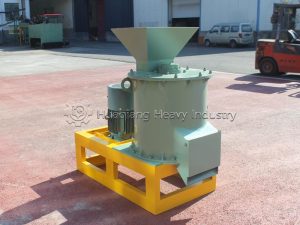
Half-wet material crusher machine: Expert in High-Moisture Material Handling
The half-wet material crusher machine is specifically designed for handling sticky, high-moisture materials, processing raw materials with a moisture content between 20% and 60%. It can directly process fresh manure, well-rotted compost, sludge, and other sticky materials that easily clog traditional crushers. The half-wet material crusher machine uses a dual-rotor, screenless design, crushing materials through high-speed impact and friction, avoiding clogging.
Key advantages: No pre-drying required, simplifying the process; effectively prevents clogging even when handling sticky materials; uniform output particle size facilitates subsequent granulation; low energy consumption (8-12 kWh per ton). This crusher is ideal for processing animal manure or wet agricultural waste.
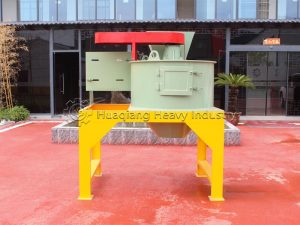
Chain Crusher: Economical and Efficient Dry Material Solution
The chain crusher employs a simple yet efficient mechanical structure—a chain on a rotating shaft impacts and crushes dry materials. It is best suited for raw materials with a moisture content below 20%, such as dry straw powder, mushroom residue, oilseed meal, and other fibrous dry materials. The output particle size can be adjusted within the range of 1-3 mm.
Key advantages: Simple structure, low maintenance costs; investment cost is approximately 60% of similar equipment; easy to operate, ideal for small producers or farms; reliable performance in handling dry, fragile materials. It can be used as a standalone unit or as part of a multi-stage crushing system.
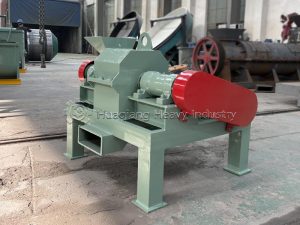
Cage Crusher: High-Capacity Fiber Processor
The cage crusher uses multiple rotating cages, each containing rows of pins. Material enters from the center and is subjected to continuous impact and shearing as it moves outward within the cage. This design generates powerful impact forces, making it ideal for processing harder, fibrous materials such as branches, corncobs, medicinal herb residue, and hardwood chips. It can achieve a material fineness of up to 80 mesh with extremely low dust generation.
Key Advantages: Effectively handles harder, fibrous materials; high throughput—30% more efficient than chain crushers for similar materials; continuous operation, suitable for medium to large-scale production lines; enclosed design minimizes dust pollution.
Selection Guide: Let the Material Decide the Equipment
The selection principle is simple: “Let the raw material determine the equipment.” For wet, viscous materials (fresh manure, wet sludge, well-rotted compost): Choose a semi-wet material crusher. It is the only option capable of handling high moisture content without clogging and requires no pre-drying.
For dry, loose materials (dry straw, sawdust, dry cake): Choose a chain crusher. It provides sufficient performance at a minimal cost, making it ideal for budget-conscious small-scale producers.
For fibrous and hard materials (twigs, corn stalks, hard waste): choose a cage crusher. Its powerful impact force provides the uniform fineness required for high-quality fertilizer.
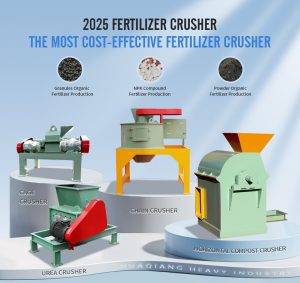
Advanced Configuration: Combined Crusher
For medium to large-scale production lines handling a variety of materials, consider a two-stage crushing process: first, process the fresh, wet material using a half-wet material crusher, then dry it before further fine crushing using a chain crusher or cage crusher. This combination ensures the optimal particle size required for producing high-quality organic fertilizer.
Choosing the right crusher is not about finding the “best” machine, but about finding the machine best suited to your specific material. By matching the crusher’s performance to the characteristics of your raw materials and production scale, you can ensure efficient pretreatment—the foundation for high-quality granulation and successful organic fertilizer production.
The correct selection of crushing equipment is the critical first step in any organic fertilizer production equipment line. After the raw materials are properly processed by the appropriate organic fertilizer raw material processing equipment—whether a half-wet material crusher machine for high-moisture manure, a chain crusher for dry, fibrous materials, or a powerful cage crusher for harder feedstocks—the uniformly sized powder is ready for the next crucial stage: granulation. This is where the material is transformed into a marketable product. For producing high-quality spherical organic granules, a complete organic fertilizer disc granulation production line is the industry standard. As an innovative, space-saving alternative, a new type two in one organic fertilizer granulator combines the final crushing and initial granulation steps, offering a streamlined solution for many organic materials. By seamlessly integrating the right crushing technology with an appropriate granulation system, producers can ensure a smooth, efficient workflow from raw, variable waste to a consistent, high-value, and easy-to-apply granular fertilizer.