
Customized Organic Fertilizer Production Line: Tailor-Made for Livestock Farms
Transforming the large quantities of pig manure, cow manure, and other agricultural waste generated daily into marketable organic fertilizers is not only a necessary path to achieving environmental compliance but also a new avenue for creating substantial economic benefits.
Successful customization begins with a shift in mindset. The primary goal of production line design should not be merely “disposing of manure,” but rather “consistently producing commercial organic fertilizer that meets market standards.” This requires the solution to comprehensively consider three core variables: raw material characteristics (manure type, moisture content, and availability of auxiliary materials), site conditions (available area, distance from the breeding area), and product positioning (powdered or granular fertilizer, market requirements for quality and cost). For example, processing fresh pig manure with a moisture content exceeding 80% will require a completely different process starting point and equipment selection compared to processing pre-composted cow manure.
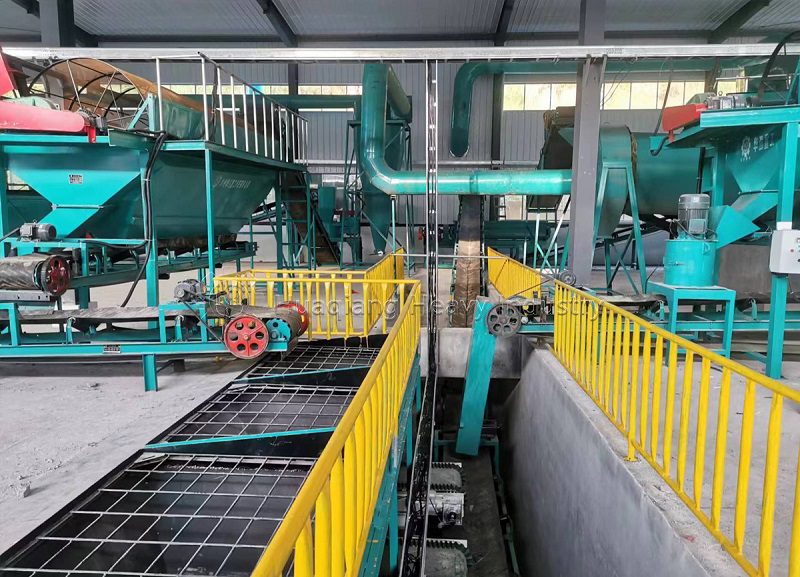
Core Process Chain: Segmented Customization, Precise Matching
A complete customized production line is a precisely designed “waste value-added assembly line,” typically including a flexible combination of the following key segments:
- Pre-treatment and Conditioning Segment: Solid-Liquid Separation is the “Bottleneck”
This is the starting point of the entire production line and the key to ensuring the smooth operation of subsequent processes. For high-moisture manure, it must first be reduced in volume using a screw press or inclined screen solid-liquid separator. The separated solid portion (with a moisture content of approximately 60-65%) enters the main process, while the liquid portion can enter a biogas digester or be further processed into liquid fertilizer. The key at this stage is to select equipment with matching separation efficiency and dryness based on the fiber content and viscosity of the manure, which is the first manifestation of customization.
- High-Efficiency Fermentation Segment: Process Selection Determines Efficiency and Cost
This is the core link for “harmless and stable” treatment of manure. There are two main highly customizable options: For farms with ample land area and limited investment budgets, windrow aerobic fermentation can be used, employing wheeled or tracked turning machines for regular turning. This is low-cost but has a longer cycle and is affected by weather. For scenarios requiring efficient, intensive production with strict environmental requirements, enclosed fermentation tanks (reactors) or solar-powered fermentation workshops are superior choices. Through forced ventilation and automatic temperature control, they can complete thorough composting within 10-15 days, offering high efficiency, no odor emission, and a small footprint, making them ideal for modern farms.

- Deep Processing and Shaping Section: Market-Oriented “Packaging”
The fermented and composted material is already basic powdered organic fertilizer. To increase product added value and sales radius, customized deep processing is required. This includes:
Fine crushing: Using a semi-wet material crusher to ensure uniform particle size, which is beneficial for granulation.
Scientific compounding: Customizing the addition of functional microbial agents or trace elements based on soil and crop needs to produce more marketable bio-organic fertilizers or formulated organic fertilizers.
Flexible granulation: Choosing a disc granulator (to produce spherical granules) or an extrusion granulator (to produce cylindrical granules, requiring no drying, thus saving energy) based on market preferences. Whether to configure post-processing equipment such as drying, cooling, screening, and coating depends entirely on the target positioning of the product’s appearance and quality.
- Environmental Integration Section: Indispensable “Green Insurance”
A responsible customized production line must incorporate odor and dust control into the overall design. In odor-producing stages such as fermentation and drying, biological filter odor removal devices or chemical scrubbing towers can be integrated; in crushing and screening stages, a pulse bag dust removal system can be configured. These environmental units are not an extra burden, but rather “green insurance” to ensure that the production line can operate legally, compliantly, and sustainably.
Case Study: Taking the “Fushun Jiayuan Bio-organic Fertilizer Project” as an example
The core lesson from successful projects like “Fushun Jiayuan” lies in deep customization and resource integration. The project team did not simply copy templates, but instead designed a flexible production line centered on “efficient trough fermentation + functional microbial agent addition + disc granulation” based on the abundant livestock manure resources in the area and the fertilizer needs of surrounding economic crop areas. It not only efficiently processes waste materials but also produces high-value organic fertilizer that meets the high-end demands of cash crops, maximizing both environmental and economic benefits.
Following the organic fertilizer fermentation process, the cured manure requires size reduction, a step handled by key fertilizer raw material processing machinery and equipment. For fibrous compost, a chain crusher is effective; for materials with higher moisture, a half-wet material crusher machine is essential. The subsequent organic fertilizer production granulation stage offers flexibility. For premium spherical granules, a complete organic fertilizer disc granulation production line is ideal. For facilities prioritizing compactness, a new type two in one organic fertilizer granulator that combines crushing and granulation is a strong option. For producing high-density cylindrical pellets, a flat die pelleting machine is perfectly suited. This modular equipment approach allows for a production line precisely tailored to the specific manure characteristics, desired product form, and operational scale of the farm or processing center.