
Customized Organic Fertilizer Production Lines for Livestock and Poultry Manure Recycling
For large-scale farms, the treatment of livestock and poultry manure has transformed from a mere environmental burden into a resource utilization challenge with immense economic benefits. A scientifically designed and efficiently operating customized organic fertilizer production line can not only completely solve pollution problems but also transform manure into marketable organic fertilizer, achieving both environmental and economic benefits. The key to success lies in “customization”—it must closely revolve around the manure characteristics, site conditions, investment scale, and product goals of the farm, creating a seamless conversion pipeline from “waste” to “resource.”
Customization Process Step 1: Precise “Diagnosis” and Front-End Reduction
Customization begins with a deep understanding of the “raw materials.” Manure from different livestock species (pigs, chickens, cattle) varies significantly in moisture content, carbon-nitrogen ratio, and fiber content. Therefore, the first step in production line design is “tailored treatment,” and solid-liquid separation is the “bottleneck” of the entire treatment process.
For fresh manure with a moisture content exceeding 80%, mechanical dewatering must be used for reduction. The key here is the precise matching of equipment selection. For example, for cattle manure with high fiber content, a screw press separator is a reliable choice; while for viscous chicken or pig manure, a slanted screen separator or a higher-pressure plate and frame filter press may be needed. The goal of customization is to stably control the moisture content of the solid material at around 60%-65%, which is the optimal range for efficient aerobic fermentation. The separated liquid portion can enter a biogas project or be further processed into liquid fertilizer, achieving full resource utilization.
Customization Process Step 2: Efficient and Stable “Conversion” Core
After solid-liquid separation, the solid material enters the core fermentation and maturation stage. This is the key to harmless treatment and fertilizer production, and also the most significant area of differentiation in customization.
Efficient Closed Fermentation Solution: For modern farms with limited land, strict environmental requirements, and a pursuit of continuous year-round production, the use of intelligent high-temperature aerobic fermentation tanks (reactors) is recommended. This equipment integrates mixing, aeration, and temperature control systems, allowing for complete composting in a sealed environment within 10-15 days, killing pathogens and weed seeds, and preventing odor emissions. It is the preferred choice for intensive, factory-style production.
Economical and Flexible Fermentation Solution: If the farm has a spacious, hardened area and a limited investment budget, trough-type aerobic fermentation can be used. Regular turning and aeration are performed in concrete fermentation troughs using a rail-mounted turning machine, with a fermentation cycle of approximately 15-25 days. This solution strikes a good balance between cost and efficiency while maintaining strong processing capacity.
Customization Process Step Three: Market-Oriented “Product Shaping”
The composted material is already basic organic fertilizer, but to transform it into a marketable product, further deep processing and customization are required.
Refinement and Formulation: A semi-wet material crusher is used to crush the composted material to a uniform particle size. The production line can be customized with a mixing system and storage bins for adding trace elements or functional microbial agents, producing formulated organic fertilizers or bio-organic fertilizers that meet the needs of specific soils and crops, significantly increasing product added value.
Shaping and Packaging: Choose the appropriate granulation method based on target market preferences. For traditional spherical granules, a disc granulator can be used; if energy efficiency is a priority and the product is intended for orchards, tea plantations, etc., the columnar granules produced by a roller extrusion granulator are a better choice, requiring no drying and consuming less energy. Finally, the finished product is packaged using an automatic quantitative packaging scale.
Recommended Equipment Combination
A typical customized production line suitable for a 10,000-head pig farm or a correspondingly sized poultry farm has the following core equipment combination process:
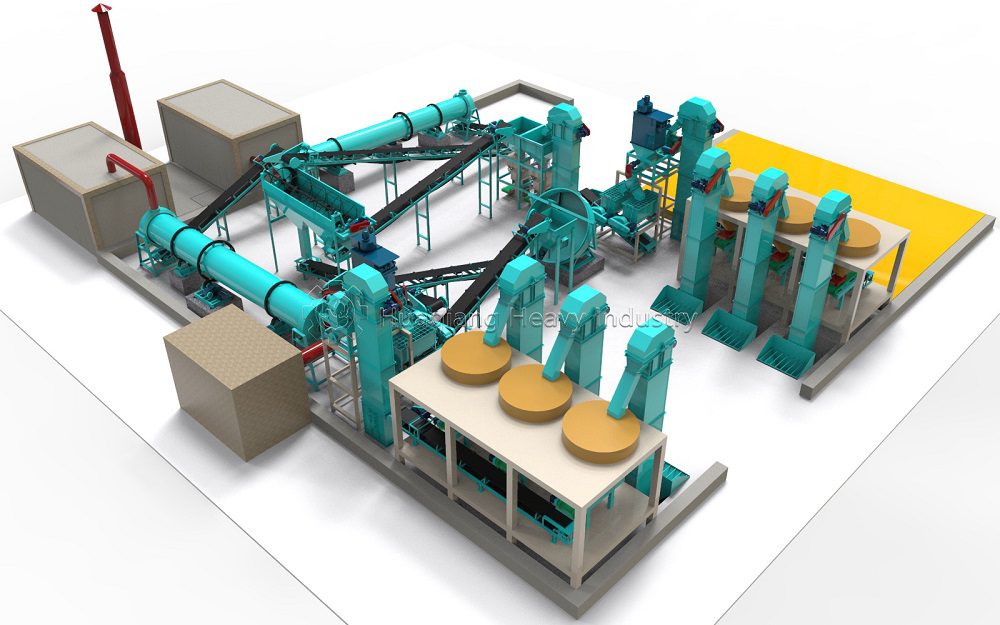
Solid-liquid separation system → Mixing and conditioning system (adding auxiliary materials to adjust the carbon-nitrogen ratio) → Intelligent fermentation system (tank or trough type) → Fine crushing system → Batching and mixing system (optional) → Granulation and shaping system → Drying and cooling system (required for disc granulation) → Screening and packaging system.
Customizing an organic fertilizer production line for a farm is essentially a systematic turnkey project. Its value lies not only in providing an equipment list, but also in offering a complete solution encompassing process design, equipment matching, installation and commissioning, and technical training. Successful customization allows farms to establish a new profit growth stream while complying with the strictest environmental regulations, truly achieving sustainable development through “waste utilization and integrated farming.” When making decisions, engaging in thorough communication with experienced suppliers, from “manure analysis” to “market positioning,” is the most crucial first step to a successful investment.
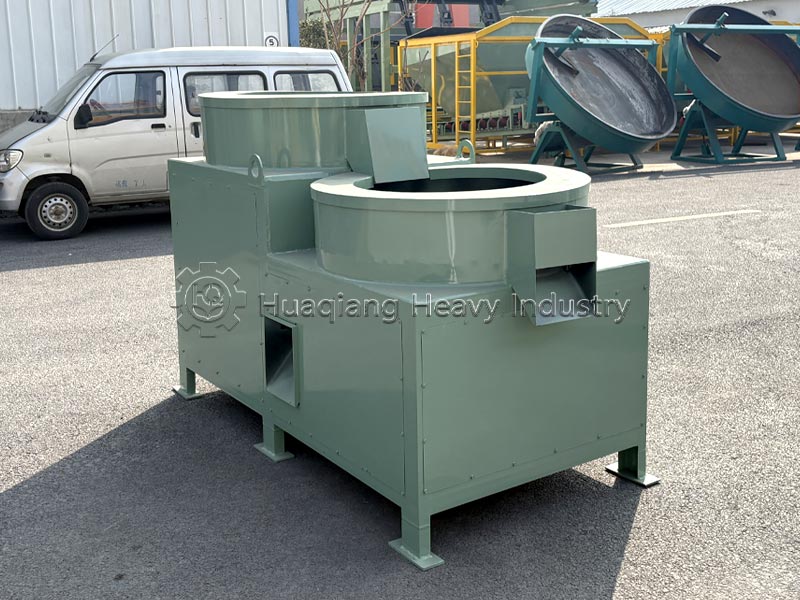
Following the organic fertilizer fermentation process, the composted material requires size reduction before further processing. Several fertilizer raw material processing machinery and equipment options are available. A half-wet material crusher machine is essential for handling the typical moisture content (25-55%) of fermented compost, preventing clogging. For materials requiring different crushing actions, a chain crusher offers robust performance for harder lumps, while a cage crusher provides a finer, more uniform grind ideal for preparing material for granulation. After crushing, the material moves to the shaping stage. For production of high-quality organic granules, an organic fertilizer disc granulation production line is a popular choice. As a space-saving alternative, a new type two in one organic fertilizer granulator combines crushing and granulation functions, offering a compact and efficient solution for smaller-scale operations or specific product requirements, seamlessly completing the transformation from raw compost to valuable fertilizer granules.