
Granulation Problems? Solving the Complete Organic Fertilizer Granulation Dilemma
On organic fertilizer production lines, one of the most troublesome problems is “low granulation rate”—using the same raw materials and formula, the result is a mess: either too much powder, loose and brittle granules, or simply clumped together and impossible to screen. This not only directly lowers the product qualification rate but also means invisible losses of profit. The root cause of low granulation rate often lies in three dimensions: raw materials, equipment, and process. This article will start with five common causes and provide solutions one by one to help you easily solve granulation problems.
Cause 1: Inappropriate Raw Material Moisture Content—Too High and It Sticks, Too Low and It Falls
Moisture is the “soul” of granulation. When the raw material moisture content is too high (above 35%), the material easily sticks to the walls and clumps in the granulation equipment, forming large lumps that cannot be screened; when the moisture content is too low (below 15%), there is insufficient liquid bridging force between the granules, making granulation difficult, and even if granules are formed, they are easily broken.
Solution: Equip with online moisture detection methods. If the moisture content is too high, dehydration equipment (such as a screw extruder) can be added during the pretreatment stage, or the natural drying time can be extended. If the moisture content is too low, an automatic spraying device can be installed in the mixing stage to evenly replenish the moisture to a suitable range (usually 25%-30%). For pure organic materials, this range needs to be finely adjusted according to the fiber content.

Reason Two: Raw Material Not Finely Crushed – Coarse Particles Difficult to Bind
Particle formation depends on the close contact between fine powders. If there are too many coarse particles in the raw material (such as incompletely crushed straw segments or clumps of raw and auxiliary materials), the gaps between these “skeletons” are too large, and the binder cannot effectively fill them, resulting in insufficient particle strength and a large amount of breakage during screening.
Solution: Replace or add a semi-wet material crusher. This type of equipment is specifically designed to handle materials with a moisture content of 20%-50%, using a dual-stage rotor or screenless design to prevent clogging. It can crush fermented chicken manure, cow manure, etc., to a fineness of over 60 mesh in one pass. The surface area of the crushed material increases, the intermolecular forces are strengthened, and the granulation rate naturally improves. It is recommended to add a vibrating screen after crushing to ensure the fineness meets the standard before entering the granulation stage.
Reason 3: Inappropriate Granulator Parameters – Equipment Isn’t Just a “One-Turn” Solution
Many users believe that a granulator only needs to be powered on to produce good granules, but this is not the case. The disc tilt angle, rotation speed, and scraper position of a disc granulator, as well as the roller pressure and feeding speed of an extrusion granulator, all directly affect the forming effect. For example, an excessively large disc tilt angle will cause the material to stay in the disc for too short a time, resulting in premature discharge before it can form granules; an excessively small tilt angle will cause the material to accumulate too thickly, leading to uncontrolled particle size.
Solution: Equipment debugging is a “technical task.” The disc tilt angle of a disc granulator is usually adjustable between 35° and 55°, and the rotation speed is generally controlled between 10-20 rpm. The optimal combination needs to be determined through repeated experiments based on the material characteristics and target particle size. It is recommended that during the equipment installation and debugging phase, the manufacturer’s technicians provide on-site service, conduct trial runs with the raw materials on site, find the most suitable parameter combination, and train operators on the adjustment methods.
Reason 4: Improper Binder Ratio – Organic Matter Also Needs “Glue”
Pure organic materials (such as well-rotted chicken manure and mushroom residue) contain some colloidal substances, but sometimes their natural viscosity is insufficient, especially for high-fiber materials like cow manure and straw. If one blindly pursues “purely natural” and ignores necessary formula adjustments, the molding rate will be difficult to meet standards. Furthermore, some users arbitrarily add clay in compound fertilizer production, which may affect the organic matter content.
Solution: For pure organic fertilizer, a dedicated organic fertilizer granulator (such as a stirring tooth granulator) can be used. Its principle is to use high-speed rotating stirring teeth to generate mechanical extrusion force, causing the materials to naturally bind together through frictional heating. No additional binder is needed, and the molding rate can still be stably maintained above 90%. For compound organic fertilizers that require the addition of inorganic nutrients, bentonite, starch, and other natural binders should be thoroughly premixed with the main materials in a horizontal mixer to ensure uniform distribution of the “glue.” The mixing time is generally controlled within 3-5 minutes; excessively long mixing times may cause the materials to overheat and clump.
Reason 5: Imbalanced Carbon-to-Nitrogen Ratio of Raw Materials – Microbial “Strike” Leading to Loose Structure
This point is often overlooked. When the carbon-to-nitrogen ratio of the raw materials is too high (e.g., pure straw), microbial activity is slow during fermentation, organic matter decomposition is incomplete, and the composted material has a loose structure and lacks stickiness. When the carbon-to-nitrogen ratio is too low (e.g., pure chicken manure), fermentation is too vigorous, nitrogen loss occurs, which also affects pelleting performance.
Solution: Before fermentation, use a twin-shaft mixer to evenly mix high-carbon raw materials (straw powder, rice husks) with high-nitrogen raw materials (livestock manure) in a specific ratio, adjusting the carbon-to-nitrogen ratio to the ideal range of 25:1-30:1. This not only helps with sufficient fermentation but also improves the physical structure of the composted material, giving it better pelleting characteristics.
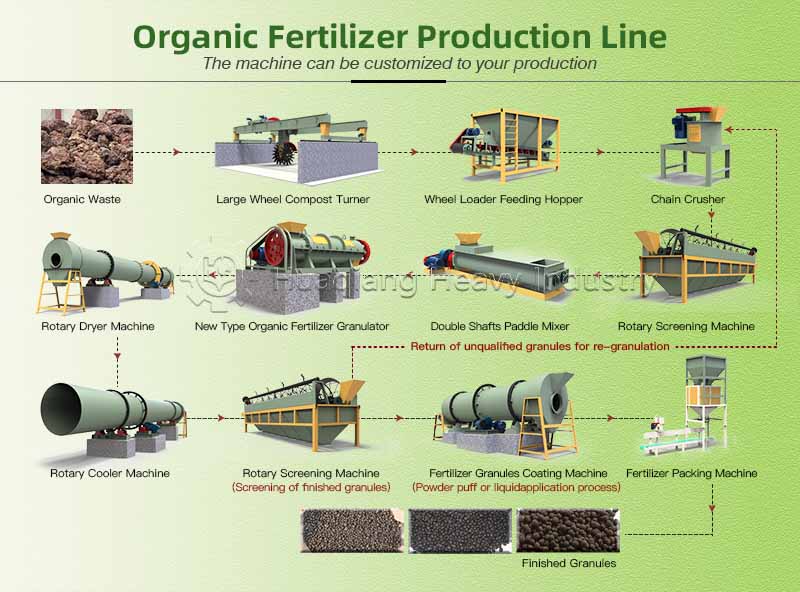
Post-Failure Remediation: Screening and Returning Material for Pellet Reuse
Even with the best efforts at the front end, substandard pellets are still inevitable during production. Don’t despair! Separate the powder and broken particles using screening equipment and return them to the pelletizer for reprocessing, achieving the recycling of raw materials. A three-layer vibrating screen is recommended: the upper layer removes oversized particles (which can be crushed and reused), the middle layer collects qualified finished products, and the lower layer screens out fine powder (which is directly returned to the granulation stage). This not only avoids waste but also increases the overall raw material utilization rate to over 98%.
The systematic troubleshooting of low granulation rates underscores that successful organic fertilizer production granulation is the result of a perfectly orchestrated system, where every piece of organic fertilizer production equipment plays a critical role. The journey begins with proper raw material preparation, where a half-wet material crusher machine is indispensable for processing fermented materials to the ideal fineness, addressing the root cause of coarse particles. This uniformly prepared feedstock is then ready for the shaping stage, where the choice from the organic fertilizer granulator series is pivotal. For producing premium spherical granules, a complete organic fertilizer disc granulation production line is a classic and effective choice, with its adjustable parameters for disc angle and speed. For operations seeking a compact, versatile solution, a new type two in one organic fertilizer granulator can combine the final stages of crushing and initial granulation, streamlining the process. In a dedicated bio organic fertilizer production line, where preserving microbial activity is paramount, the choice of gentle granulation technology is even more critical. The integration of the right organic fertilizer raw material processing equipment with a properly configured granulator—whether a classic disc or an innovative two-in-one model—is the key to transforming consistent, high-quality raw materials into the uniform, high-value granules that command a premium in the market.
From precise moisture control to strict control of crushing fineness, and meticulous adjustment of equipment parameters—improving the granulation formation rate is essentially about refined management of the entire production process. When you see trays of smooth, uniform granules pouring off the production line, you’ll understand that behind every “difficulty” lies a path to “ease.” Choosing the right equipment and using the right methods will eventually make the problem of poorly formed granules a thing of the past.