
Hydraulic Roller Press Granulator: The Art of Precision Forming Under High Pressure?
Overview: The Dry-Forming Revolution Without Binders
In industries such as fertilizers, metallurgy, chemicals, and ceramics, directly converting powdered materials into high-strength, regularly shaped granules has always been a critical production step. The hydraulic roller press granulator, an outstanding representative of modern dry-forming technology, abandons the complex steps of adding water, binders, or applying heat required in traditional granulation processes. It relies purely on immense mechanical pressure to “cold-press” dry powder into dense sheets or pillow-shaped briquettes through a pair of precisely matched rollers, which are then crushed and screened to obtain uniform granules. This technology, characterized by high efficiency, energy savings, and high product purity, is leading a quiet revolution in the field of solid-state forming.
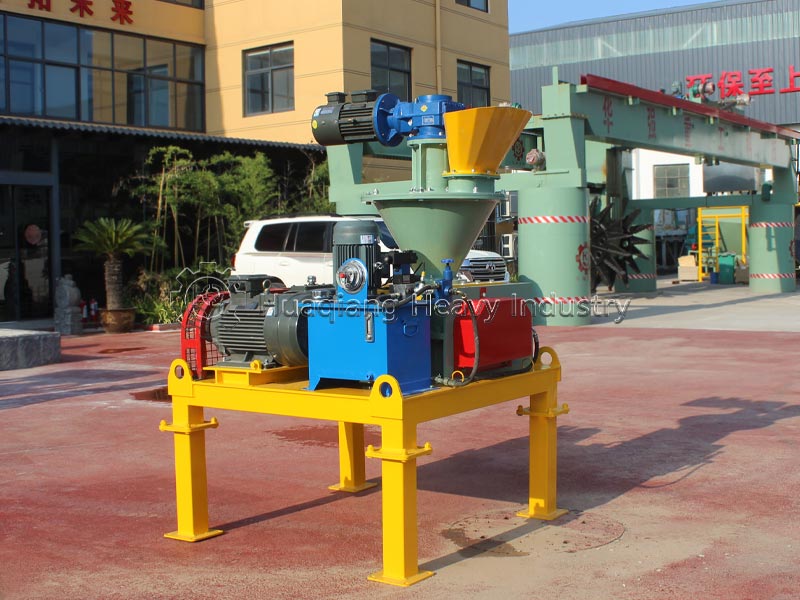
Core Principle: The Scientific Fusion of Pressure and Mold
The working principle of a hydraulic roller press granulator is essentially the engineering application of hydrostatic pressure forming. The process involves no chemical changes, only a physical transformation o
Detailed Four-Step Forming Process:
Controlled Feeding: Precisely metered dry powder is fed evenly and continuously into the nip area between two parallel rollers via a screw feeder or gravity feeder.
High-Pressure Compaction: This is the core step. Driven by a powerful hydraulic system, two counter-rotating rollers (one fixed, one horizontally floating) apply an extremely high linear pressure (typically 50-300 MPa) to forcibly compact the captured powder. The material undergoes three zones within the roller gap (roll nip):
Feed Zone: Material is drawn in.
Compression Zone: Pressure increases dramatically, air between particles is expelled, and the particles themselves undergo plastic deformation or brittle fracture, bonding tightly together through intermolecular forces.
Forming Zone: The material reaches maximum density and is pressed into a continuous sheet with a specific shape (e.g., oval, pillow-shaped) according to the pockets engraved on the roller surface.
Demolding & Discharge: The formed sheet naturally detaches from the pockets as the rollers rotate and discharges under gravity.
Crushing & Sizing: The discharged continuous sheet is usually very dense and needs to be fed into a chain crusher or fine breaker for gentle. It is then screened by a vibrating screen to separate granules meeting the size requirements. Oversized particles return to the crusher, while undersized fines are recycled back to the feeding system, forming a closed-loop production.
Core Structure: The Vessel of Force and Precision
A high-performance hydraulic roller press granulator is a complex mechatronic and hydraulic integrated system:
Roller Assembly: The core working component.
Rollers: Typically made of high-hardness, high-wear-resistant alloy steel (e.g., 60CrMnMo), with surfaces specially heat-treated (e.g., quenching, carburizing). The roller surface is machined with precisely arranged pockets, whose shape and size directly determine the of the finished granules.
Accumulators: Used to cushion pressure shocks, maintain stable rolling pressure, and protect mechanical components.
Control System: Through pressure sensors and PLC, it enables precise pressure setting, automatic compensation, and overload protection. This is key to ensuring stable forming quality and operational safety.
Drive System: Consists of the main motor, reducer, gearbox, and universal joints, driving the two rollers to rotate synchronously and counter-rotating.
Feeding System: Ensures material is fed evenly, stably, and adjustably into the roll nip, preventing and pressure fluctuations.
Electrical Control System: Integrates automated control for one-touch start/stop, parameter setting, fault diagnosis, and data logging.
Performance Advantages: Why Choose a Hydraulic Roller Press?
Compared to traditional wet or semi-wet processes like drum granulation,or pan granulation, hydraulic roller press granulators hold overwhelming advantages in specific application scenarios:
| Comparison Dimension | Hydraulic Roller Press (Dry Process) | Rotary Drum Granulator (Wet Process) |
| Process Principle | High-pressure dry compaction, pure physical process | Liquid-phase bonding + rolling agglomeration, physico-chemical combination |
| Product Characteristics | High granule density, great strength, controllable dissolution, no internal pores | Porous granules, lower strength, fast dissolution |
| Raw Material Requirements | No need for binders or water, high product purity | Requires water or binders, may introduce impurities |
| Energy Consumption | Very Low, only requires mechanical energy, no drying process | Very High, requires evaporating |
| Environmental Impact | No wastewater or exhaust gases, green | Potential process wastewater and dust emissions |
| Suitability | Suitable for heat-sensitive, moisture-sensitive, or slow-release materials | Suitable for, fast-dissolving fertilizers or chemicals |
Summary of Core Advantages:
Exceptional Product Performance: Produces granules with high true specific gravity and extremely high mechanical strength (up to 20-50N), long-distance transport, mechanical application, and fertilizers requiring slow release (e.g., controlled/slow-release fertilizers).