
Organic Fertilizer Disc Granulation Production Line: Core Advantages and Configuration Points
The organic fertilizer disc granulation production line is a classic configuration for small- to medium-scale organic fertilizer production. With its high granulation rate, stable operation, and wide material adaptability, this production line has become the preferred choice for many enterprises and farms worldwide. Centered on a disc granulator, this production line integrates raw material pretreatment, mixing, granulation, drying, screening, and packaging into a closed-loop process. It can efficiently process materials such as decomposed manure, straw residue, mushroom waste, and municipal sludge, producing uniform, high-strength spherical pellets.
Core Advantages: Precision and Efficiency
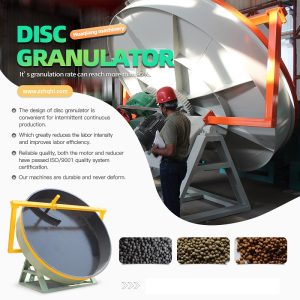
The core advantage of this production line lies in the precise control of the disc granulator. By adjusting the disc inclination angle (typically 35°-55°), rotation speed (10-20 rpm), and liquid binder spraying amount, operators can precisely control the pellet size, keeping it within the optimal range of 2-5 mm. The granulation rate consistently exceeds 90%, with high pellet uniformity, minimizing the need for secondary screening and maximizing raw material utilization.
Unlike high-temperature extrusion, disc granulation is performed at room temperature, preserving the activity of beneficial microorganisms in bio-organic fertilizers. The rolling action produces aesthetically pleasing, smooth spherical granules, a significant advantage in the high-end market. Furthermore, the equipment is simple in structure, low in energy consumption (8-12 kW·h per ton), and requires very little maintenance, making it highly cost-effective for small-scale production enterprises.
Complete Production Line Configuration: From Raw Materials to Finished Products
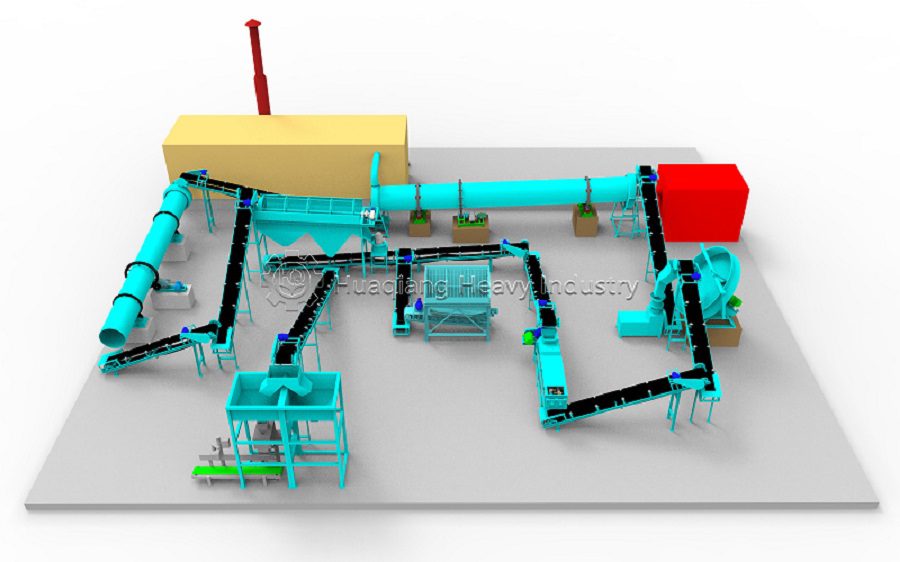
A well-designed disc granulation production line follows the principle of “capacity matching and process integration.” A typical configuration includes:
- Raw Material Pretreatment: Fresh or well-rotted organic materials typically have a moisture content between 30% and 50%. A semi-wet material crusher is crucial for crushing these materials to a particle size of ≤3 mm to ensure uniformity in subsequent granulation. This step is critical—oversized particles lead to uneven particle size and reduced forming rate.
- Mixing: The pretreated material enters a horizontal or vertical mixer for thorough mixing with binders (if necessary) and any other functional ingredients. Proper mixing ensures uniform particle formation and nutrient distribution.
- Disc Granulation: The mixed material is continuously fed into a disc granulator. Under the action of centrifugal force and friction, the fine particles roll and agglomerate into spherical particles. Operators monitor the process and adjust parameters to maintain optimal particle size and yield.
- Drying (Optional): While some applications allow natural air drying, most commercial production requires the use of a rotary dryer to reduce the moisture content to below 15%. Temperature control is crucial—excessive temperatures can kill beneficial microorganisms in the organic fertilizer.
- Screening: The dried granules pass through a vibrating screen. Products with a suitable particle size (typically 2-5 mm) proceed to the packaging stage, while oversized particles are crushed and returned to the granulator, and fine powder is recycled.
- Packaging: The finished granules are weighed and bagged by an automatic packaging machine for storage or shipment. III. Application Scenarios and Customization
This disc granulation production line has a capacity of 0.5 to 5 tons per hour and is suitable for annual production of 1,000 to 50,000 tons. It is ideal for farms processing their own manure, start-up fertilizer companies, or specialized producers serving local markets. The line can accommodate various raw materials and can produce general agricultural fertilizers or crop-specific formulations for fruits, vegetables, and cash crops.
Layout and Environmental Considerations
When planning the installation, ensure smooth material flow between equipment to minimize manual operation. Sufficient space should be reserved for maintenance. For outdoor installations, consider constructing sheltered structures to protect the equipment from weather. Basic dust removal systems (cyclone separators or bag filters) and deodorization measures (biofilters or chemical scrubbers) help comply with environmental regulations.
The organic fertilizer disc granulation production line achieves an optimal balance between economy, efficiency, and product quality. Its precise control over particle size, high forming rate, and ease of operation make it an ideal entry point for organic fertilizer production. With proper configuration and operation, this production line can transform agricultural waste into valuable, marketable products, thereby contributing to environmental sustainability and improving farm profitability.
The organic fertilizer disc granulation production line is a cornerstone of the broader organic fertilizer granulator series, offering a proven and efficient method for producing premium spherical pellets. Central to this line is the disc granulator machine, whose adjustable parameters allow for precise control over particle size and quality. However, the performance of this core organic fertilizer production equipment is entirely dependent on the quality of the feedstock it receives. This is where specialized organic fertilizer raw material processing equipment becomes critical. A half-wet material crusher machine is essential for processing the typical 30-50% moisture content of fermented manure and compost, ensuring a consistent particle size that feeds uniformly into the disc granulator machine. For operations seeking to optimize space and streamline the process, an innovative alternative within the organic fertilizer granulator series is the new type two in one organic fertilizer granulator. This versatile machine can combine the final stages of crushing with the initial granulation, offering a compact solution for producers. Ultimately, the most successful organic fertilizer disc granulation production line is one where every component, from the primary half-wet material crusher machine to the final disc granulator machine, is carefully selected and integrated to work in harmony, transforming raw, variable waste into a consistent, high-value granular product.