
A Comprehensive Analysis of Organic Fertilizer Raw Material Processing Equipment: A Crucial Step from Pretreatment to Fermentation
In organic fertilizer production, raw material pretreatment is the core step determining subsequent fermentation efficiency and granulation quality. Whether it’s livestock manure, straw, or food waste, untreated raw materials either have excessively high moisture content, excessively long fibers, or are mixed with impurities, directly leading to prolonged fermentation cycles and loose, brittle granules. A precisely matched raw material processing equipment system can improve fermentation efficiency by more than 30%. This article will deeply analyze the functions and adaptation techniques of four core processing equipment categories: crushing, screening, mixing, and dehydration.
Organic fertilizer raw material processing equipment can be summarized into four functional modules: crushing equipment is responsible for finely crushing the material, providing a larger contact area for microorganisms; screening equipment removes impurities, ensuring the purity of the raw material; mixing equipment adjusts the carbon-nitrogen ratio and moisture, creating optimal fermentation conditions; and dehydration equipment controls the moisture content, preventing excessive moisture and clumping. These four components work together to construct a closed-loop pretreatment process from “waste” to “raw material.”
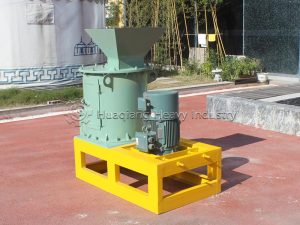
Half-wet material crusher: The nemesis of livestock and poultry manure and food waste. The half-wet material crusher is a core piece of equipment for processing raw materials with a moisture content of 25%-60%, such as livestock and poultry manure, kitchen waste, and food processing waste. It adopts a dual-shaft shearing structure, with blades forged from high-wear-resistant alloy steel. It can crush viscous, fibrous wet materials to a fineness of 5-15mm while preventing material blockage. For materials with an initial moisture content exceeding 70%, such as fresh cow manure and chicken manure, it is recommended to pre-dehydrate them to below 60% using a screw extruder before processing in the crusher. The equipment is equipped with variable frequency speed control, which can adjust the speed according to the material’s moisture content, ensuring both crushing effect and energy saving.
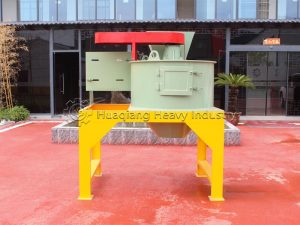
Chain crusher: The ideal choice for straw and fibrous raw materials. Fiberous raw materials such as straw, rice husks, and mushroom residue require a chain crusher or hammer mill. The chain crusher uses a high-speed rotating chain to crush long fibers to 2-5mm, meeting the requirements for uniform mixing while preventing entanglement in the equipment. For long straws such as corn stalks and wheat stalks, it is recommended to first chop them into 10-20cm sections using a chaff cutter before feeding them into a chain crusher for further crushing. The screen mesh size can be selected according to the requirements of subsequent processes; 4-6mm screens are typically chosen for granulation raw materials.
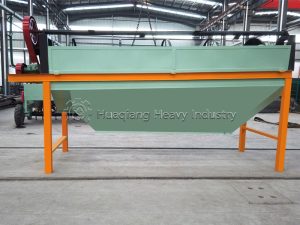
Screening Machine: A Key Barrier to Impurity Removal
Impurities such as stones, nails, and plastic fragments mixed in the raw materials not only affect the uniformity of fermentation but may also damage subsequent granulation equipment. A drum screen is the preferred equipment for removing large impurities. The screen body is installed at an angle, and the material is graded during rotation: fine materials (≤8mm) enter the next process, while coarse materials are discharged from the end. For raw materials containing a high amount of impurities, a permanent magnet drum can be installed at the front end of the screen to adsorb ferrous metals and prevent damage to the blade assembly.
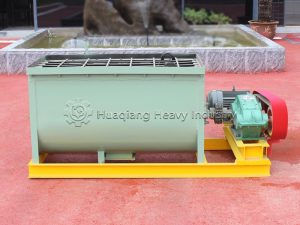
Horizontal Mixer: A Platform for Precise Adjustment of the Carbon-Nitrogen Ratio
The core of fermentation lies in the precise control of the carbon-nitrogen ratio (C/N) of 25-30:1. The horizontal twin-shaft mixer mixes high-carbon raw materials (straw, rice husks) and high-nitrogen raw materials (livestock and poultry manure) in a calculated ratio, while simultaneously adding microbial agents and auxiliary materials to achieve uniform material distribution. The mixing time is 3-5 minutes, aiming for uniform material color and no lumps. An optional spray system can be added to the equipment to simultaneously adjust the moisture content to 55%-65% during the mixing process.
Equipment adaptation schemes for different raw materials: For processing livestock and poultry manure, the standard configuration is: screw extruder dewatering machine (moisture content 70%→55%) → high-moisture material crusher (fineness ≤10mm) → horizontal mixer (+straw C/N adjustment). For processing straw raw materials, the configuration is: chaff cutter (cutting to 10-20cm) → chain crusher (fineness ≤5mm) → horizontal mixer (+manure C/N adjustment). For mixed waste such as fruit and vegetable waste and food scraps, the following equipment is required: vibrating screen (to remove packaging) → high-moisture material crusher (fineness ≤15mm) → screw press dewatering machine (moisture content reduced to below 60%).
The precise matching of crushing, screening, mixing, and dehydration equipment forms the essential organic fertilizer raw material processing equipment system. The output from this system—a uniform, finely crushed, and optimally conditioned feedstock—is the ideal foundation for the next critical stage: organic fertilizer production granulation. This prepared material is perfectly suited for the wide range of organic fertilizer production equipment in the organic fertilizer granulator series. For producing premium spherical granules, a complete organic fertilizer disc granulation production line is a classic and effective choice, centered on a disc granulator machine. For operations seeking a compact, streamlined workflow, an innovative new type two in one organic fertilizer granulator can combine the final stages of conditioning and initial granulation. The synergy between the upstream organic fertilizer raw material processing equipment—such as the half-wet material crusher machine—and the chosen granulation technology is fundamental. By ensuring the feedstock is perfectly prepared, this integrated system enables the granulator to operate at peak efficiency, producing uniform, high-strength granules that are ready for the market.