
High-Moisture Raw Material Clog-Free Operation: A Complete Practical Guide to Semi-Moist Material Crusher
In organic fertilizer production, fermented chicken and cow manure are the most common raw materials. However, their high moisture content (30%-50%) deters countless crushers – ordinary equipment either experiences frequent screen clogging and shutdowns, or the blades become entangled and unable to operate, significantly reducing production efficiency. Huaqiang Heavy Industry’s semi-moist material crusher was designed to solve this problem and is hailed as the “nemesis of high-moisture raw materials.” This article will provide a complete breakdown of how to effectively use this core piece of equipment, from raw material pretreatment and equipment operation techniques to post-crushing process adaptation and daily maintenance, ensuring that high-moisture materials no longer become a stumbling block to production.
Raw Material Pretreatment: Good Crushing Starts with “Feeding”
Even the best equipment needs the right “ingredients” to perform at its best. While the semi-moist material crusher specializes in high-moisture raw materials, proper pretreatment can double its efficiency.
Optimal Moisture Content: 30%-50% is the ideal operating range for the equipment. Judging by feel: When you squeeze the material tightly in your hand, it should feel moist between your fingers but no water drips. After releasing your hand, the material should clump together but crumble easily with a light touch. If the moisture content is too high (over 55%), you can add some dry material or extend the drying time. If the moisture content is too low (below 25%), there will be more dust during crushing; you can spray water to adjust the moisture content.
“Break up” large pieces of material first: Fermented cow dung often has large, compacted pieces. It is recommended to break it into pieces smaller than 20 cm manually or with simple tools to avoid clogging the feed inlet by feeding in too large pieces at once. This is especially important during the initial feeding.
Prevent hard objects from “mixing in”: Stones, nails, screws, and other debris are the “number one killer” of crushers. It is recommended to install a magnetic separator on the feed conveyor belt, or at least install a grating at the feed inlet to ensure these “uninvited guests” are blocked. An unexpected shutdown of a crusher is often caused by a small piece of iron.
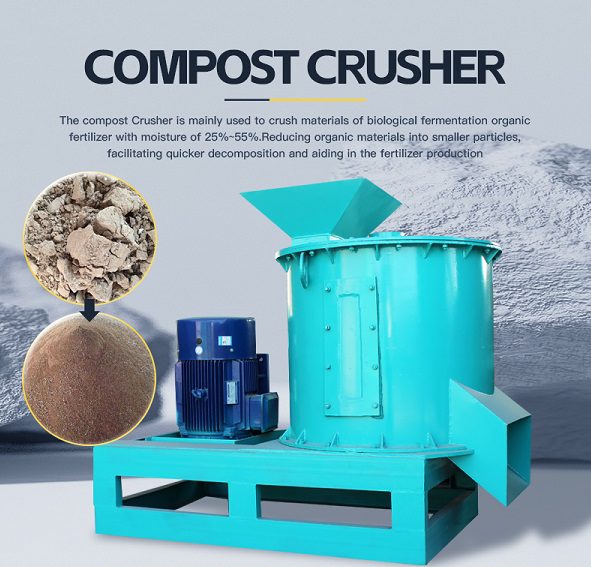
Key Points for Equipment Operation: Ensuring Optimal Machine Performance
Correct operating habits are the guarantee of efficient equipment operation. While the design of Huaqiang Heavy Industry’s semi-wet material crusher fully considers user convenience, the following points still require special attention:
Check Blade Gap Before Start-up: The gap between the blades and the liner directly affects the fineness and efficiency of the crushing process. For high-moisture materials, it is recommended to appropriately increase the gap (approximately 5-8 mm) to ensure passage while preventing excessive material compression into cakes. Huaqiang equipment is equipped with a one-button adjustment device, allowing users to adjust the gap within 30 seconds according to material characteristics, without the need for specialized tools.
Feeding Requires a “Uniform Speed and Small Amount”: Many users increase the feed rate drastically to increase output, resulting in the opposite effect—material accumulates inside the machine, leading to excessive instantaneous load and even machine stall. The correct approach is to start the equipment and let it idle for 30 seconds until it runs smoothly, then feed material evenly and continuously, maintaining a feed rate that matches the equipment’s processing capacity. Observe the ammeter reading; controlling it within 80%-90% of the rated current is the optimal operating range.
Selecting the right speed is crucial: For highly viscous chicken manure, a medium-low speed is recommended (the equipment has three adjustable speeds: high, medium, and low) to reduce intense friction and heat generation between the material and the blades, preventing moisture evaporation and increased stickiness due to temperature rise. For cow manure with more fiber, a high speed can be selected to use impact force to tear the fibers.
Handling blockages in three steps: In case of minor blockage, do not blindly poke with an iron rod. The correct steps are: ① Immediately stop feeding; ② Keep the equipment idle for 1-2 minutes to allow the material inside to drain naturally; ③ If the blockage persists, stop the machine, open the cleaning door, manually remove the blockage, identify the cause, and then restart.
III. Adapting the crushed material to the next process: Paving the way for the next stage
The semi-wet material crusher not only solves the problem of “difficult crushing,” but also creates excellent conditions for the subsequent granulation stage.
The ideal fineness is controlled between 20-40 mesh: Particles in this range have sufficient specific surface area to ensure adhesion, but are not too fine and will absorb moisture too quickly. Experience shows that materials processed by a semi-wet material crusher can directly enter a disc granulator or a stirring tooth granulator without additional drying or binder addition. After using Huaqiang equipment, a farm achieved uniform and stable chicken manure crushing fineness, and the pelletizing rate of the matching granulator increased from 65% to over 95%, significantly improving product qualification rates and reducing monthly return material processing costs by nearly 10,000 yuan.
Perfect Moisture Retention: Traditional crushers often experience drastic temperature rises, leading to significant moisture evaporation from the material, requiring subsequent water addition for granulation. The semi-wet material crusher, however, uses low-temperature crushing technology, controlling moisture loss during crushing to within 3%, with the output moisture content essentially equal to the input moisture, directly meeting the moisture requirements for granulation and eliminating an adjustment step, truly achieving seamless “crushing-granulation” integration.
Daily Maintenance: The Secret to Extending Equipment Lifespan
Clean Three Areas Per Shift: After each shift, inspect and clean three key areas: the blades, the inner wall of the machine casing, and the discharge port to prevent residual material from fermenting and corroding the equipment.
Regularly inspect worn parts: Blades and liners are wear parts, and it is recommended to check their wear weekly. When the blade edge becomes dull or the liner develops obvious grooves, it should be replaced or reversed immediately. Huaqiang equipment blades are made of high-chromium alloy, which has 3-5 times the wear resistance of ordinary steel and can be used on both sides, doubling their lifespan.
Don’t neglect bearing lubrication: Add grease to the bearing housing every 200 hours of operation; clean the bearings and replace the grease every 1000 hours of operation. Remember: more lubrication is not better; moderation is key, as excessive lubrication can lead to overheating.
Seasonal maintenance: Before the rainy season, check the moisture-proof seals of the motor and control cabinet; before winter shutdown, thoroughly clean the materials inside the machine to prevent freezing and cracking of parts.
By correctly using a semi-wet material crusher, you have mastered the core techniques for handling high-moisture raw materials. When the pulverized material flows smoothly and evenly into the next process, when the granulation rate steadily increases, and when the production line no longer frequently stops due to blockages—you will find that choosing the right equipment is only the first step, and using the right equipment is the real productivity booster.
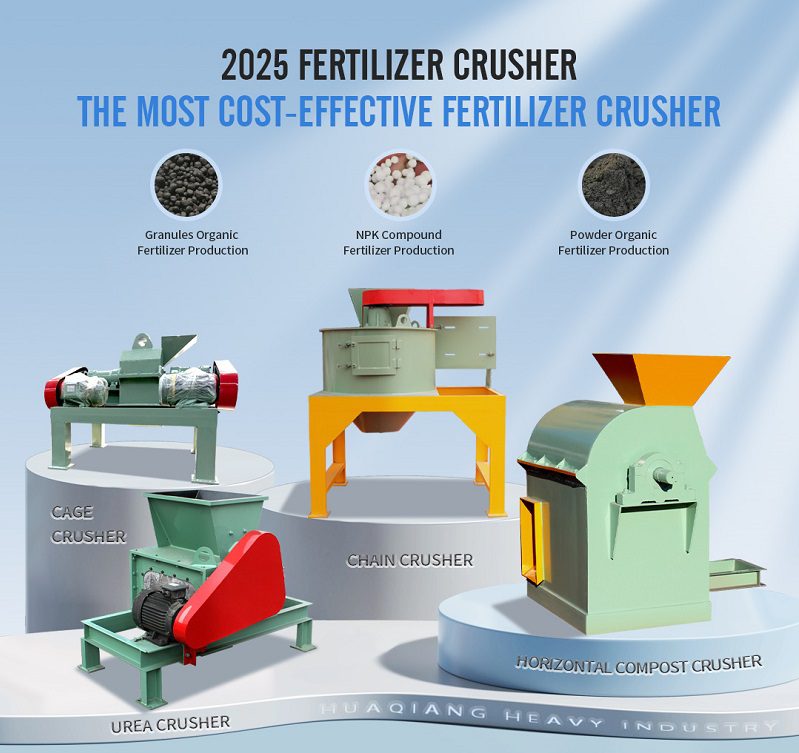
The half-wet material crusher machine is a critical component within the broader category of fertilizer raw material processing machinery and equipment. Its ability to handle fermented organic materials with 30%-50% moisture content makes it the ideal “first step” in preparing material for granulation. The uniformly crushed output, with its optimal 20-40 mesh fineness and retained moisture, is perfectly conditioned for the next stage: organic fertilizer production granulation. This prepared powder can be fed directly into a range of equipment within the organic fertilizer granulator series. For producing premium spherical granules, a complete organic fertilizer disc granulation production line is an excellent choice. As an innovative, space-saving alternative, a new type two in one organic fertilizer granulator can combine the final crushing and initial granulation steps, offering a streamlined solution for processing high-moisture organics. For drier materials or those with harder lumps, a chain crusher or cage crusher might be used earlier in the process. This integrated approach—from the specialized half-wet material crusher machine to the final granulator—ensures that even the most challenging high-moisture raw materials are efficiently transformed into high-value organic fertilizer granules.