
Palm Fruit Bundle Regeneration: Empty Fruit Bundles as Organic Fertilizer for Soil Improvement
What are Empty Palm Fruit Bundles?
Empty palm fruit bunches are the fibrous fruit clusters remaining after the palm fruits have been steamed and threshed during the palm oil extraction process. Approximately 0.2 to 0.25 tons of empty fruit bunches are produced for every ton of palm oil produced. These materials have a moisture content of about 60% to 70%, a cellulose content as high as 40% to 50%, a hemicellulose content of 20% to 25%, and a lignin content of 15% to 20%, with a carbon-to-nitrogen ratio as high as 70:1 to 100:1, making them extremely slow to decompose naturally. If left untreated, accumulation or incineration will cause serious environmental problems. However, through mechanical processing and microbial fermentation, empty fruit bunches can be transformed into high-quality organic soil conditioners.
The Three-Step Conversion Process for Empty Fruit Bundle Organic Fertilizer
The core challenge in making fertilizer from empty fruit bunches lies in the hard fibers and the excessively high carbon-to-nitrogen ratio. The complete processing flow includes three essential steps:
Step 1: Physical Crushing. Fresh empty fruit bunches are typically 30 to 50 centimeters long, with coarse and hard fiber bundles that cannot be directly fermented. The material needs to be processed by a twin-shaft shear crusher to cut it into fragments of 1 to 5 centimeters. Two-stage crushing is recommended—coarse crushing to cut the empty fruit bunches, and fine crushing to further pulverize the fibers. The bulk density of the crushed material can be increased from 80 kg/m³ to 180 to 250 kg/m³, facilitating subsequent stacking and turning.
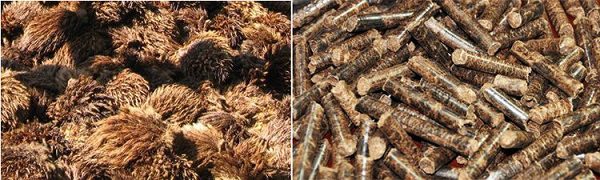
Step Two: Carbon-to-Nitrogen Ratio Adjustment and Fermentation. The carbon-to-nitrogen ratio of empty fruit bunches is as high as 80:1 or more, while the ideal ratio for aerobic microbial fermentation is 25:1 to 30:1. 20 to 30 kg of nitrogen source (poultry manure or urea) needs to be added per ton of empty fruit bunches for adjustment. The crushed empty fruit bunches are mixed with the nitrogen source and composted return material in the correct proportions, and stacked in windrows (3 to 5 meters wide and 1.2 to 1.5 meters high). A mobile turner is used to turn the material every 3 to 5 days. The mixture is heated to 55 to 65 degrees Celsius within 48 hours and maintained at this high temperature for 10 to 15 days. Because of the tough fiber structure of hollow fruit bunches, the fermentation cycle requires 25 to 35 days, which is 1.5 to 2 times longer than conventional livestock and poultry manure fermentation.
Step 3: Secondary crushing and screening. After fermentation, the fibers of the hollow fruit bunches have partially degraded but still retain elasticity. They need to be crushed again using a semi-wet material crusher, ensuring that over 90% of the material passes through a 3 to 5 mm screen, forming a uniform, dark brown fibrous organic material. Screening equipment with a 2 to 4 mm aperture is used; the undersize material becomes the finished soil conditioner, while the oversize material (incompletely decomposed coarse fibers) is returned to the fermentation tank for further processing.
Mechanism of Soil Physical Property Improvement: Hollow fruit bunch organic fertilizer has a significant improvement effect on the infertile red soil and sandy soil commonly found in tropical regions. Its high cellulose and lignin content slowly decomposes in the soil, playing the following three roles: Increasing soil organic matter. The organic matter content of hollow fruit bunch organic fertilizer can reach 65% to 75%, which can be continuously utilized by microorganisms after application to the soil, promoting the formation of aggregate structure. Field data show that continuous application for two seasons (10 tons per hectare) can increase the organic matter content in the 0-20 cm topsoil layer from 1.2% to over 2.0%.
It improves soil water and fertilizer retention capacity. The porous structure of the hollow fruit bunch fiber, when applied to sandy soil, can increase field water holding capacity by 15% to 25%. Simultaneously, its cation exchange capacity reaches 30 to 40 centimoles per 100 grams, exhibiting strong adsorption capacity for potassium, calcium, and magnesium cations, reducing leaching losses.

It alleviates soil acidification. Long-term application of chemical fertilizers in palm-growing areas has led to a general drop in soil pH to 4.0 to 4.5. The decomposition of the hollow fruit bunch organic fertilizer produces alkaline substances, which can raise the soil pH by 0.3 to 0.6 units, while simultaneously replenishing exchangeable calcium and magnesium.
A production line for organic fertilizer from empty fruit bunches with an annual output of 5,000 tons (processing approximately 8 to 10 tons of empty fruit bunches per day) includes the following equipment: a twin-shaft shear crusher (coarse crusher + fine crusher), a mixer, a mobile turning machine (or 2 to 3 fermentation tanks with a trough-type turning machine), a semi-wet material crusher, a drum screen, and an automatic packaging scale. In major palm oil producing areas such as Indonesia and Malaysia, such projects can also apply for special subsidies for waste resource utilization.
Closing the Loop from Palm Oil Waste to Soil Fertility
Converting Oil palm empty fruit bunch (OPEFB) from an environmental liability into a high-value soil conditioner exemplifies how purpose-built organic fertilizer machine systems can address both waste management and agricultural productivity challenges. The three-step processing flow—twin-shaft shear crushing, C:N ratio-adjusted fermentation with nitrogen supplementation, and secondary crushing-screening—transforms recalcitrant, high-cellulose biomass into dark brown, friable organic matter with 65–75% organic content. For operators scaling to commercial output, a dedicated organic fertilizer manufacturing plant integrates these units with automated packaging, creating a continuous pipeline that processes 8–10 tons of raw EFB daily. The nitrogen source required for C:N balancing can be sourced from an on-site Animal manure processing machine or chicken manure fertilizer machine workflow, creating synergistic waste-to-value loops across multiple agricultural streams. Where granular products are desired, roller extrusion and a fertilizer drying and cooling machine extend shelf life and enhance marketability. Ultimately, OPEFB-based organic fertilizer does not merely dispose of palm oil residues—it rebuilds acidic, depleted tropical soils, increases water holding capacity by 15–25%, and drives measurable yield improvements, proving that sustainable waste valorization and profitable plantation management are inseparable objectives.