
How the Large Wheel Compost Turning Machine Rules Large-Scale Operations
Look out across a serious composting operation—the kind that handles mountains of material day after day, week after week—and you’ll see something impressive. Windrows stretch to the horizon, neat triangular ridges of organic matter steaming gently in the morning light. And somewhere in that vast landscape, a machine moves with purpose. It’s big. It’s powerful. And it’s absolutely essential.
When Size Actually Matters
Let’s be honest about something: not every operation needs a giant. If you’re running a small farm with a few dozen animals, a tractor-pulled turner or a compact self-propelled model will serve you just fine. But when you’re handling thousands of tons of material annually—when your windrows stretch longer than football fields and your volume demands serious throughput—you need something built for the scale.
That’s where the large wheel compost turning machine earns its keep.
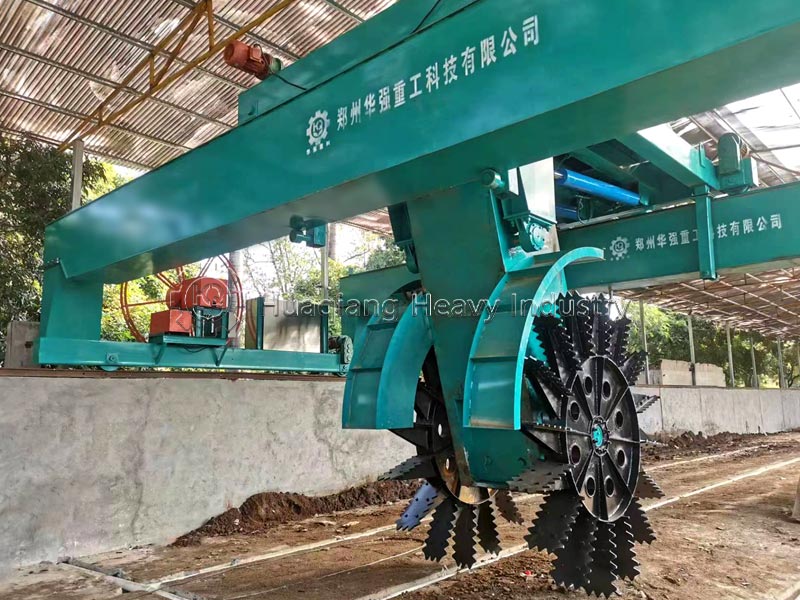
Picture this: a massive steel frame straddling a windrow that stands taller than a man. At its heart, a gigantic drum—sometimes eight feet in diameter or more—studded with heavy-duty tines or paddles. Hydraulics raise and lower the drum to exactly the right depth. A powerful engine, often pushing hundreds of horsepower, provides the muscle. This isn’t a machine that hopes to get the job done. This is a machine that knows it will.
How the Giant Works
The operation is deceptively simple. The machine positions itself at one end of a windrow, lowers its massive drum into the material, and begins to move forward. The rotating drum digs in, lifting the compost, shredding clumps, and throwing it all out the back in a controlled, fluffy arc.
But simple doesn’t mean unsophisticated. As that drum spins, several critical things happen simultaneously:
Oxygen floods the pile. The material gets thoroughly mixed. Particle size reduces as clumps are broken apart. Moisture redistributes evenly throughout the windrow. And all of this happens at a scale that smaller machines simply cannot match.
In a single pass, a large wheel turner can process windrows that are ten feet wide at the base and six feet high. The throughput is staggering—hundreds of tons per hour, depending on conditions and material density. What would take a smaller machine all day, this beast handles before lunch.
The Scale of the Job
Let’s put this in perspective. A large-scale dairy operation with two thousand cows produces an almost unimaginable amount of manure every single day. Add in bedding—straw, sawdust, sand sometimes—and the volume multiplies. Left unmanaged, that material becomes an environmental liability, a neighbor relations nightmare, and a regulatory headache.
But with a large wheel compost turner in the lineup, that same mountain of waste becomes raw material for a profitable product line.
The machine moves methodically along the windrows, turning each one on a schedule that optimizes decomposition. Temperatures climb and hold. Pathogens die. Weed seeds sterilize. Odors fade. And week by week, the material transforms from stinky waste into valuable resource.
Integration with the Full Production Line
After weeks of regular turning—perhaps every few days during the active phase, then less frequently as the material stabilizes—the compost is ready for further processing. A front-end loader moves it from the windrows to the next stage.
First stop: a semi-wet material crusher, reducing any remaining large particles to a consistent size. Then a mixer, ensuring any additional ingredients—specific beneficial microbes, trace minerals, other organic amendments—are evenly distributed throughout the batch.
Now the material enters the granulator. For a top-tier operation, this might be a new type two-in-one organic fertilizer granulator, capable of handling the fibrous, challenging material that comes from large-scale composting. The rotary drum granulator transforms the powdery compost into uniform, spherical pellets with excellent strength and market appeal.
After granulation, a dryer reduces moisture to the ideal level, and a cooler brings the pellets to ambient temperature. A screening machine separates any oversized or undersized granules—the former get crushed and recycled, the latter go back for another pass through the granulator. A coating machine can apply a protective layer to prevent caking and enhance appearance. Finally, an automatic packaging scale fills bags with robotic precision, ready for palletizing and shipment.