
Large Wheel Compost Turner: Monster or Gentle Giant?
You hear it before you see it a deep, grinding rumble that shakes dust off the rafters. Then the machine emerges from behind the windrow: a massive steel frame riding on two spoked wheels, each one taller than a man. This is the large wheel compost turner, and it does not so much flip compost as rearrange mountains.
The windrow stretches down the fermentation yard like a dark brown snake, steaming in the cool morning air. The turner straddles it, its wheels running on the ground outside the pile while a central rotor churns through the heart of the material. But unlike smaller turners that use paddles or screws, this one relies on two enormous wheels fitted with digging teeth. As the wheels rotate, the teeth slice into the windrow, lift the material, and throw it backward in a wide, even arc. The effect is violent and beautiful – a fountain of compost rising and falling like a dark wave.
Behind the turner, the rest of the production line waits. A chain crusher stands ready to break down any oversized clumps. A vibrating screen will later separate fine humus from coarse fibers. And at the far end, a disc granulator spins slowly, turning the mature compost into uniform pellets. But none of those machines can do their job if the compost is not fully stabilized. The large wheel turner ensures that every gram of material gets oxygen, loses excess moisture, and reaches the right temperature not too hot, not too cold.
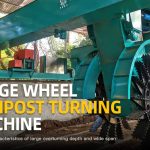
Installation day was a heavy lift. The two wheels arrived on separate flatbed trucks, each one weighing nearly two tons. A mobile crane hoisted them into position while fitters bolted the central frame together. The alignment had to be perfect a difference of even five millimeters between the wheels would make the machine crab sideways, chewing up the windrow on one side and missing it on the other. The old technician crawled underneath with a laser alignment tool, shouting numbers to his apprentice. “Left wheel up two millimeters!” The crane creaked. “Good. Now lock it.”
The most impressive feature is the adjustable wheel angle. Each wheel can tilt independently, allowing the operator to control how deep the teeth bite. For wet, heavy material, the wheels tilt back, taking shallow cuts. For dry, fluffy compost, they tilt forward, digging in like claws. “It is like choosing between a fork and a shovel,” the operator explained. “Same machine, different appetite.”
During the trial run, the turner crawled down the first windrow at a walking pace. The wheels threw material ten feet into the air, and a cloud of steam rose behind them. Temperature probes stuck into the pile showed a rapid drop from seventy to sixty degrees Celsius fresh oxygen flooding the core. The old technician pointed at a digital display. “That is what we want. Drum fertilizer cooler means the microbes are breathing. If it stays hot, they suffocate.”
At the end of the row, the turner lifted its wheels, reversed direction, and started back. The transformed windrow looked darker, fluffier, more uniform. No wet pockets, no dry crust just rich, crumbly compost ready for the next stage. A front end loader dumped fresh material behind the turner, and the cycle began again.
So why a large wheel design instead of drums or screws? The answer is scale. A single pass can turn up to three thousand cubic meters of compost per hour enough to feed a whole fertilizer line without breaking a sweat. The large wheel compost turner is not a tool for gardeners. It is a tool for feeding the world.