
The Chain Compost Turner: The Workhorse of Deep-Trough Fermentation
When Windrows Won’t Work
Let’s start with a simple problem: space. Not every farm or composting facility has acres of land for sprawling windrows. Some operations are under roof, protected from rain and snow. Some are in urban fringe areas where every square foot costs real money. Some simply want to pack more material into a smaller footprint.
A windrow compost turner can’t help you here. A double screws machine might struggle with the depth. But a chain compost turner? This is its natural habitat.
How the Chain Works Its Magic
The design is beautifully simple, which is exactly what you want in a machine that runs day and night in harsh conditions.
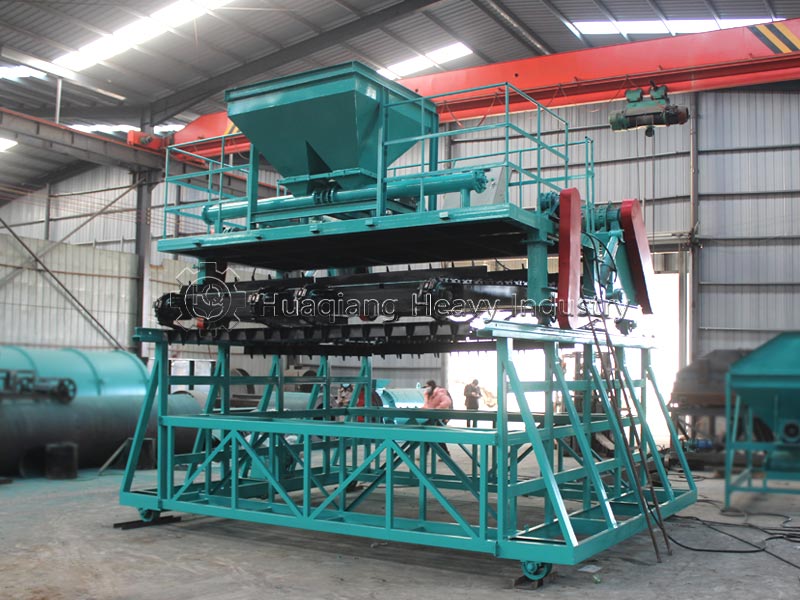
A massive steel frame spans the width of the fermentation trough, riding on rails mounted along the top of the trough walls. Suspended from this frame, reaching down into the depths of the material, is a continuous loop of heavy-duty chain fitted with steel plates or paddles.
As the machine travels slowly along the trough, that chain loop rotates continuously. The plates dig into the material at the very bottom, scoop it up, and carry it vertically to the top before releasing it in a cascading shower of fragmented organic matter. By the time it falls back into the trough, it’s been thoroughly aerated, broken apart, and mixed with material from every layer of the pile.
Why does this vertical lifting matter so much? Because depth creates challenges. In a deep trough, the bottom layers are cut off from oxygen. They go anaerobic. They turn sour and smelly. They become a refuge for pathogens and weed seeds. A turner that only skims the surface leaves these problems untouched.
The Built-In Advantages
Beyond its depth capability, the chain compost turner offers some distinct advantages that make it the smart choice for serious operators.
Gentle but Thorough — The chain plates carry material upward rather than hurling it violently. This matters when you’re working with fragile microbial communities or when you want to preserve the physical structure of your compost rather than pulverizing everything into dust.
Bacterial Integration — Many chain turners come equipped with liquid spray systems mounted directly on the machine. As the turner works its way down the trough, it can simultaneously inoculate the material with beneficial microbes. Two critical jobs in one pass, saving time and ensuring the microbes are distributed evenly throughout the entire batch.
The Rhythm of the Troughs
Using a chain turner creates a predictable, manageable rhythm that operators come to love.
Load a fresh trough with raw manure and amendments. Let it sit for a few days to start heating naturally. Then run the turner through it—maybe daily at first, while the material is fresh and needs frequent aeration. As the compost stabilizes, you might switch to every other day, then twice a week, then just once as it approaches maturity.
The Complete Production Line
Of course, even the hardest-working chain turner doesn’t work alone. In a full bio-organic fertilizer production line, it’s the critical first step—but many steps follow.
After weeks of regular turning, the mature compost is ready for further processing. A front-end loader moves it from the troughs to the next stage. A semi-wet material crusher reduces any remaining large particles to a consistent size. A mixer ensures any additional ingredients—specific beneficial microbes, trace minerals, other organic amendments—are evenly distributed.
Then the material enters the granulator. For a top-tier operation, this might be a new type two-in-one organic fertilizer granulator, designed specifically to handle the fibrous, challenging material that comes from deep-trough composting. The granulator transforms the powdery compost into uniform, spherical pellets with excellent strength and market appeal.
After granulation comes drying, cooling, screening, coating, and finally packaging—a complete transformation from raw waste to premium product.